Skip to content

De beste plek voor een full-body LED-spiegel hangt af van de indeling van de ruimte en hoe de spiegel wordt gebruikt. In een slaapkamer is een positie naast de kledingkast of kleedruimte vaak een goed uitgangspunt, mits deuren en laden vrij kunnen openen. In een woonkamer kiest u een plek met een nuttige weerspiegeling die het hoofdlooppad niet blokkeert. Controleer bij kleine ruimtes vóór de beslissing de volledige voetafdruk, het zichtbereik en de stroomtoegang van de spiegel.
Deze gids legt uit hoe u spiegelposities vergelijkt op basis van meubelvrije ruimte, natuurlijk licht, kabelgeleiding en dagelijks gebruik. Hij bevat ook een checklist per ruimte voor woningbouw- en retailprojecten.
Belangrijkste punten
- Kies een spiegelpositie op basis van dagelijks gebruik, zichtruimte en meubelindeling.
- Controleer de draairichting van deuren, vrije ruimte rond de kledingkast, looppaden en de volledige voetafdruk van de spiegel.
- Controleer wat de spiegel vanaf de normale kijkpositie weerspiegelt, vooral bij ramen en drukke meubelzones.
- Gebruik natuurlijk licht met zorg. Een spiegel kan een helder raam weerkaatsen of ongewenste hinderlijke reflectie veroorzaken.
- Plan de LED-stroomaansluiting en kabelroute voordat u de definitieve positie vastzet.
- Beoordeel voor retail- en woningbouwprojecten de indeling van elke ruimte in plaats van aan te nemen dat één positie overal werkt.
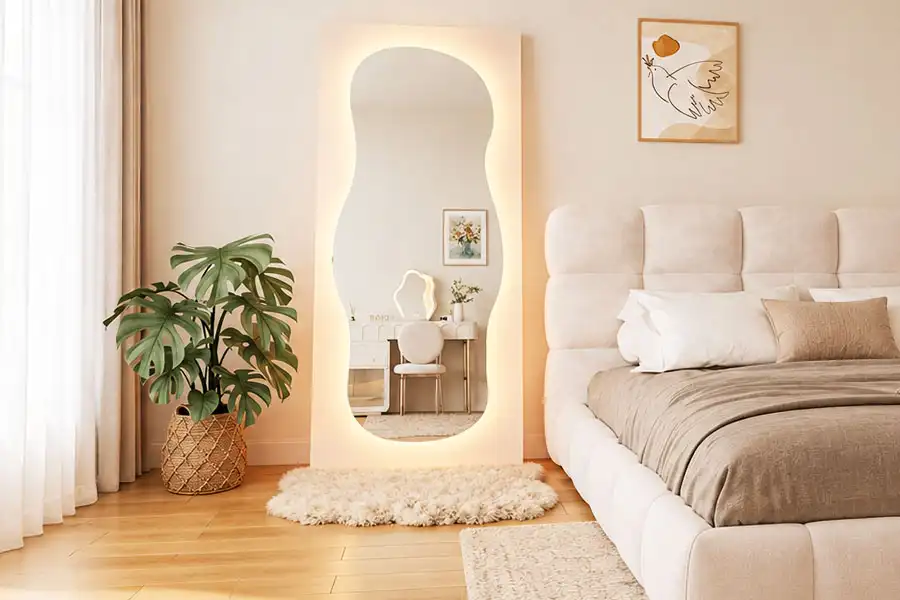
Hoe kies je de juiste plek voor een full body LED-spiegel
De beste plek voor een full body LED-spiegel is er een die een vrij zicht biedt, in de ruimte past en veilig, praktisch gebruik mogelijk maakt. Begin met de kijkpositie en controleer vervolgens het nabije meubilair, licht, stroomtoegang en beschikbare ruimte.
Overweeg deze vijf punten voordat u meubels verplaatst of een muur kiest:
- Zichtruimte: Is er genoeg ruimte om voor de spiegel te staan en uw volledige spiegelbeeld te zien?
- Vrije ruimte rond meubels: Kunnen deuren, kastpanelen en laden openen zonder de spiegel of de bevestiging ervan te raken?
- Looppad: Moeten mensen om de spiegel heen bewegen om de ruimte binnen te komen of over te steken?
- Licht en reflectie: Wat weerspiegelt de spiegel? Kan direct zonlicht of een helder raam hinderlijke reflectie veroorzaken?
- Stroomtoegang: Can the LED mirror reach a suitable power source without leaving a cable across a walking route?
A useful way to test a position is to mark the mirror’s proposed outline on a room plan. Include the stand footprint if the mirror is floor-standing. Then mark the viewing area, door swings, furniture, and outlet location.
This easy plan helps find issues before they are installed. It’s useful for a single bedroom, but it’s even more useful when planning ways to arrange different rooms.
For a project, write down where you want to put things and how you want them mounted for each type of room. If two rooms have similar furniture, that doesn’t mean that the same spot will work in both of them.
Where Should You Place a Full Body LED Mirror in a Bedroom?
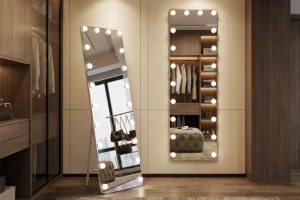
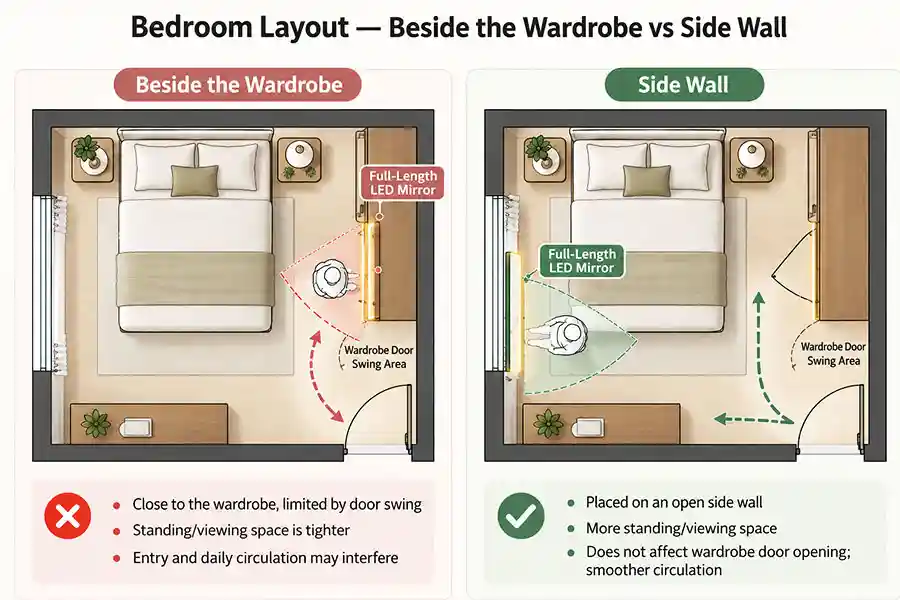
In a bedroom, position a full-body LED mirror so that it does not interfere with the bed, wardrobe, doors, or walking route. The wardrobe area is often a useful starting point, but the best position depends on the room layout.
Beside the Wardrobe or Dressing Area
Placing a full body mirror near the wardrobe can make it easier to check an outfit after getting dressed. It also keeps the mirror close to the area where clothing is stored.
Before using this position, check the wardrobe doors and drawers in their fully open positions. A mirror may fit against the wall when the room is empty, yet become difficult to use once the wardrobe is open.
For a compact bedroom, compare the available wall space beside the wardrobe with the space near the room entrance. Choose the position that offers a clear view and does not interrupt movement between the bed, wardrobe, and door.
On an Open Side Wall
An open side wall can work when the wardrobe area is crowded. It may also provide a clearer viewing angle than a narrow space beside the bed.
Before choosing the wall, check the distance available for standing and the view reflected in the mirror. A mirror facing a cluttered corner may make that area more noticeable. A position that reflects an open part of the room may feel less crowded.
Do not select a wall based only on its size. Consider the viewing angle, the route people take through the bedroom, and access to the mirror’s power connection.
Bij een raam: wat moet je controleren?
A mirror near a window may reflect daylight and make part of a bedroom feel brighter. However, the result depends on the direction of the light and the angle of the mirror.
Before fixing the position, check the reflection at different times of day. Direct sunlight or a bright window in the mirror can cause glare. If the mirror has integrated LED lighting, check how its light appears alongside the room’s natural light.
The goal is a useful reflection and comfortable viewing, not simply placing the mirror as close to a window as possible.
How to Position a LED Full Body Mirror in a Living Room
In a living room, place a full-length LED mirror where it complements the furniture layout, reflects a suitable view, and stays clear of the main circulation path. Its role may be partly decorative, so the reflected scene matters as much as the wall itself.
Work With Furniture Placement and the Main Walking Route
A side wall near a sofa or sideboard may provide a suitable position if the mirror does not interrupt movement through the room. Before deciding, view the proposed location from the entrance and from the usual seating area.
Check three things:
- Furniture relationship: Does the mirror fit the room without crowding nearby furniture?
- Reflected view: Does it reflect a useful part of the room rather than a cluttered area?
- Movement: Can people pass the mirror without striking its frame or support?
A freestanding mirror also needs enough space behind or beside it for its support. Do not judge the layout from the front view alone.
Use Natural Light Without Creating Glare
A full body LED mirror can reflect daylight into a living room, but the result depends on the window position, mirror angle, and reflected view. A mirror facing a bright window may create glare instead of improving viewing comfort.
Before choosing the final position, check the reflection from the entrance and main seating area. Compare how the room looks during the day and under artificial lighting at night.
For a mirror with integrated LEDs, review the lighting with the room lights on and off. The mirror should provide a useful reflection without placing a bright light source directly in the normal viewing line.
Where Should a Full-Length Body Mirror Go Near a Closet or Dressing Area?
Near a closet or dressing area, position the mirror where it is easy to use after changing clothes and where doors, drawers, and storage access remain clear. The available wall space is only one part of the decision.
Check the Closet Doors and Drawers
Measure the available space with wardrobe doors and drawers fully open. This helps reveal conflicts that may not be visible when everything is closed.
If the mirror sits beside the wardrobe, check whether its frame or support interferes with door movement. If it is placed inside a dressing area, confirm that there is enough room to stand back and view the full reflection.
For projects with repeated room layouts, use the same checks for each room type. A position that works in one room may not work in another if the wardrobe, entrance, or furniture arrangement changes.
Compare the Available Mounting Options
A wall-mounted mirror, a freestanding mirror, and a mirror designed for a door each have different space requirements. The suitable option depends on the actual product design and the room’s restrictions.
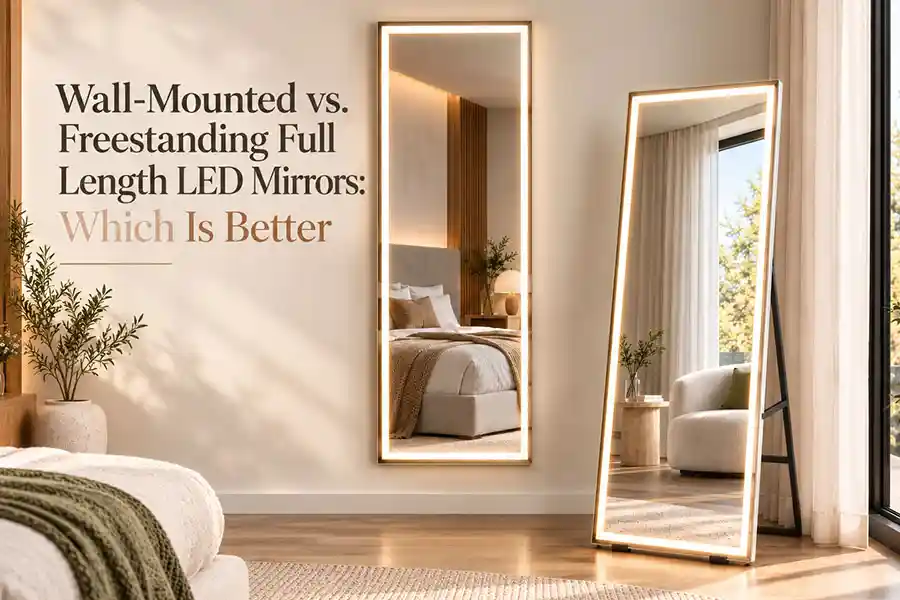
This article focuses on where the mirror should go. For a detailed comparison of support structures, installation requirements, and floor-space use, read our guide to wall-mounted vs. freestanding full-length LED mirrors.
Do not assume that every mirror can be switched between wall-mounted and freestanding use. Confirm the supplied support parts and installation instructions before making that decision.
Keep Everyday Access in Mind
The mirror should remain easy to reach, clean, and use. Avoid placing it where clothing, bags, or frequently used items are likely to cover it.
For a shared dressing area, consider the needs of more than one user. A location that works for one person’s routine may not provide enough viewing space when the area is shared.
The best arrangement supports normal use without requiring people to move furniture or block the route to the wardrobe each time they use the mirror.
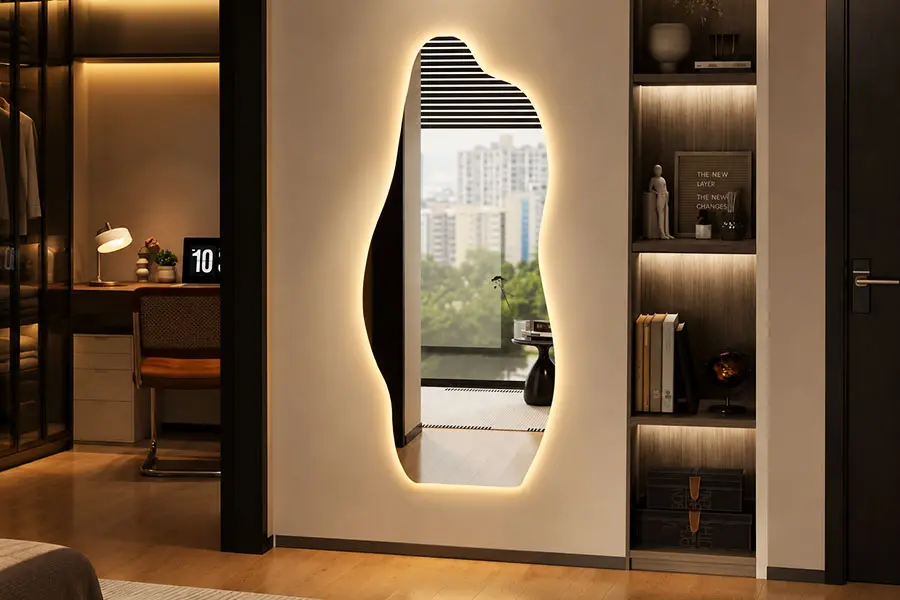
Hoe je een volledige lichaamsspiegel met verlichting in kleine ruimtes past
Kies in een kleine ruimte een spiegelpositie die de looproute, toegang tot opbergruimte en voldoende ruimte om de spiegel te gebruiken behoudt. Een spiegel die op een muur past, kan toch ongeschikt zijn als de voet een deuropening blokkeert of het snoer een pad kruist.
Measure the Full Setup
For a floor-standing mirror, measure the area needed by the mirror and its support in the approved position. For a wall-mounted mirror, check the proposed fixing area, the surrounding furniture, and the viewing space.
| What to check | Waarom het belangrijk is |
|---|---|
| Overall mirror dimensions | Confirms that the mirror fits the available wall or floor area |
| Stand or base footprint | Shows how much floor space the freestanding setup needs |
| Door and drawer movement | Helps prevent the mirror from blocking furniture |
| Walking route | Keeps normal movement through the room clear |
| Power outlet and cable path | Helps avoid inaccessible sockets and cables across walkways |
| Kijkpositie | Confirms that the mirror can be used as intended |
For more detailed measurements, see our guide to choosing the best size full-length mirror. This article focuses on placement; the linked guide covers the size-selection task in more detail
Make Use of Available Wall Space
A narrow wall section may be useful if the mirror and its mounting system fit without blocking a door or cabinet. A corner may also work, but check the angle and the space available in front of the mirror.
In rental homes, wall alterations may be restricted. A freestanding mirror may be an option if its support fits the room and any required restraint can be used. Do not assume that every freestanding mirror can be placed safely without additional fixing.
If neither option fits the available space, consider a different location or mirror size rather than forcing a poor layout.
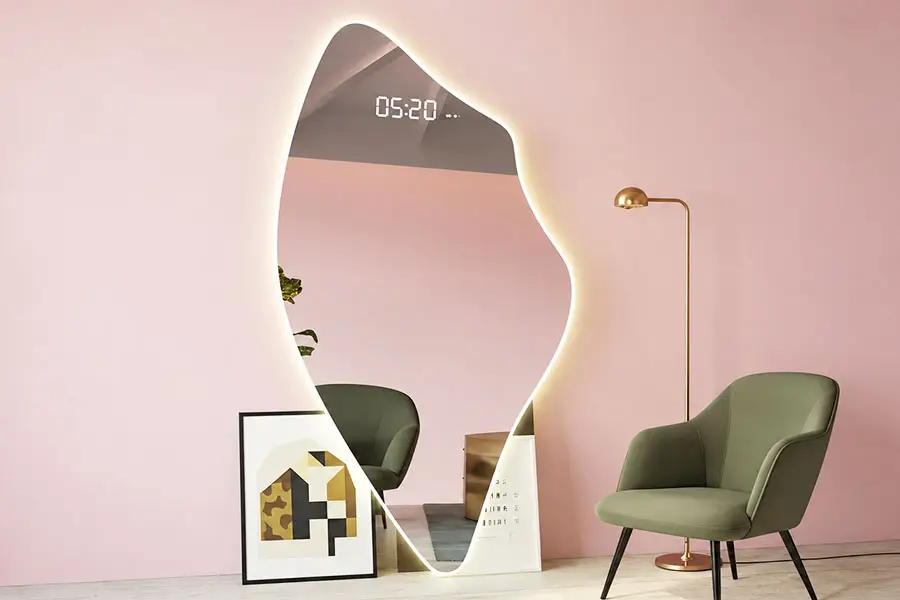
How to Style a Lighted Full Body Mirror Without Blocking Its Function
A Lighted Full Body Mirror can add a decorative feature to a room, but it should still provide a useful reflection and remain easy to use. The best position balances the reflected view, nearby furniture, lighting, and available space.
Treat the Reflection as Part of the Room
Before finalizing the position, check the scene that appears in the mirror. The reflection may include furniture, a window, artwork, or a doorway. These elements become part of the view, even though they are not physically beside the mirror.
For a simple interior, an open wall or a neat furniture arrangement may work well. In a busy room, a different angle may create a calmer reflection.
Do not add furniture only to fill the space around the mirror. Keep the arrangement practical and preserve enough room to stand in front of it.
Keep Style and Everyday Use in Balance
The mirror should fit the room without blocking a walkway or competing with the furniture. Its frame and LED lighting can support the room’s design, but its position should still allow comfortable use.
Lighting also affects the result. The U.S. Department of Energy explains that LED sources can vary in color quality and that the color rendering index (CRI) has limits as a measure of color appearance. See its LED lighting guidance.
For an outfit-checking area, review the actual mirror lighting in the intended room. Do not assume that the mounting position alone determines lighting quality.
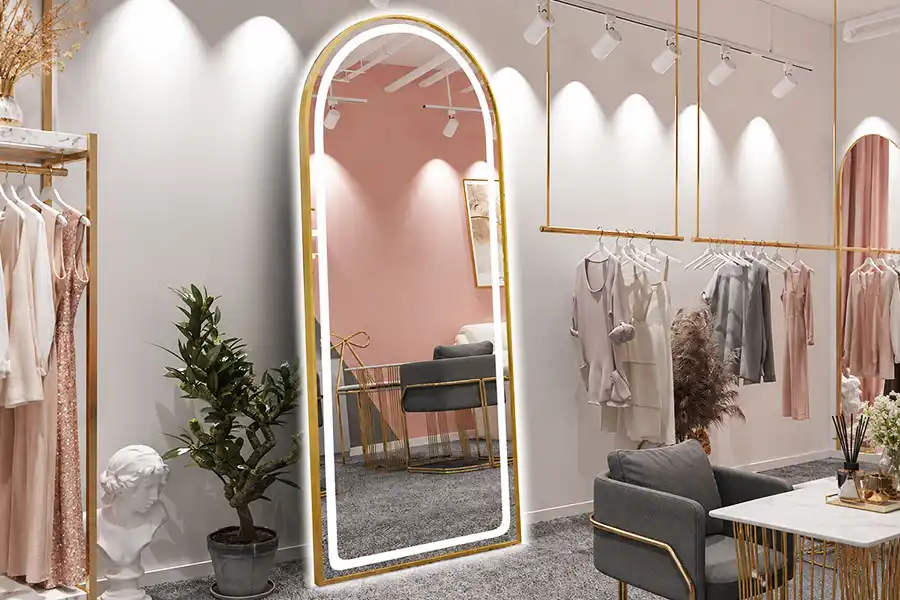
A Full Body Mirror Layout Checklist for Residential and Retail Projects
For residential and retail projects, record the mirror location, room layout, support arrangement, lighting needs, and access requirements before confirming the product. This helps designers and buyers compare room types and avoid repeating a layout that only works in one space.
Wat moet een kamerindelingsoverzicht bevatten?
For a multi-room project, do not rely on the total number of mirrors alone. Record the layout conditions for each room type.
A useful planning sheet should include:
| Item | What to record |
|---|---|
| Room use | Bedroom, living room, dressing room, or retail fitting area |
| Proposed position | Wall, corner, wardrobe area, or other planned location |
| Available space | Mirror area, support footprint, and viewing area |
| Furniture clearance | Door swings, wardrobe doors, drawers, and walking paths |
| Verlichting | Natural light, room lighting, and intended LED use |
| Power access | Outlet location, cable route, and switch access |
| Support | Proposed mounting method and any required restraint |
| Product requirements | Dimensions, frame finish, lighting features, and other confirmed preferences |
| Project consistency | Which room types can share the same mirror position and configuration |
| Approval documents | Product photos, layout drawings, samples, and installation instructions to review before ordering |
Hoe moeten projecten met meerdere kamers worden gepland?
For residential and retail projects, group rooms by layout rather than assuming every room can use the same mirror position.
For example, two apartment bedrooms may have similar floor areas but different wardrobe and door positions. A mirror beside the wardrobe may work in the first room, while a side wall may provide better clearance in the second. The choice should follow the actual furniture layout, viewing area, and power access.
The same approach applies to retail fitting rooms. Check the customer route, nearby fixtures, and space available for the mirror’s support before repeating a layout across several rooms.
For freestanding mirrors, check the base or stand and any restraint required by the manufacturer’s instructions. The U.S. Consumer Product Safety Commission’s Anchor It! guidance explains general furniture tip-over prevention and the need to follow manufacturer instructions. It is not a mirror-specific installation standard, so the actual mirror’s instructions must guide the final setup.
For a bulk order, confirm the approved dimensions, mounting arrangement, lighting configuration, and required documentation before production. Shein Mirror offers LED floor and full body mirror options for residential and commercial applications. Buyers can share their room layouts and project requirements to discuss suitable options.
Veelgestelde vragen
Q1: Where is the best place to put a full body LED mirror in a bedroom?
A: A full body LED mirror often works well beside a wardrobe, near a dressing area, or on an open side wall. It lets you check your outfit without moving across the room. However, the mirror should not block wardrobe doors, drawers, or walking paths. If the wardrobe area is too narrow, consider a side wall with a clear viewing space. Check the available light and power outlet before choosing the final position.
Q2. Can a full body LED mirror make a small room look bigger?
A: A full body LED mirror can make a small room feel more open by reflecting light and parts of the surrounding space. The effect depends on the mirror’s position, viewing angle, and what appears in its reflection. Placing it near a source of natural light may help brighten the view, but direct reflections can cause glare. A mirror changes how a room looks; it does not increase the available floor space.
Q3. Where should a full body LED mirror be placed in a living room?
Een zijwand bij een bank, dressoir of open ruimte kan goed werken als de spiegel de beweging niet blokkeert. Kies een positie die een nuttig deel van de kamer weerspiegelt in plaats van een rommelige hoek. Controleer het zicht vanaf de ingang en de belangrijkste zitplek. Als de spiegel een vloerstandaard heeft, laat dan genoeg ruimte voor de volledige ondersteuningsconstructie en houd hem vrij van drukke looproutes.
Q4. Should a full body LED mirror be placed beside a closet or inside a dressing area?
Beide locaties kunnen werken, afhankelijk van de beschikbare ruimte en hoe de ruimte wordt gebruikt. Een spiegel naast de kast biedt snelle toegang bij het kiezen van kleding, terwijl een aparte kleedruimte meer zichtruimte kan bieden. Controleer kastdeuren, laden, meubels en verlichting voordat je beslist. Als de spiegel op een muur of deur wordt gemonteerd, controleer dan of het product en de installatie-instructies die montage ondersteunen.
Q5. What should you check before placing a freestanding LED mirror in a small space?
A: Check the mirror’s overall dimensions, the depth of its open stand, and the space needed to walk past it. Make sure doors, wardrobes, and drawers can open without hitting the frame or support. Plan the power cable so it does not cross a walking route. Follow the manufacturer’s instructions for the stand and any required anti-tip restraint. Do not reduce the support footprint by changing its approved setup.
Conclusie
The right full body LED mirror placement depends on room use, furniture clearance, natural light, support space, and power access. Bedrooms, living rooms, and small spaces each need a different layout check. For residential and retail projects, planning these details early can help avoid costly changes.
Shein Mirror supplies OEM LED mirror solutions for different custom needs. Send your need for full length mirror dimensions, quantities, and more need. To get your project supplier solutions.