跳到内容
跳到内容 
A one-way mirror is a regular mirror with a 100% opaque back coating. It is only used for single-sided reflection and you cannot see through it. A two-way mirror (also called a half-silvered mirror) uses a nano-scale coating that allows partial light to pass through. A two-way mirror achieves a unidirectional see-through effect.
In high-end fields like commercial buildings, smart homes, security, and modern hotel design. one-way and two-way mirrors are two optical products that people easily confuse. Many people find it hard to accurately tell the core physical differences between these two types of glass.
This guide will explain what they are, how they work, and 4 easy ways to tell them apart. And their innovative uses in modern business and smart home applications.
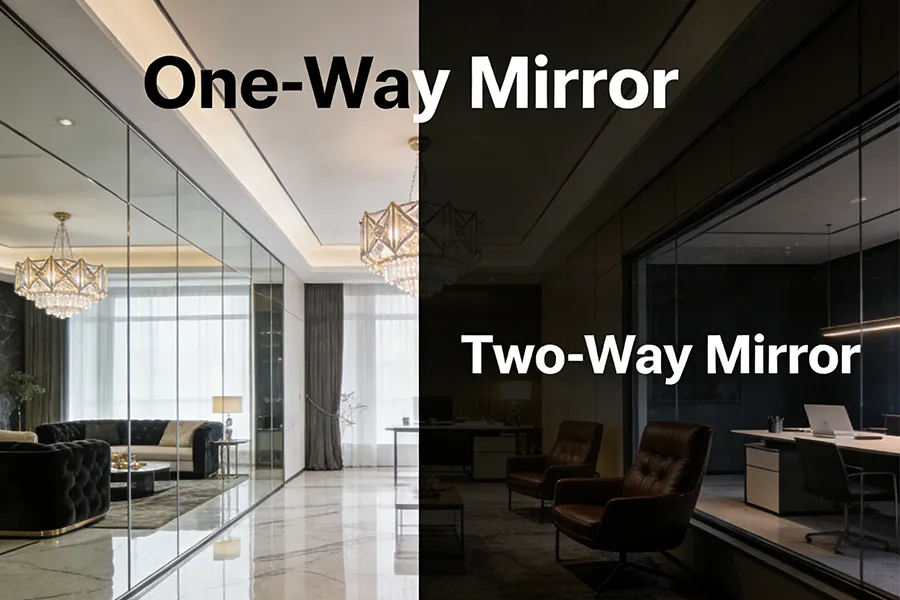
H2: What Is a Two-Way Mirror?
A two-way mirror is often called a one-way observation mirror or a half-silvered mirror. It is a special optical glass with the features of “single-sided reflection and single-sided observation.
This means the front of the glass has a thin reflective coating. It allows some light to pass through and reflects some light. The front looks like a normal mirror, but the back does not have a reflective material coating.
Different from common public misunderstandings, a two-way mirror is not like a normal window where “both sides can see each other.” Under the right conditions, one person sees a perfect mirror, but the person on the other side can see right through it.
You have usually seen this in movies or documentaries about police interrogation rooms. Inside the interrogation room, there is a mirror showing reflections. But the observers outside can see the indoor interrogation process through this mirror.
H2: What Is a One-Way Mirror?
The core structure of a one-way mirror is a layer of 100% opaque, fully reflective metal (usually silver or aluminum) coated on the back of high-quality float glass. To block all light and protect the metal, makers add a thick, waterproof paint on the back.
Almost all visible light hitting the mirror surface will be reflected. You can only see a clear reflection on the uncoated front side. From the coated back side, you cannot see anything on the other side of the glass. It only achieves one core function: “single-sided reflection,” with no see-through effect at all.
Tips: Buyers often get confused here. When people say they want a “oneway observation mirror,” they actually mean a two-way mirror. Many buyers often confuse the two when searching and choosing.

H2: How Do One-Way and Two-Way Mirrors Work?
The principle of a one-way mirror is “total reflection.” Its opaque protective back paint will block 100% of light penetration. The principle of a two-way mirror is “semi-transparent and half-reflective coating + lighting difference.” It acts like a light filter, allowing partial light to pass through. It must rely on a brightness difference of at least 10:1 between the two sides to achieve the one-way see-through illusion of “a mirror in the bright side, glass in the dark side.”
How Do One-Way Mirrors Work?
The imaging principle of a one-way mirror is extremely simple. The core is the total reflection optical effect (absolute physical light blocking). Its opaque, fully reflective metal back coating will reflect almost all visible light hitting the mirror. When human eyes receive the reflected light, they see a clear image of themselves.
The other side of the glass completely blocks light from passing through because of the coating and protective paint. So, from the back, you cannot see anything on the opposite side. It is a pure, solid mirror with no see-through function.
How Do Two-Way Mirrors Work?
The core working principle of a two-way mirror is half-silvered coating technology + light brightness difference control.
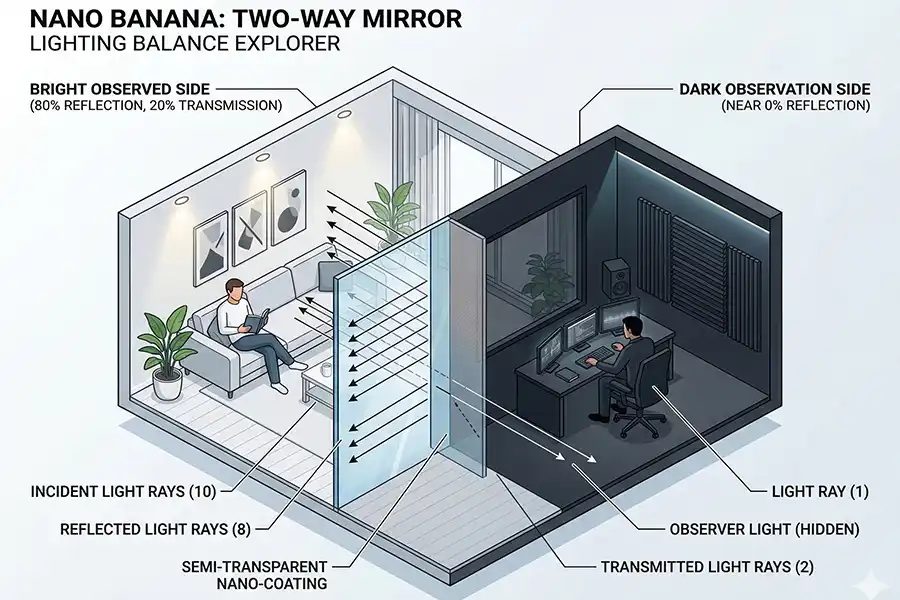
This is also the core of how it achieves the see-through effect. It is just a piece of glass coated with a thin reflective layer on one side. If one side is brighter, that side acts like a mirror. At the same time, on the darker side, there is enough light passing through.
The nano-scale semi-transparent and half-reflective coating on the surface is like a tiny sieve. It will not block all light completely, but splits it according to a preset ratio. For commonly used two-way mirrors in the industry, the reflectance is mostly 50%-80%, and the Visual Light Transmission (VLT) is mostly 10%-30%. You can change these numbers based on what you need for smart mirrors or security rooms.
A two-way mirror is not magic. Its secret lies in light balance. When the light brightness difference between the two sides reaches 10 times or more, the effect is the best.
- The Bright Side: Because the light is extremely sufficient, the high-intensity light reflected by the coating completely “drowns out” the weak light transmitting from the dark area. So, people in the bright area only see a perfect mirror.
- The Dark Side: There is almost no light here. There is no strong reflection to block your view. Your eyes can easily catch the light coming from the bright area, clearly seeing through the whole glass.
- When It Fails: When It Fails: If equal bright light shines on both sides, the one-way illusion of the two-way mirror will instantly fail. It turns into a piece of tinted, semi-transparent glass. People on both sides can see each other.
What Is the Difference Between a One-Way Mirror and a Two-Way Mirror?
The most difference between a one-way mirror and a two-way mirror lies in light transmittance and physical structure.
A one-way mirror has an opaque waterproof back paint that blocks 100% of light penetration, used only for daily mirror checking.
A two-way mirror uses a nano-scale semi-transparent and half-reflective coating, removing the opaque back paint. It must strictly rely on the light balance difference between the two sides Rto achieve the “one-way see-through” optical illusion. It is the core base material for smart mirrors and security observation windows.
The table below uses 7 core comparison dimensions to visually present the differences between the two mirrors:
| Comparison Dimension | Standard One-Way Mirror | Two-Way Mirror |
| Core Definition | A standard fully reflective flat mirror, providing single-sided reflection only. | A semi-reflective, semi-transparent observation glass, allowing reflection on one side and see-through observation on the other. |
| Physical Structure | Float glass substrate + 100% opaque fully reflective metallic coating + waterproof backing paint, completely blocking all light transmission. | Ultra-clear float glass substrate + ultra-thin nano-scale semi-reflective metallic coating, with NO opaque backing paint, allowing light to be partially reflected and partially transmitted. |
| Optical Properties | Reflects nearly 100% of incoming visible light. Zero light transmission; completely opaque. | Reflectance and transmittance can be custom-engineered. Standard specs offer 50%-80% reflectance and 10%-30% Visible Light Transmission (VLT), balancing reflection and visibility. |
| Visual Effect | A clear reflection is visible only on the front. The back side offers zero visibility into the opposite room. | When the brightness ratio is ≥10:1, the bright side sees a mirror, while the dark side sees through clearly. If lighting is equalized, people on both sides can see the reflection as well as through the glass. |
| Main Applications | Everyday applications like household dressing mirrors, bathroom vanity mirrors, standard commercial decorative mirrors, and retail fitting rooms. | Scenarios requiring covert observation or light transmission, such as security interrogation rooms, retail surveillance, studio teleprompters, smart magic mirrors, and psychology observation rooms. |
| Installation Requirements | No specific lighting requirements. Can be directly glued or hung on a solid wall. No open space is needed behind the mirror. | Requires a minimum 10:1 brightness differential. A dark, enclosed observation space must be reserved behind it. Strict requirements on which direction the coated side faces (usually requires embedded installation). |
| Price Range | Low production cost and highly affordable. Standard household models typically range from tens to hundreds of dollars. | Significantly higher production cost than standard mirrors. Prices fluctuate based on coating specifications, dimensions, and customization needs, typically ranging from hundreds to thousands of dollars. |
Is it one-way or two-way mirror?
To ensure extremely high accuracy, combine the “Flashlight Test” and “Tapping Test”. You can also check how it is installed to make a comprehensive judgment. Here we share 4 methods:
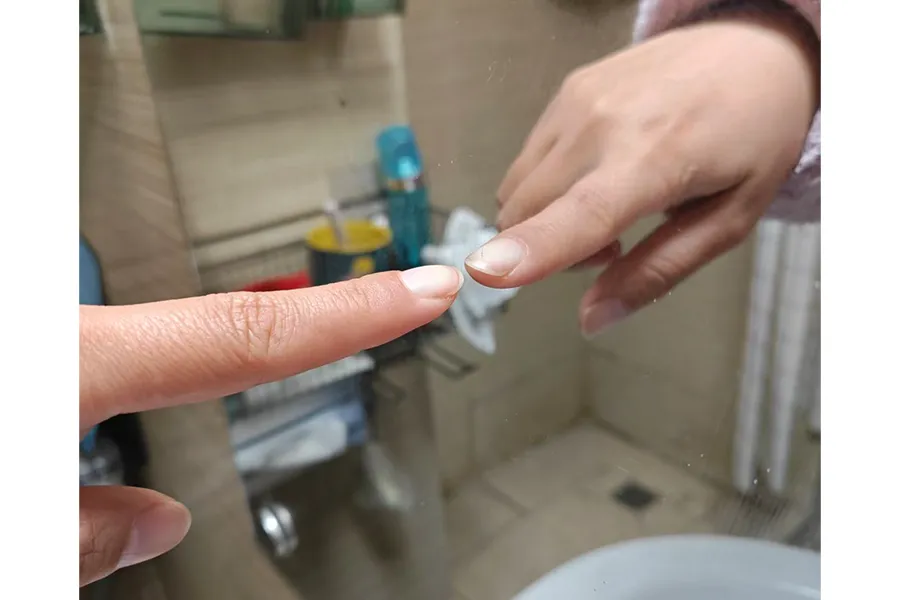
The Fingernail Test (Quick Check)
Press the tip of your fingernail tightly against the mirror surface. Observe the gap between your fingernail and the reflection. If there is an obvious and clear gap between them, it is a normal one-way mirror. If your fingernail and the reflection touch almost seamlessly with no gap, it is highly likely a two-way mirror.
Note: You can also use other thin ID cards instead of your fingernail. This method is only for quick screening. Some ultra-thin one-way mirrors may also show a no-gap situation, so it cannot be used as the only basis for judgment.
The Flashlight Test (Core Judgment)
This is the verification method with the highest accuracy. You can turn off all the lights in the room and close the curtains, making your room completely dark. Then, press a bright flashlight (or your phone flash) tightly against the mirror surface.
If it is a two-way mirror, the light will penetrate the glass, and you can clearly see the scene on the opposite side. If it is a normal one-way mirror, you will only see the strong reflected light and will not see any content on the other side.
The Tapping Test (Secondary Judgment)
Normal one-way mirrors are mostly hung or glued directly onto solid walls and wooden boards. When tapped, they make a dull, thick, and flat “thud” sound.
A two-way mirror has a reserved empty observation room behind it. When tapped, it will make a crisp, hollow echoing sound.
Installation Observation Method (Context Help):
Normal one-way mirrors are mostly wall-mounted or glued to the wall. The mirror sticks out from the wall, and the back is completely enclosed.
Two-way mirrors are mostly flush-mounted. The mirror is completely flush with the wall, with a fixed frame around it. There is a high probability that an observation space is reserved behind it.
Applications of Two-Way Mirrors?
Relying on its unique dual optical features of “single-sided reflection + single-sided transmission.” The two-way mirror has long broken through traditional security interrogation and market research fields.
Today, it is widely used in commercial retail anti-theft and studio teleprompters. It is also an indispensable core optical material in modern high-end interior design for Smart LED TV mirrors, hidden TVs, and Infinity Mirrors. For example:
- Security and Law Enforcement: : This is the most classic application. It is widely installed in one-way observation windows in police stations, detention centers, and interrogation rooms. Police use them in interrogation rooms to watch suspects without bothering them.
- Commercial Retail: In anti-theft monitoring observation rooms, chain stores, luxury shops, and supermarkets. It can achieve store management and anti-theft monitoring without affecting the customer’s shopping experience. It can also be used for product display observation windows at exhibitions.
- Media and Broadcasting: Teleprompters in TV studios and live broadcast rooms. Guest observation rooms for talk shows. One-way see-through windows in recording rooms, and stage holographic visual illusions.
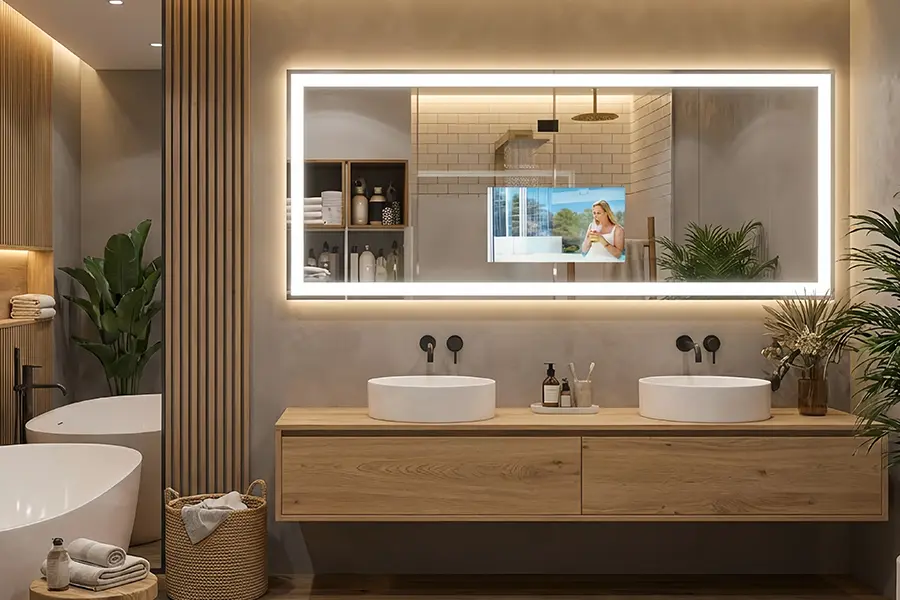
- Smart Home and Consumer Electronics: This is currently the field with the most commercial explosive power. A two-way mirror is the core material for making high-end Smart Mirrors. This includes smart bathroom mirrors, smart dressing mirrors, fitness mirrors, and hidden car displays.
- Medical and Psychological: In experimental psychology clinics, children’s behavior rehab rooms, and hospital Intensive Care Units (ICUs). This glass builds a perfect one-way isolation wall. Hospitals and psychologists use them to watch patients safely without disturbing them.
- Industrial and Special Fields: Isolation observation windows in dust-free workshops, laboratories, and precision instrument production lines. Engineers can watch the work without bringing dirt into the room.

How to Use and Install Two-Way Mirrors?
To make a two-way mirror work, you must follow three rules: First, control the lighting. Second, the coated side must face the bright room. Third, seal it well with glass glue.
The usage effect of a two-way mirror completely depends on standardized installation and debugging. Here is the professional and actionable full installation process:
Core Preparation Before Installation
- Confirm Lighting Environment: Plan the space on both sides of the mirror in advance to ensure the see-through effect. You must ensure the brightness of the observed side is 10 times or more than the observation room. The observation room needs good light-blocking treatment, with no light leaks and no extra light sources.
- Confirm Optical Parameters: confirm the size, thickness, and key optical ratio of the two-way mirror with the supplier. For home smart mirrors, a 70% reflection and 20% transmission is good. For security, choose higher reflection.
- Prepare Installation Materials: Make a fixing frame of matching size in advance. Prepare tools like neutral glass glue, stainless steel fixing parts, sealing strips, soft pads, and a level. Avoid using sharp tools to scratch the coating layer.
Standard Flush-Mount Installation Steps
- Frame Fixing: Fix the installation frame horizontally and vertically in the reserved position. The frame needs enough installation slots, and at the same time, ensure the observation side space is completely closed without light leaks.
- Mirror Installation: Two-way mirrors have strict front and back sides. The coated side faces the bright observed side. Do not install it backward!
- Fixing and Sealing: Use neutral glass glue or stainless steel pressing strips to fix the mirror evenly in the frame. Seal all the edges tightly so no light leaks through the cracks.
- Effect Debugging: After installation, turn on the light source to test the reflection clarity and see-through effect. If it is blurry, check for light leaks, fix the lighting, or see if the glass is backward.
Usage and Maintenance Precautions
When cleaning the mirror, use a soft microfiber cloth + neutral glass cleaner. Do not use strong acid or alkali cleaners, steel wire balls, or other sharp objects to avoid scratching the coating layer.
During use, you must ensure the dark and enclosed state of the observation side. Never turn on light sources on the observation side.
Regularly check if the coated side of the two-way mirror is damaged.
Are two-way mirrors illegal to install?
The production, sale, and compliant installation of two-way mirrors are not illegal themselves. What is illegal is the installation and usage behavior aimed at invading others’ privacy in unauthorized scenes.
Different countries have strict privacy laws, and this needs to be checked according to national regulations.
For example: In private spaces like hotel rooms, public restrooms, public bathrooms, store fitting rooms, and rental houses, installing a two-way mirror for spying or secret filming violates others’ privacy rights.

Frequently Asked Questions (FAQ)
Q1: Can a two-way mirror work at night?
No, not automatically. The one-way see-through effect of a two-way mirror strictly depends on the light difference. If at night, the observation room has lights on, and the observed outside environment is dark, the see-through effect will completely reverse.
Q2: Are one-way and two-way mirrors the same product?
No. But many people mistakenly call a two-way mirror a “one-way see-through glass.” This causes confusion. A one-way mirror blocks all light. A two-way mirror uses special coating to let some light pass through.
Q3: Is the fingernail test 100% accurate?
No. The fingernail test is just a quick check. Some very thin normal mirrors might also look like they have no gap.
Q4: Can two-way mirrors be used to make smart mirrors?
Yes! They are the best choice for this. Modern LED bathroom mirrors and fitness mirrors use them. When the screen behind it is off, it looks like a normal mirror. When the screen turns on, the light shines through the glass to show the time or weather.
Conclusion
In short, the main difference is how light passes through them and how you use them.
If you just need a normal mirror for getting dressed, a one-way mirror is your best and cheapest choice.
If you are building a security room, a TV studio, or a high-tech Smart LED Lighted mirror, a two-way mirror is exactly what you need.
Contact Us To Lear More Smart Lighted LED Mirror Details.
Sourcing From:
- Two way mirrors are ideal for observation, privacy, infinity mirrors, and optical illusions.
- Visible Light Transmission (VLT) Explain
- Smart mirrors are a relatively new trend that takes reflectivity in the bathroom to the next level.
- Regarding privacy laws, please refer to the “Law of the People’s Republic of China on Penalties for Administration of Public Security“.
Related Article:
- TOP 10 Smart TV Mirrors Manufacturers in 2025~2030
- TOP 20 LED Mirror Companies and Brands
- TOP 7 Led Vanity Mirrors Factory & Supplier in China
- What is a Smart Mirror?
- Smart LED Bathroom Mirror with TV Built In: Buyer’s Guide
- Top 17 FAQs About Sourcing OEM/ODM LED Mirrors from China
- How to Choose Anti-Fog Bathroom Mirrors for Hotels?