Vai al contenuto

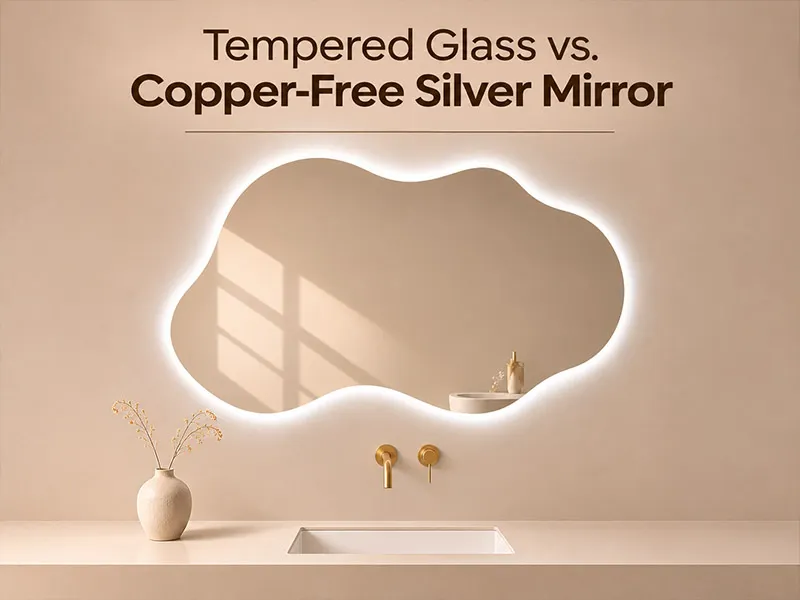
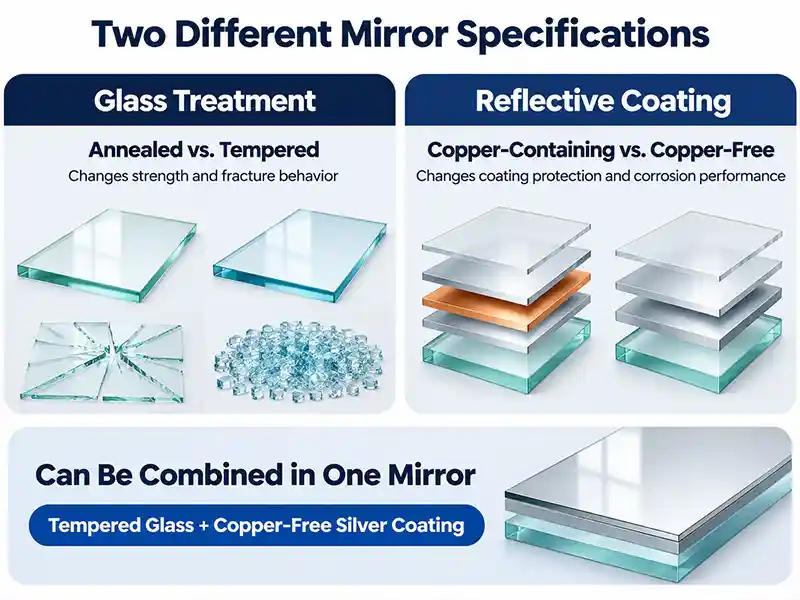
Uno specchio in vetro temperato utilizza vetro trattato termicamente, mentre uno specchio argentato senza rame utilizza un sistema di rivestimento riflettente senza strato di rame. Il confronto tra specchio temperato e specchio argentato senza rame riguarda parti diverse dello stesso prodotto. Scegli il vetro per il comportamento alla rottura e il rivestimento per la protezione dalla corrosione; un processo di produzione adeguato può combinare entrambi.
La tempera modifica la resistenza interna del vetro, il comportamento alla frattura e i limiti di fabbricazione, mentre l'argentatura senza rame migliora la barriera protettiva dietro la riflessione argentata. La pellicola di sicurezza antisfondamento aggiunge una terza opzione indipendente per trattenere i frammenti rotti. Per progetti commerciali di ospitalità e specchi da bagno LED, abbina il trattamento del vetro, la pellicola di sicurezza e la sigillatura dei bordi all'installazione effettiva, quindi approva la chiarezza della riflessione su un campione di pre-produzione realizzato con quella esatta costruzione. Consulta la nostra Guida agli specchi senza rame per il bagno: perché sceglierli?
“Attualmente, Shein Mirror ha completato un gran numero di ordini di specchi in vetro temperato nella personalizzazione da parte dei clienti di specchi LED. Gli specchi in vetro temperato sono praticamente infrangibili, soddisfacendo così i requisiti dei clienti in materia di tassi di rottura all'arrivo.” – Ha dichiarato il team di Shein Mirror.
Punti chiave
- Diversi strati dello specchio: La tempera modifica la resistenza del vetro e il comportamento alla rottura, mentre l'argentatura senza rame protegge la riflessione argentata dalla corrosione.
- Compatibili in produzione: Uno specchio può combinare vetro temperato e argentatura senza rame se prodotto con la corretta sequenza di fabbricazione e rivestimento.
- Prassi del settore degli specchi LED: La maggior parte degli specchi da bagno LED da parete per l'ospitalità abbina 5 mm vetro ricotto senza rame con pellicola di sicurezza di Categoria II per prevenire bordi neri e distorsione ottica a onde.
- Trattenimento separato dei frammenti: La pellicola di sicurezza trattiene le schegge di vetro rotto in caso di impatto, mentre le norme statunitensi sulla vetratura di sicurezza dipendono dalla posizione di installazione e dai codici applicabili.
- Specifiche complete per la richiesta di offerta: Definisci separatamente trattamento del vetro, spessore, sistema di rivestimento, pellicola di sicurezza e protezione dei bordi prima di approvare preventivi o campioni.
Specchio in vetro temperato vs specchio argentato senza rame: due strati diversi
Temperato descrive il trattamento del vetro e senza rame descrive il sistema di rivestimento, ma nessuna delle due etichette indica la costruzione completa dello specchio. Uno specchio senza rame può utilizzare vetro ricotto, e uno specchio temperato necessita comunque di un rivestimento riflettente specificato.
Specchio in vetro temperato. Il materiale di partenza è vetro sottoposto a riscaldamento controllato e raffreddamento rapido. Il trattamento crea sollecitazioni compressive sulla superficie e modifica il modo in cui il vetro si rompe. Il rivestimento riflettente è una parte separata della realizzazione dello specchio.
Specchio argentato senza rame. Lo strato riflettente è argento, ma il sistema protettivo omette lo strato di rame utilizzato negli specchi argentati convenzionali. I rivestimenti di fondo proteggono comunque la superficie riflettente. La dicitura senza rame non indica se il vetro è stato trattato termicamente.
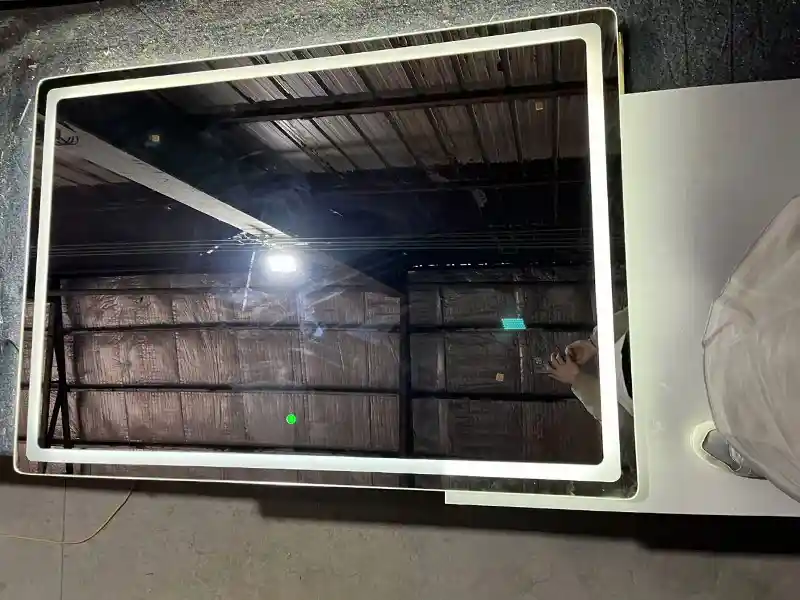
L'etichetta del vetro risponde a domande sulla resistenza e sul comportamento dopo la rottura, mentre l'etichetta del rivestimento identifica il sistema riflettente. Per il rivestimento, la questione è la resistenza al deterioramento nelle condizioni previste. Uno specchio può soddisfare entrambe le cose, ma ogni proprietà richiede la propria specifica.
| Punto di confronto | Specchio temperato | Specchio d'argento senza rame |
|---|---|---|
| Parte descritta | Substrato in vetro trattato termicamente | Rivestimento in argento e relativo sistema protettivo |
| Modifica principale | Resistenza e comportamento alla frattura | Rimozione dello strato di rame |
| Aspetto rilevante | Rottura del vetro e applicazioni con vetro di sicurezza | Deterioramento del rivestimento, soprattutto in prossimità dei bordi vulnerabili |
| Domanda senza risposta | Quale rivestimento utilizza? | Il vetro è ricotto o temperato? |
| Scelta aggiuntiva | Supporto di sicurezza e rivestimento | Supporto di sicurezza e trattamento del vetro |
Uno specchio più spesso non appartiene automaticamente a nessuna delle due colonne. Spessore, trattamento termico e rivestimento sono specifiche separate, anche quando i fornitori le raggruppano in una descrizione di prodotto. Per Specchi da bagno a LED, queste due scelte influiscono direttamente sulle prestazioni reali: il vetro temperato previene la rottura da stress termico causata dal riscaldamento localizzato delle piazzole dello sbrinatore posteriore, mentre l'argentatura senza rame protegge le strisce luminose sabbiate o incise al laser dall'annerimento indotto dall'umidità.
Cosa cambia la tempera nel substrato di vetro
La tempera blocca nel vetro una compressione superficiale bilanciata da una tensione interna, aumentando la resistenza agli urti e modificando il suo schema di frattura. Poiché il vetro temperato non può essere tagliato o forato successivamente, tutte le dimensioni, i ritagli e la lavorazione dei bordi devono essere finalizzati prima del trattamento termico.
Il vetro ricotto standard si rompe in grandi schegge appuntite sotto un forte impatto. Il vetro completamente temperato rilascia la tensione interna immagazzinata frantumandosi in piccoli frammenti relativamente smussati, riducendo i rischi di lacerazioni gravi in ambienti ad alto passaggio.
Il EN 12150-1 discussion in a 2024 research paper definisce una resistenza caratteristica minima a flessione di 120 MPa per il vetro float temprato termicamente. Per vetro di spessore 4–12 mm, la norma specifica almeno 40 frammenti entro una maschera di conteggio 50 × 50 mm secondo regole definite di prova di frattura. Sebbene tali valori disciplinino la prova europea sul vetro temperato anziché la certificazione del prodotto specchio finito, essi illustrano differenze meccaniche misurabili tra substrati ricotti e completamente temperati.
In officina, la tempera blocca precocemente il disegno di fabbricazione: fori di montaggio, ritagli per sensori e bordi smussati o lucidati non possono essere modificati una volta che la lastra esce dal forno. Gli acquirenti dovrebbero anche distinguere il vetro di sicurezza completamente temperato dal vetro indurito termicamente, che offre una resistenza intermedia senza soddisfare i criteri completi di frattura del vetro di sicurezza.
Cosa cambia la tecnologia senza rame nel rivestimento argentato
L'argentatura senza rame rimuove lo strato di rame soggetto all'ossidazione mantenendo l'argento per una riflettività nitida ad alto CRI. La resistenza reale alla corrosione in bagno dipende quindi dalla chimica di passivazione, dalla protezione dei bordi lavorati e dall'ambiente di installazione.
AGC’s Mirox MNGE technical data sheet reports laboratory edge-corrosion performance tested under EN 1036-1 durability protocols.
| EN 1036-1 Test | Mirox MNGE Result | EN 1036-1 Limit |
| Neutral salt spray | 0.05 mm | 1.0 mm |
| CASS acetic salt spray | 0.25 mm | 1.5 mm |
| Condensation water | 0.05 mm | 0.2 mm |
Lower millimeter values represent less inward edge creep during accelerated testing. In installed bathrooms, service life is further shaped by chemical glass cleaners, standing water in bottom channels, adhesive chemistry, and ventilation.
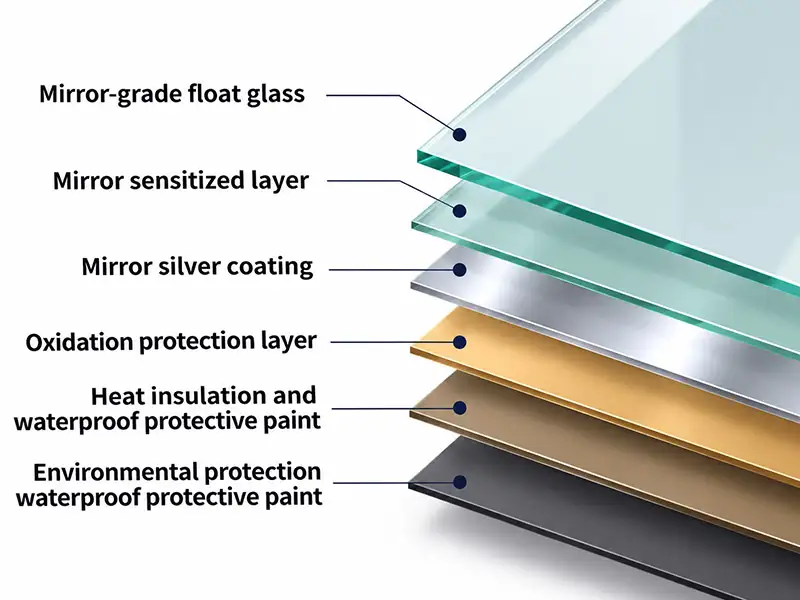
Perimeter edgework deserves special attention whenever jumbo mirror sheets are cut down into custom project sizes. Guardian Glass recommends preserving factory-coated edges where feasible and applying edge sealers in high water-splashing zones in its UltraMirror processing guidelines. When specifying cut-to-size mirrors, verify whether perimeters are processed edges and stipulate edge sealing on drawings for damp vanity or spa zones.
At Shein Mirror, our bathroom mirror engineering treats black-edge prevention as an integrated system combining copper-free silver glass, clean CNC diamond edge polishing, compatible neutral-cure silicones, and targeted edge protection.
Can One Mirror Be Both Tempered and Copper-Free?
Yes—one mirror can combine tempered glass with copper-free silvering when manufactured through a compatible finished-mirror process. A standard finished annealed silver mirror cannot be placed into a tempering furnace afterward, because conventional mirror backing paints burn at tempering temperatures.
Specialist mirror manufacturers produce combined constructions through two established industrial routes:
- Temper-then-silver sequence: Float glass is cut, edge-worked, drilled, and thermally tempered first, then coated on a copper-free silvering line.
- Temperable mirror stock: Specialized heat-treatable coated glass is fabricated in its annealed state and subsequently tempered under dedicated furnace instructions.
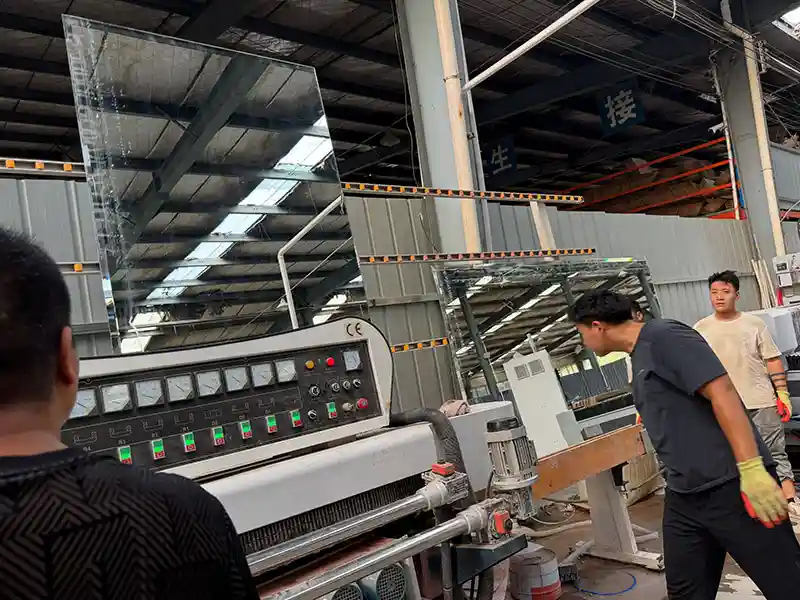
Practical engineering for custom LED bathroom mirrors: Producing illuminated mirrors involves precision sandblasting or laser frosting for LED light strips, plus bonding rear anti-fog heating pads, touch switches, and aluminum chassis frames. In Shein Mirror OEM and hospitality production, standard wall-mounted LED vanity mirrors predominantly pair 4 mm annealed copper-free silver glass with shatterproof safety backing film. This configuration delivers distortion-free close-up reflection, strong moisture durability, reliable shard retention, and clean light-strip frosting. Conversely, Shein Mirror specifies tempered copper-free mirrors for oversized full-length dressing mirrors, freestanding floor mirrors, fitness studio walls, and regulated enclosure panels.
Does Tempering Affect Reflection Quality?
Horizontal glass tempering can introduce subtle optical distortion—specifically roller wave—causing straight tile lines or doorframes in the background to appear slightly wavy. Safety performance and close-range reflection flatness therefore require separate acceptance checks.
IIBEC explains how softened glass sags microscopically between furnace rollers during horizontal heat treatment before rapid cooling locks that wave profile into the glass in its glass-distortion discussion. The publication notes architectural facade criteria sometimes cited for roller wave—0.08 mm at the center and 0.20 mm near leading or trailing edges—while pointing out the absence of a universal quality standard for roller wave. Meanwhile, the ASTM C1503-24 mirror specification covers silvered annealed monolithic glass mirrors up to 6 mm thick and excludes safety-glazing products from its scope.
Because hotel guests and homeowners inspect bathroom vanity mirrors from arm’s length under bright lighting, always approve reflection flatness on a physical prototype built to the exact proposed glass construction. Use straight vertical and horizontal reference lines at an agreed viewing distance, and keep that inspection setup consistent between golden-sample approval and mass-production QC. Never rely on an annealed hand sample to approve optical appearance for a tempered production run.
Shatterproof Safety Backing Film: Category II vs Tempered Glass
Safety backing film retains glass fragments on an adhesive membrane after breakage, whereas tempering alters the fracture mechanics of the glass itself. A film-backed annealed mirror therefore prevents shards from falling off the wall without turning the glass into tempered glazing.
In international technical literature, AGC’s Mirox data sheet associates its safety-backed mirrors with soft-body impact retention under AS/NZS 2208:1996 Grade A. In North American commercial hospitality specifications, architects and purchasing managers widely specify Category II (Cat II) architectural safety backing film tested against the 400 ft-lb impact drop criteria of 16 CFR Part 1201 or ANSI Z97.1.
Keep the two breakage behaviors distinct during procurement:
- Unbacked tempered mirror: Breaks into small cubical fragments, which still fall loose unless held by a backing film or laminated interlayer.
- Cat II film-backed annealed mirror: Forms radial cracks under heavy impact while keeping sharp glass pieces adhered together on the backing sheet.
In Shein Mirror project specifications, safety film is defined explicitly by film grade (such as CAT I or CAT II woven PE backing), adhesive durability, and tested mirror thickness rather than left as a vague “safety-backed” note. For hotel orders combining safety backing with heated pads and lighting, review our hotel anti-fog mirror selection guide.
Which Construction Fits the Project?
Choose the coating for the exposure and the glass construction for the breakage requirement. For a humid bathroom, prioritize coating durability and edge protection. Add the required safety construction without assuming that thicker glass or copper-free silvering provides it.
| Project priority | Recommended direction | Condition that changes the choice |
|---|---|---|
| Humid bathroom wall installation | Copper-free silver system with suitable edge protection | Direct splashing, exposed processed edges, or aggressive cleaning |
| Fragments must remain attached after breakage | A specified and appropriately tested backing system | Local rules require a different safety-glazing construction |
| Mirror forms a regulated door or enclosure | Accepted safety-glazing construction for that use | Project requirements and the applicable authority’s acceptance |
| Close-range reflection is the main concern | Approve optical quality on the finished proposed construction | Changing from annealed to tempered glass after sample approval |
| Premium hotel or brand positioning | Consider 5 mm copper-free glass with the required backing and treatment | Size, structure, safety requirements, and approved sample |
Across Shein Mirror hospitality and retail brand quotations, 5 mm copper-free silver mirror with shatterproof safety backing is the preferred standard for upscale hotels and commercial vanities, alongside 3.8 mm copper-free silver mirror configurations for lighter builds. Because a thicker annealed mirror does not substitute for safety glazing—and equal-thickness mirrors vary widely in coating and backing quality—always evaluate the complete multi-layer construction.
For multi-area hospitality mirror applications, group mirrors by room zone and mounting detail before assigning glass specs across a property.
Need engineering feedback on your mirror schedule? Send your target sizes, mounting type, and destination market to the Shein Mirror quotation team. Our engineers help hoteliers, contractors, and lighting brands compare 3mm, 4mm, 5 mm copper-free + Category II safety film against custom tempered LED mirror builds before sample tooling begins.
What the Mirror RFQ Specification Should Say
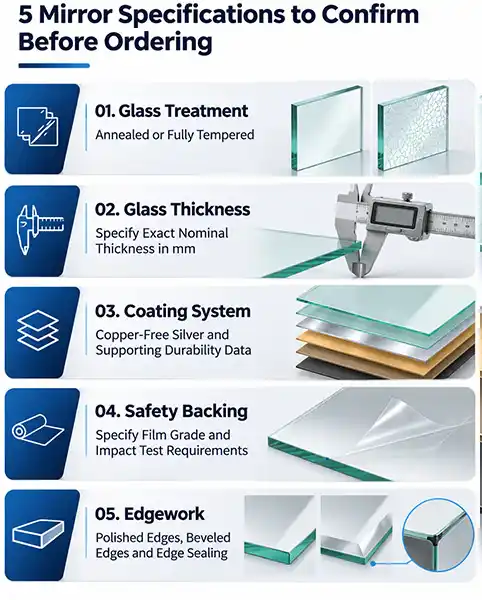
A clear B2B mirror specification separates glass treatment, thickness, coating, safety backing, and edgework into five independent fields tied to the current drawing revision:
- Glass treatment: Specify annealed or fully tempered float glass alongside any required safety-glazing performance standard.
- Thickness: State exact nominal glass thickness (such as 5 mm or 3.8 mm) rather than inferring thickness from product photos.
- Coating system: Specify copper-free silver mirror supported by EN 1036-1 edge-corrosion data.
- Safety backing: Specify none, or name the exact shatterproof backing film grade and applicable impact test report.
- Edges: Define flat polished or beveled edge details plus perimeter edge sealing required for high-moisture exposure.
A purchase order stating only “5 mm tempered mirror” leaves corrosion protection undefined, while “copper-free silver mirror” leaves thickness, heat treatment, and Cat II shatterproof film unresolved. Align your fabrication drawing, approved reflection sample, and safety documentation before mass production, and pair these glass callouts with our checklist RFQ completa per specchi LED to cover UL/ETL drivers, CRI 90+ LED strips, and anti-fog pads.
Decision rule: Choose the coating for moisture exposure, the glass treatment for breakage requirements, and the safety film for fragment retention—then approve optical reflection on that exact finished build.
Domande frequenti
Q1: Can I identify both properties by looking at the mirror?
L'aspetto da solo non può risolvere la questione specchio temperato vs specchio argentato senza rame. Per la vetratura di sicurezza temperata, cerca l'identificazione permanente richiesta e confrontala con i documenti del prodotto. Un marchio mancante o nascosto non è un test fisico affidabile del vetro. La costruzione senza rame richiede la specifica del rivestimento, non un'ipotesi visiva.
Q2: Is 5 mm copper-free glass automatically safer than 3.8 mm?
No—thickness increases panel rigidity on larger mirrors, but thickness alone does not establish heat treatment, fragment retention, or safety-glazing compliance. A 5mm copper-free mirror costs more than a 3.8mm copper-free silver mirror. Shein Mirror supplies both 5 mm and 3.8 mm copper-free configurations; compare tempering and Cat II safety backing when impact injury is the concern, and compare coating and edge sealing when corrosion is the concern.
Q3: Does copper-free also mean lead-free?
Not automatically, because copper removal and lead content in protective backing paints are separate composition metrics. AGC’s Mirox MNGE data sheet states zero copper and lead content below 0.3%, whereas specific low-lead or RoHS-compliant mirror coatings go below 0.1% lead. Request chemical compliance reports covering the exact coating system if restricted-substance limits apply.
Q4: What does “explosion-proof” mean on a LED mirror quotation?
On overseas mirror quotations, “explosion-proof” typically refers to an annealed mirror fitted with an adhesive shatterproof safety backing film rather than tempered glass, though suppliers sometimes use the term loosely for either. Ask Shein Mirror or any quoted factory to state in writing whether the build uses annealed glass + CAT I/CAT II safety film, tempered glass, or both, supported by impact test data.
Q5: Is a copper-free mirror automatically suitable beside a swimming pool?
Standard copper-free construction alone is not enough for chlorinated indoor pool decks or steam rooms. ASTM C1503-24 explicitly excludes continuously humid or corrosive environments—including swimming-pool areas—from standard flat-mirror applications. Poolside projects require specialized environmental approval covering sealed edges, corrosion-resistant mounting hardware, and verified chemical resistance.
Conclusione
Comparing a tempered mirror vs copper-free silver mirror comes down to matching glass substrate mechanics with anti-corrosion coating durability. Choose LED mirror glass for breakage behavior, coating for exposure, and backing for fragment retention, then approve the finished construction. If you don’t want it to break, you can choose a tempered glass mirror.
Looking for Tempered Glass Mirror or Copper-free Silver Mirror?
As a direct LED mirror manufacturer since 2005 with a 30,000 m² facility, Shein Mirror helps brands, contractors, and retailers optimize both performance and BOM costs.
Not sure which glass construction fits your budget or local building codes? Send your project drawings, target dimensions, order quantity, and application details via our online quote form or email info@sheinmirror.com. Our engineering team will reply within 12 hours with a side-by-side price comparison (Copper-Free Silver vs. Tempered Glass) and can deliver a custom sample in 7 days.
References Sources:
- Efferz et al., Relation Between Edge Stress, Bending Strength, Surface Stress and Fracture Pattern of Thermally Toughened Glass, Glass Structures & Engineering, 2024
- AGC Glass Europe, Mirox MNGE Technical Data Sheet, Version 2.0, 2020
- Guardian Glass, UltraMirror Processing & Installation Guidelines, 2025
- IIBEC, Glass Distortion: Not Such a Clear View, 2024
- ASTM International, C1503-24 Standard Specification for Silvered Flat Glass Mirror, 2024
- U.S. Consumer Product Safety Commission, 16 CFR Part 1201: Safety Standard for Architectural Glazing Materials, Current eCFR Edition
- American Society of Home Inspectors, Safety Glazing, ASHI Reporter, 2011