跳到内容

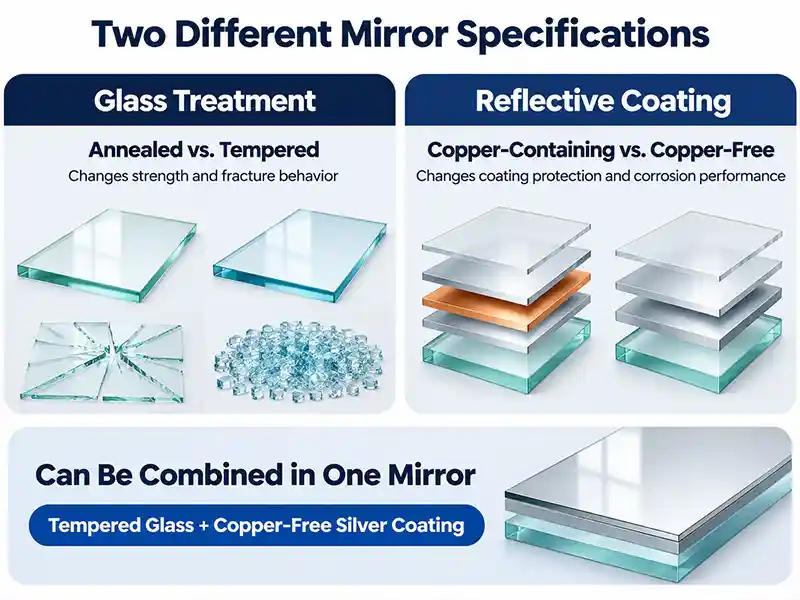
A tempered glass mirror uses heat-treated glass, while a copper-free silver mirror uses a reflective coating system without a copper layer. The tempered mirror vs copper-free silver mirror comparison concerns different parts of the same product. Choose the glass for breakage behavior and the coating for corrosion protection; a suitable manufacturing process can combine both.
Tempering changes internal glass strength, fracture behavior, and fabrication limits, whereas copper-free silvering upgrades the protective barrier behind the silver reflection. Shatterproof safety backing film adds a third, independent option for retaining broken fragments. For commercial hospitality and LED bathroom mirror projects, match glass treatment, safety backing, and edge sealing to the actual installation, then approve reflection clarity on a pre-production sample built to that exact construction. See our Copper Free Mirror for Bathroom Guide: Why Choose It?
“Currently, Shein Mirror has completed a large number of tempered glass mirror orders in its customer customization of LED mirrors. Tempered glass mirrors are virtually unbreakable, thus meeting customers’ requirements for breakage rates upon arrival.” – Shein Mirror Team Said.
Key takeaways
- Different mirror layers: Tempering modifies glass strength and breakage behavior, while copper-free silvering protects the silver reflection against corrosion.
- Compatible in manufacturing: A mirror can combine tempered glass with copper-free silvering when produced in the proper fabrication and coating sequence.
- LED mirror industry practice: Most wall-mounted hospitality LED bathroom mirrors pair 5 mm annealed copper-free glass with Category II safety film to prevent black edges and optical wave distortion.
- Separate fragment retention: Safety film retains broken glass shards on impact, while U.S. safety-glazing rules depend on installation location and applicable codes.
- Complete RFQ specs: Define glass treatment, thickness, coating system, safety backing, and edge protection separately before signing off on quotations or samples.
Tempered Glass Mirror vs Copper-Free Silver Mirror: Two Different Layers
Tempered describes the glass treatment and copper-free describes the coating system, but neither label tells you the complete mirror construction. A copper-free mirror can use annealed glass, and a tempered mirror still needs a specified reflective coating.
Tempered glass mirror. The starting material is glass that undergoes controlled heating and rapid cooling. The treatment creates compressive stresses at the surface and changes the way the glass breaks. The reflective coating is a separate part of making the mirror.
Copper-free silver mirror. The reflective layer is silver, but the protective system omits the copper layer used in conventional silver mirrors. Backing coatings still protect the reflective surface. The word copper-free does not tell you whether the glass has been heat-treated.
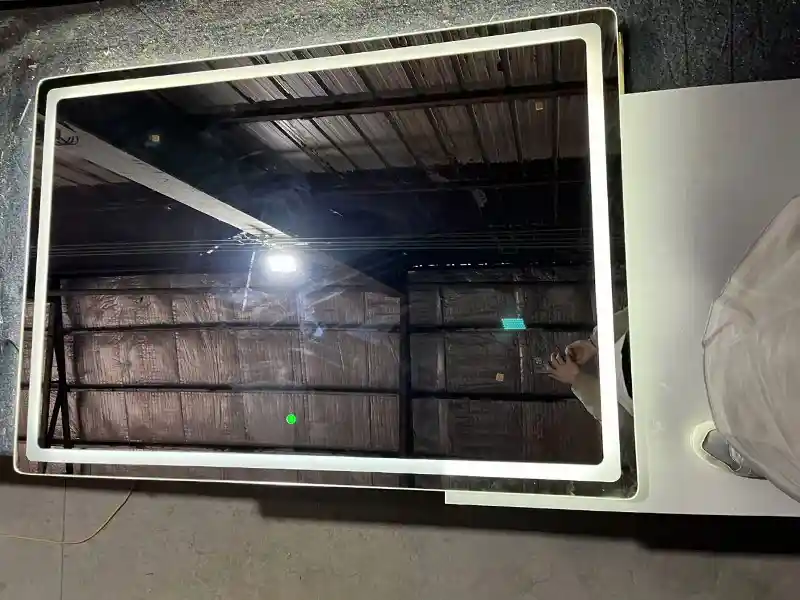
The glass label answers questions about strength and behavior after breakage, while the coating label identifies the reflective system. For the coating, the question is resistance to deterioration under the intended conditions. A mirror can address both, but each property needs its own specification.
| Comparison point | Tempered mirror | Copper-free silver mirror |
|---|---|---|
| Part described | Heat-treated glass substrate | Silver coating and its protective system |
| Main change | Strength and fracture behavior | Removal of the copper layer |
| Relevant concern | Glass breakage and safety-glazing applications | Coating deterioration, especially near vulnerable edges |
| Unanswered question | Which coating does it use? | Is the glass annealed or tempered? |
| Additional choice | Safety backing and coating | Safety backing and glass treatment |
A thicker mirror does not automatically belong in either column. Thickness, heat treatment, and coating are separate specifications, even when suppliers bundle them into a product description. For LED bathroom mirrors, these two choices directly impact real-world performance: tempered glass prevents thermal stress breakage caused by localized heating from rear defogger pads, while copper-free silvering protects sandblasted or laser-etched light strips from moisture-induced blackening.
What Tempering Changes in the Glass Substrate
Tempering locks surface compression balanced by internal tension into the glass pane, boosting impact strength and altering its fracture pattern. Because tempered glass cannot be cut or drilled afterward, all sizing, cutouts, and edgework must be finalized before heat treatment.
Standard annealed glass breaks into large, sharp shards under heavy impact. Fully tempered glass releases stored internal stress to fracture into small, relatively blunt fragments, reducing severe laceration risks in high-traffic environments.
The EN 12150-1 discussion in a 2024 research paper outlines a minimum characteristic bending strength of 120 MPa for thermally toughened float glass. For glass 4–12 mm thick, the standard specifies at least 40 fragments within a 50 × 50 mm count mask under defined fracture test rules. While those values govern the European toughened-glass test rather than finished-mirror product certification, they illustrate measurable mechanical differences between annealed and fully tempered substrates.
On the factory floor, tempering locks the fabrication drawing early: mounting holes, sensor cutouts, and beveled or polished edges cannot be modified once the pane exits the furnace. Buyers should also distinguish fully tempered safety glass from heat-strengthened glass, which offers intermediate strength without meeting full safety-glazing fracture criteria.
What Copper-Free Technology Changes in the Silver Coating
Copper-free silvering removes the oxidation-prone copper layer while retaining silver for crisp, high-CRI reflectivity. Real-world bathroom corrosion resistance then depends on the passivation chemistry, processed edge protection, and installation environment.
AGC’s Mirox MNGE technical data sheet reports laboratory edge-corrosion performance tested under EN 1036-1 durability protocols.
| EN 1036-1 Test | Mirox MNGE Result | EN 1036-1 Limit |
| Neutral salt spray | 0.05 mm | 1.0 mm |
| CASS acetic salt spray | 0.25 mm | 1.5 mm |
| Condensation water | 0.05 mm | 0.2 mm |
Lower millimeter values represent less inward edge creep during accelerated testing. In installed bathrooms, service life is further shaped by chemical glass cleaners, standing water in bottom channels, adhesive chemistry, and ventilation.
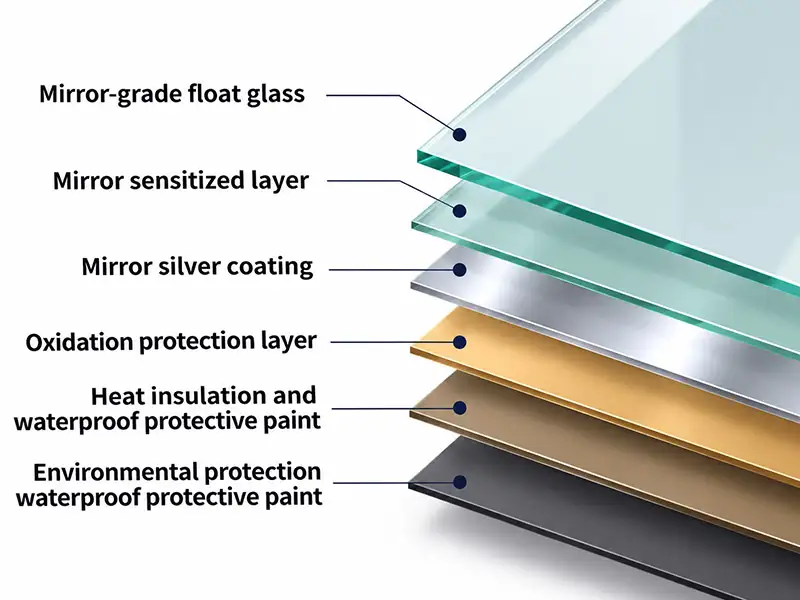
Perimeter edgework deserves special attention whenever jumbo mirror sheets are cut down into custom project sizes. Guardian Glass recommends preserving factory-coated edges where feasible and applying edge sealers in high water-splashing zones in its UltraMirror processing guidelines. When specifying cut-to-size mirrors, verify whether perimeters are processed edges and stipulate edge sealing on drawings for damp vanity or spa zones.
At Shein Mirror, our bathroom mirror engineering treats black-edge prevention as an integrated system combining copper-free silver glass, clean CNC diamond edge polishing, compatible neutral-cure silicones, and targeted edge protection.
Can One Mirror Be Both Tempered and Copper-Free?
Yes—one mirror can combine tempered glass with copper-free silvering when manufactured through a compatible finished-mirror process. A standard finished annealed silver mirror cannot be placed into a tempering furnace afterward, because conventional mirror backing paints burn at tempering temperatures.
Specialist mirror manufacturers produce combined constructions through two established industrial routes:
- Temper-then-silver sequence: Float glass is cut, edge-worked, drilled, and thermally tempered first, then coated on a copper-free silvering line.
- Temperable mirror stock: Specialized heat-treatable coated glass is fabricated in its annealed state and subsequently tempered under dedicated furnace instructions.
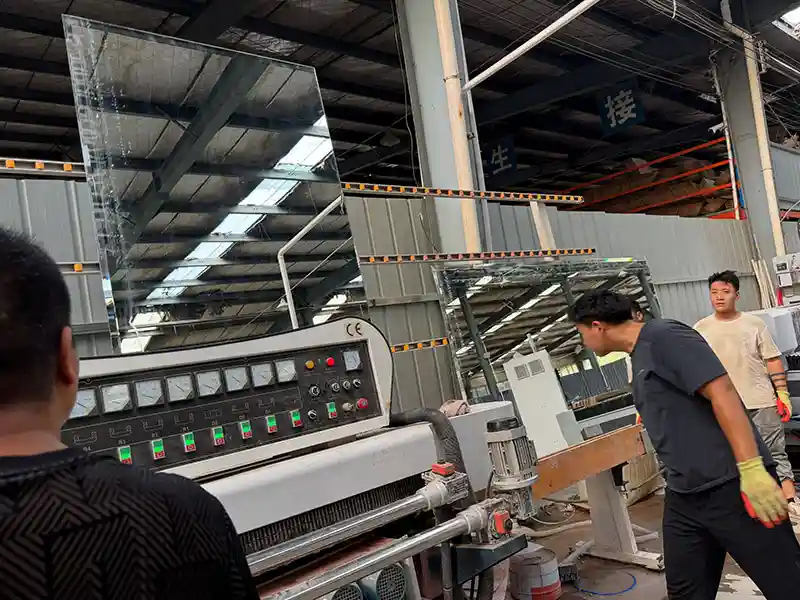
Practical engineering for custom LED bathroom mirrors: Producing illuminated mirrors involves precision sandblasting or laser frosting for LED light strips, plus bonding rear anti-fog heating pads, touch switches, and aluminum chassis frames. In Shein Mirror OEM and hospitality production, standard wall-mounted LED vanity mirrors predominantly pair 4 mm annealed copper-free silver glass with shatterproof safety backing film. This configuration delivers distortion-free close-up reflection, strong moisture durability, reliable shard retention, and clean light-strip frosting. Conversely, Shein Mirror specifies tempered copper-free mirrors for oversized full-length dressing mirrors, freestanding floor mirrors, fitness studio walls, and regulated enclosure panels.
Does Tempering Affect Reflection Quality?
Horizontal glass tempering can introduce subtle optical distortion—specifically roller wave—causing straight tile lines or doorframes in the background to appear slightly wavy. Safety performance and close-range reflection flatness therefore require separate acceptance checks.
IIBEC explains how softened glass sags microscopically between furnace rollers during horizontal heat treatment before rapid cooling locks that wave profile into the glass in its glass-distortion discussion. The publication notes architectural facade criteria sometimes cited for roller wave—0.08 mm at the center and 0.20 mm near leading or trailing edges—while pointing out the absence of a universal quality standard for roller wave. Meanwhile, the ASTM C1503-24 mirror specification covers silvered annealed monolithic glass mirrors up to 6 mm thick and excludes safety-glazing products from its scope.
Because hotel guests and homeowners inspect bathroom vanity mirrors from arm’s length under bright lighting, always approve reflection flatness on a physical prototype built to the exact proposed glass construction. Use straight vertical and horizontal reference lines at an agreed viewing distance, and keep that inspection setup consistent between golden-sample approval and mass-production QC. Never rely on an annealed hand sample to approve optical appearance for a tempered production run.
Shatterproof Safety Backing Film: Category II vs Tempered Glass
Safety backing film retains glass fragments on an adhesive membrane after breakage, whereas tempering alters the fracture mechanics of the glass itself. A film-backed annealed mirror therefore prevents shards from falling off the wall without turning the glass into tempered glazing.
In international technical literature, AGC’s Mirox data sheet associates its safety-backed mirrors with soft-body impact retention under AS/NZS 2208:1996 Grade A. In North American commercial hospitality specifications, architects and purchasing managers widely specify Category II (Cat II) architectural safety backing film tested against the 400 ft-lb impact drop criteria of 16 CFR Part 1201 or ANSI Z97.1.
Keep the two breakage behaviors distinct during procurement:
- Unbacked tempered mirror: Breaks into small cubical fragments, which still fall loose unless held by a backing film or laminated interlayer.
- Cat II film-backed annealed mirror: Forms radial cracks under heavy impact while keeping sharp glass pieces adhered together on the backing sheet.
In Shein Mirror project specifications, safety film is defined explicitly by film grade (such as CAT I or CAT II woven PE backing), adhesive durability, and tested mirror thickness rather than left as a vague “safety-backed” note. For hotel orders combining safety backing with heated pads and lighting, review our hotel anti-fog mirror selection guide.
Which Construction Fits the Project?
Choose the coating for the exposure and the glass construction for the breakage requirement. For a humid bathroom, prioritize coating durability and edge protection. Add the required safety construction without assuming that thicker glass or copper-free silvering provides it.
| Project priority | Recommended direction | Condition that changes the choice |
|---|---|---|
| Humid bathroom wall installation | Copper-free silver system with suitable edge protection | Direct splashing, exposed processed edges, or aggressive cleaning |
| Fragments must remain attached after breakage | A specified and appropriately tested backing system | Local rules require a different safety-glazing construction |
| Mirror forms a regulated door or enclosure | Accepted safety-glazing construction for that use | Project requirements and the applicable authority’s acceptance |
| Close-range reflection is the main concern | Approve optical quality on the finished proposed construction | Changing from annealed to tempered glass after sample approval |
| Premium hotel or brand positioning | Consider 5 mm copper-free glass with the required backing and treatment | Size, structure, safety requirements, and approved sample |
Across Shein Mirror hospitality and retail brand quotations, 5 mm copper-free silver mirror with shatterproof safety backing is the preferred standard for upscale hotels and commercial vanities, alongside 3.8 mm copper-free silver mirror configurations for lighter builds. Because a thicker annealed mirror does not substitute for safety glazing—and equal-thickness mirrors vary widely in coating and backing quality—always evaluate the complete multi-layer construction.
For multi-area hospitality mirror applications, group mirrors by room zone and mounting detail before assigning glass specs across a property.
Need engineering feedback on your mirror schedule? Send your target sizes, mounting type, and destination market to the Shein Mirror quotation team. Our engineers help hoteliers, contractors, and lighting brands compare 3mm, 4mm, 5 mm copper-free + Category II safety film against custom tempered LED mirror builds before sample tooling begins.
What the Mirror RFQ Specification Should Say
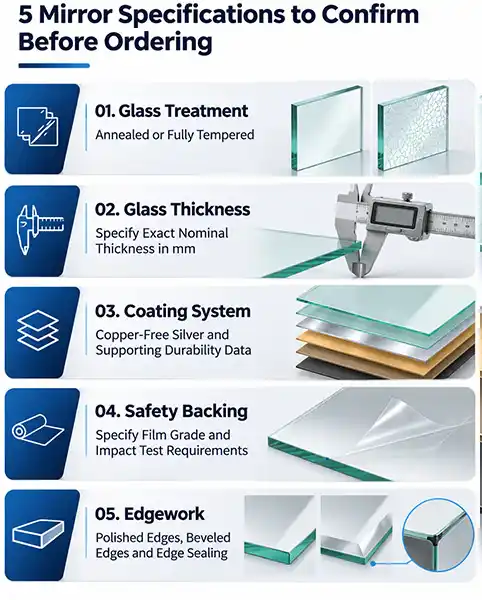
A clear B2B mirror specification separates glass treatment, thickness, coating, safety backing, and edgework into five independent fields tied to the current drawing revision:
- Glass treatment: Specify annealed or fully tempered float glass alongside any required safety-glazing performance standard.
- Thickness: State exact nominal glass thickness (such as 5 mm or 3.8 mm) rather than inferring thickness from product photos.
- Coating system: Specify copper-free silver mirror supported by EN 1036-1 edge-corrosion data.
- Safety backing: Specify none, or name the exact shatterproof backing film grade and applicable impact test report.
- Edges: Define flat polished or beveled edge details plus perimeter edge sealing required for high-moisture exposure.
A purchase order stating only “5 mm tempered mirror” leaves corrosion protection undefined, while “copper-free silver mirror” leaves thickness, heat treatment, and Cat II shatterproof film unresolved. Align your fabrication drawing, approved reflection sample, and safety documentation before mass production, and pair these glass callouts with our LED mirror RFQ checklist to cover UL/ETL drivers, CRI 90+ LED strips, and anti-fog pads.
Decision rule: Choose the coating for moisture exposure, the glass treatment for breakage requirements, and the safety film for fragment retention—then approve optical reflection on that exact finished build.
Frequently Asked Questions
Q1: Can I identify both properties by looking at the mirror?
Appearance alone cannot settle the tempered mirror vs copper-free silver mirror question. For tempered safety glazing, look for the required permanent identification and match it to the product documents. A missing or hidden mark is not a reliable physical test of the glass. Copper-free construction needs the coating specification, not a visual guess.
Q2: Is 5 mm copper-free glass automatically safer than 3.8 mm?
No—thickness increases panel rigidity on larger mirrors, but thickness alone does not establish heat treatment, fragment retention, or safety-glazing compliance. A 5mm copper-free mirror costs more than a 3.8mm copper-free silver mirror. Shein Mirror supplies both 5 mm and 3.8 mm copper-free configurations; compare tempering and Cat II safety backing when impact injury is the concern, and compare coating and edge sealing when corrosion is the concern.
Q3: Does copper-free also mean lead-free?
Not automatically, because copper removal and lead content in protective backing paints are separate composition metrics. AGC’s Mirox MNGE data sheet states zero copper and lead content below 0.3%, whereas specific low-lead or RoHS-compliant mirror coatings go below 0.1% lead. Request chemical compliance reports covering the exact coating system if restricted-substance limits apply.
Q4: What does “explosion-proof” mean on a LED mirror quotation?
On overseas mirror quotations, “explosion-proof” typically refers to an annealed mirror fitted with an adhesive shatterproof safety backing film rather than tempered glass, though suppliers sometimes use the term loosely for either. Ask Shein Mirror or any quoted factory to state in writing whether the build uses annealed glass + CAT I/CAT II safety film, tempered glass, or both, supported by impact test data.
Q5: Is a copper-free mirror automatically suitable beside a swimming pool?
Standard copper-free construction alone is not enough for chlorinated indoor pool decks or steam rooms. ASTM C1503-24 explicitly excludes continuously humid or corrosive environments—including swimming-pool areas—from standard flat-mirror applications. Poolside projects require specialized environmental approval covering sealed edges, corrosion-resistant mounting hardware, and verified chemical resistance.
Conclusion
Comparing a tempered mirror vs copper-free silver mirror comes down to matching glass substrate mechanics with anti-corrosion coating durability. Choose LED mirror glass for breakage behavior, coating for exposure, and backing for fragment retention, then approve the finished construction. If you don’t want it to break, you can choose a tempered glass mirror.
Looking for Tempered Glass Mirror or Copper-free Silver Mirror?
As a direct LED mirror manufacturer since 2005 with a 30,000 m² facility, Shein Mirror helps brands, contractors, and retailers optimize both performance and BOM costs.
Not sure which glass construction fits your budget or local building codes? Send your project drawings, target dimensions, order quantity, and application details via our online quote form or email info@sheinmirror.com. Our engineering team will reply within 12 hours with a side-by-side price comparison (Copper-Free Silver vs. Tempered Glass) and can deliver a custom sample in 7 days.
References Sources:
- Efferz et al., Relation Between Edge Stress, Bending Strength, Surface Stress and Fracture Pattern of Thermally Toughened Glass, Glass Structures & Engineering, 2024
- AGC Glass Europe, Mirox MNGE Technical Data Sheet, Version 2.0, 2020
- Guardian Glass, UltraMirror Processing & Installation Guidelines, 2025
- IIBEC, Glass Distortion: Not Such a Clear View, 2024
- ASTM International, C1503-24 Standard Specification for Silvered Flat Glass Mirror, 2024
- U.S. Consumer Product Safety Commission, 16 CFR Part 1201: Safety Standard for Architectural Glazing Materials, Current eCFR Edition
- American Society of Home Inspectors, Safety Glazing, ASHI Reporter, 2011