跳到内容

Commercial LED mirror controls come in four main types: touch switches, IR hand-wave sensors, 5.8GHz radar motion sensors, and voice control.
In commercial LED mirror projects, capacitive touch is the lowest-risk default. IR hand-wave and radar fit touchless spaces with strict layout limits, while voice control brings the highest cost and maintenance risk.
Key Takeaways
- Touch switches offer the lowest cost and handle dimming, color tuning, and anti-fog on one surface. Add power-off memory for wall-switched rooms.
- IR hand-wave sensors cut fingerprints and germ contact in washrooms. Use them only when side walls, tall faucets, and glossy counters stay clear of the beam.
- Radar motion sensors hide behind glass and save energy in busy public restrooms. They need directional tuning or a manual bypass to stop false triggers from nearby hallways.
- Voice control enables hands-free use in luxury suites or accessible rooms, but tiled-room echo, Wi-Fi upkeep, and compliance testing raise total cost. Always pair it with a physical backup switch.
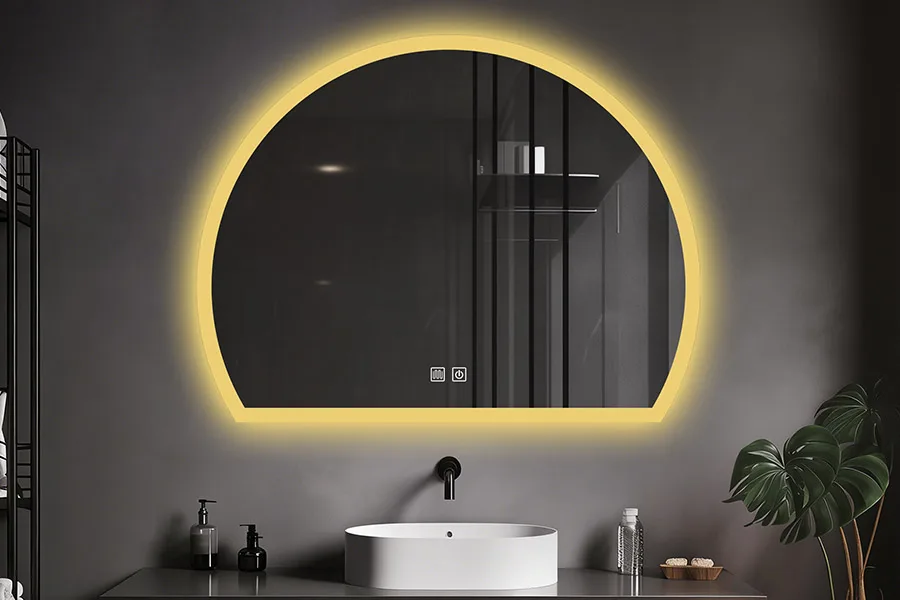
Quick Commercial Comparison: Trade-Offs Across All 4 LED Mirror Controls
Selecting a mirror control in a commercial build is a trade-off between fixture cost, fabrication changes, electrical compliance, and post-handover maintenance. Before requesting quotes across our commercial LED mirror solutions, use this matrix to filter out options that conflict with your project condition.
| Evaluation Factor | Capacitive Touch Switch | IR Hand-Wave Sensor | Radar Motion Sensor | Voice Control (Offline / Cloud) |
| Trigger & Hygiene | Direct finger tap; leaves smudges | Touchless hand swipe; clean glass | Automatic approach; zero touch | Spoken commands; hands-free |
| Relative Total Cost Tier | Baseline (Lowest) | Low–Moderate | Moderate–High | Highest |
| Glass & Frame DFM | Rear laser-etched icon; sealed flush glass | Exposed frame cutout; gasket seal needed | Hidden behind glass; needs non-metallic signal path | Mic pinhole with waterproof breathable membrane |
| Hardwired Wall-Switch Fit | High (specify power-off memory) | Moderate–High (verify hardwire driver) | Moderate (add manual bypass for shutoff) | Moderate (keep physical backup switch) |
| Compliance / RF Trigger | Electrical safety + damp IP rating | Electrical safety + damp IP rating | Electrical safety + intentional RF rules (FCC / RED) | Offline: EMC; Cloud: intentional RF rules (FCC / RED) |
| Top Commercial Field Risk | Wet/gloved-hand lag; night standby glare | False triggers from side walls, faucets, or glare | Phantom triggers through glass doors or hallways | Bath echo/fan noise; Wi-Fi drops & privacy issues |
| Best Commercial Fit | Hotel guestrooms, executive offices | Clinics, upscale restaurant washrooms | Airport, mall, and office public restrooms | Luxury suites, accessible living |
| Hard Anti-Fit (Avoid) | Vandal-prone public restrooms | Tight recessed wall alcoves | Corridor-facing glass stalls without tuning | Multi-room hotels without IT support |
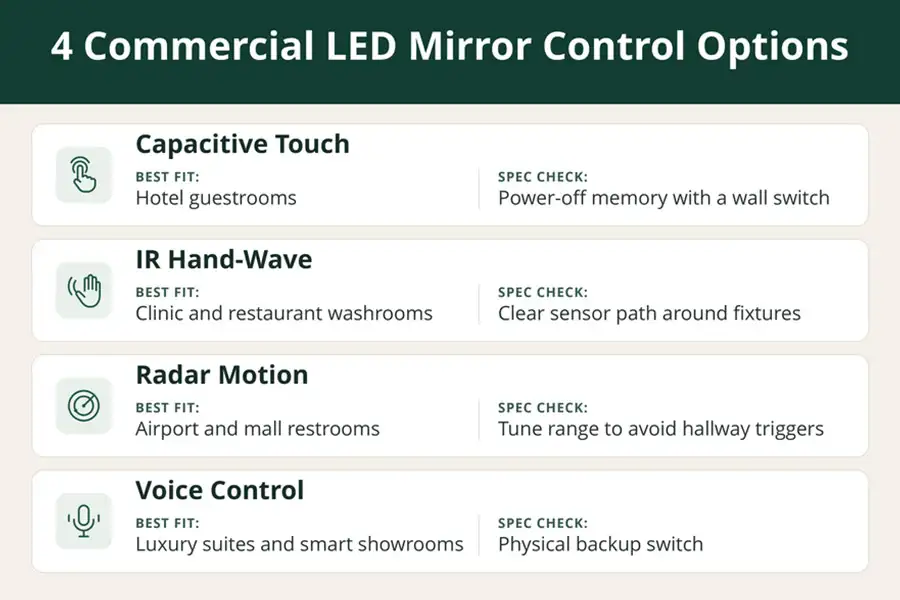
Capacitive Touch Switch: The Standard LED Mirror
A capacitive touch switch turns an LED mirror on and off by sensing the tiny electrical charge of a human finger through the glass. Because it has no moving mechanical parts, it lasts through tens of thousands of taps and remains the baseline choice for hotel guestrooms.
Capacitive touch controls are not etched into the front reflective face of the glass. Instead, manufacturing removes the reflective silver and protective paint layers from the rear surface using precision laser removal so the backlit icon shines cleanly through the front glass.
Key DFM checkpoints to confirm before sampling:
- Glass thickness and edge corrosion protection: Standard commercial mirrors are typically built on 3 mm, 4 mm, or 5 mm copper-free mirror glass, with edge-coating treatments applied to prevent black-edge oxidation in high-humidity bathrooms. Because capacitance attenuates through thicker glass or specialty coatings, any specification exceeding standard glass thickness or adding laminated/security layers requires pre-production sensitivity testing. (see our Tempered Glass vs. Copper-Free Silver Mirror)
- Backlit icon sealing: The laser-stripped rear icon area is a potential moisture entry path if left exposed. Verify that the touch module is bonded tightly with a moisture barrier behind the stripped coating.
- Single-button vs. separate icons: Combining power, dimming, and CCT shifting onto one multi-tap icon looks minimalist on a CAD rendering, but short-stay hotel guests often struggle to operate hold-to-dim sequences. Separating power/dimming from the anti-fog heater icon cuts front-desk support calls.
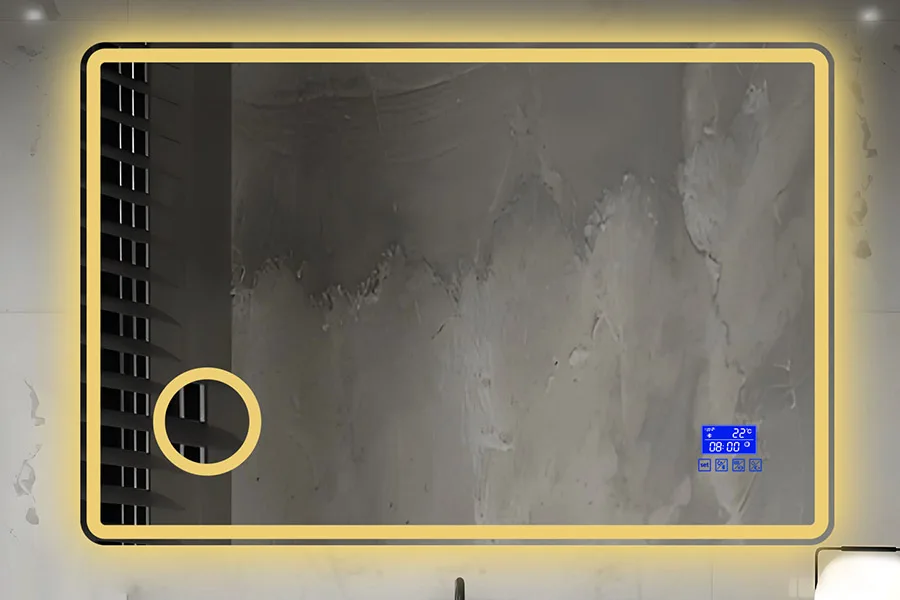
IR Hand-Wave: Frame Cutouts, Sensing Distance & Adjacent Obstacle Clearances
An active infrared (IR) hand-wave sensor emits a short infrared beam and flips the mirror power when a hand moves within 5–10 cm of the sensor head. It is the lowest-cost way to add touchless switching to a commercial vanity project.
Unlike capacitive touch, an infrared hand-wave sensor cannot reliably operate through solid silvered mirror glass without dedicated optical windows, so manufacturers typically mount the IR lens in a cutout along the bottom edge or side frame.
DFM and layout constraints to audit against your bathroom elevations:
- Frame interruption: Side or bottom frame cutouts alter minimalist anodized or powder-coated profiles and must be gasket-sealed to maintain the fixture’s IP rating.
- Wide variance in sensing distance: Commercial IR modules vary substantially in detection range—typically spanning roughly 2 to 4 inches (5–10 cm) on calibrated vanity sensors, while generic wholesale modules can extend up to 15 cm. If the factory does not lock the short-range window for your model, passersby will trigger the mirror unintentionally.
- Alcove and fixture clearance: Never specify a side-mounted IR sensor for a mirror recessed inside a tight wall alcove where side walls sit close to the sensor beam. Similarly, bottom-mounted IR lenses must clear high-arc faucets, counter-mounted soap dispensers, and glossy stone backsplashes that reflect infrared light continuously and cause rapid flickering or lockouts.
- Control granularity limits: Single-eye IR sensors handle on/off and basic hold-to-dim well, but are poorly suited for projects requiring independent CCT selection and separate defogger control.
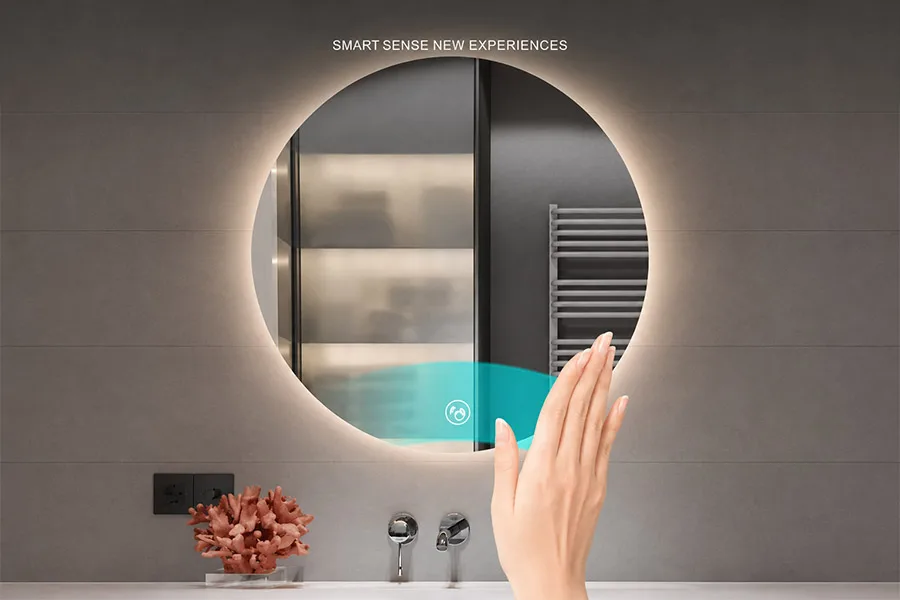
Radar Motion: Concealed Integration, Metal Backplate Shielding & Detection Tuning
Microwave radar sensors allow a completely seamless, hole-free glass face—making them strong candidates for vandal-resistant public washrooms. However, procurement teams often confuse compact bathroom presence-sensing radar modules with industrial high-speed door radar sensors designed to separate pedestrian and vehicular cross-traffic. Vanity mirror radar must operate accurately at close interior ranges without bleeding across partitions.
Before signing off on a radar-controlled sample, verify three structural and calibration details:
- Metal backplate attenuation: Many commercial backlit mirrors use full-metal rear chassis plates for structural rigidity and passive heat dissipation. Solid metal blocks microwave signals. Confirm whether the radar module radiates forward through a non-metallic zone of the glass assembly or sits behind a dedicated non-metallic radome aperture—never buried inside an unvented steel box.
- Frequency band and beam containment: Higher-frequency directional radar modules generally offer tighter detection zones than broader low-frequency boards, reducing unwanted spill into adjacent hallways or shower stalls. Request the module’s detection pattern and sensitivity adjustment range from your supplier before locking the spec.
- Manual override integration: Pure radar mirrors cannot easily be turned off by an occupant who wants a dim bathroom at night. In hospitality suites, pair radar approach lighting with a manual touch override or hardwired wall-switch control.
Voice Control: Acoustic Protection, Offline vs. Cloud Architecture & Firmware Boundaries
Integrating a microphone into a wet bathroom creates an immediate engineering conflict: sound waves need an open acoustic path, while steam and splash water must stay out of the main control board. Manufacturers address this by machining an acoustic port sealed with a waterproof breathable membrane—though water droplets resting directly on the port can temporarily muffle voice pickup.
More importantly, buyers must separate offline onboard voice modules from cloud/smart-assistant integrations during project scoping:
| Evaluation Dimension | Offline Onboard Voice Module | Cloud / Smart-Ecosystem Voice (Wi-Fi / Assistant) |
| Network & IT Dependency | None; runs locally on embedded chip | Requires stable commercial Wi-Fi, VLAN setup, and account provisioning |
| Guest Privacy & Compliance | No cloud audio transmission; lower privacy pushback | Higher guest privacy concern and corporate IT security review |
| Command Flexibility | Fixed pre-programmed wake words and command list | Broad natural-language scenes and room-automation links |
| Custom Language / Wake-Word Cost | Triggers firmware NRE fees and higher MOQ thresholds | Handled via ecosystem app, but adds ongoing API/app maintenance risk |
| Recommended Commercial Safeguard | Pair with physical touch or wall-switch backup | Pair with physical backup; avoid unless property has dedicated IT staff |
Engineering rule: Do not commit to custom wake words or regional language firmware on low-volume orders without quoting firmware development (NRE) charges and minimum run quantities up front.
Total Project Cost Breakdown: Module BOM, Compliance Testing, and Wiring Rework
Procurement teams frequently misjudge control pricing by comparing bare switch components sourced from wholesale marketplaces. On an OEM assembly line, changing the control method changes the LED driver architecture, moisture sealing, certification scope, and on-site electrical compatibility. Evaluating total landed and installed cost requires looking at three layers beyond the sensor itself.
Hardware Cost Drivers Beyond the Sensor Module
A mirror switch does not operate in isolation. When a project moves from a baseline capacitive touch switch to radar or voice control, unit cost increases across several connected BOM items:
- LED driver channel matching: Multi-function touch mirrors integrate power switching, dimming, CCT shifting (such as 3000K/4000K/6000K), and anti-fog relays onto matched low-voltage outputs. Radar and voice controllers often require dedicated auxiliary power rails or relay boards to handle heated defogger loads safely.
- Moisture sealing and board protection: Commercial bathroom humidity degrades unprotected control PCBAs. Upgrading to conformal-coated electronics, sealed driver enclosures, and waterproof wire-entry grommets adds material and assembly labor compared to dry-area cabinet switches.
- Chassis and glass machining: Exposed IR sensors require CNC frame cutouts and sealed bezels; radar modules inside full-metal back boxes require non-metallic transmission windows; voice modules require acoustic port machining and waterproof breathable membranes.
- End-of-line calibration and testing: Baseline touch pads require straightforward functional checks during aging tests, whereas radar sensitivity tuning and voice-command verification add bench time per unit.
Compliance & RF Certification Cost Triggers (UL/ETL, IP Rating & Wireless Modules)
Compliance is the fastest way for a seemingly minor control upgrade to break a small- or mid-volume project budget. Two recurring procurement mistakes happen during specification:
- Treating component approvals as finished-fixture certification: A UL-recognized LED strip or low-voltage sensor does not make the completed mirror compliant. Permanently connected commercial bathroom mirrors in North America are evaluated as complete fixtures under luminaire and electrical safety standards such as UL 1598 (Standard for Luminaires).
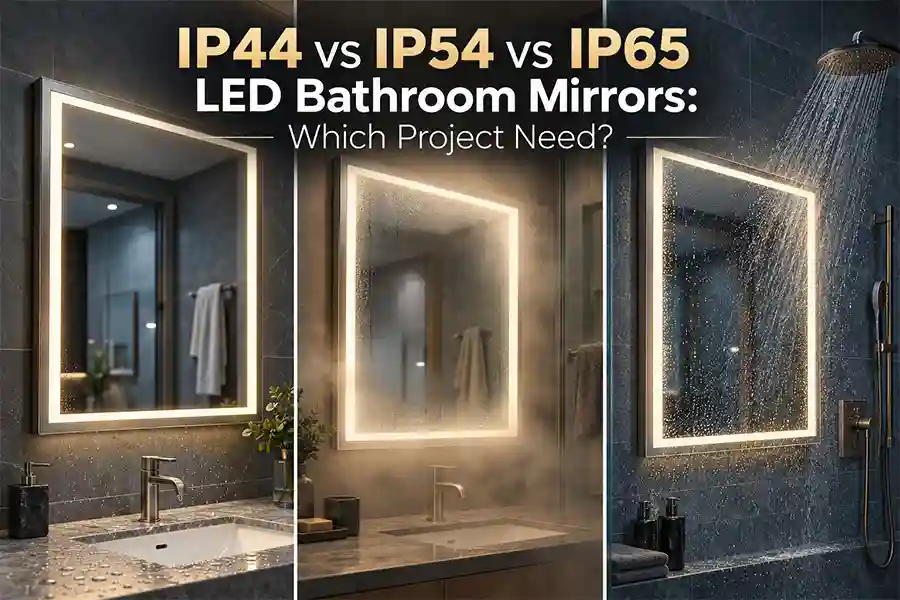
- Mixing low-IP wholesale switches into damp commercial zones: Many off-the-shelf cabinet or vanity switches carry IP22 or IP34 ratings, whereas commercial vanity zones typically require at least IP44 splash protection under IEC 60529 Ingress Protection (IP) standards—or IP54/IP65 where steam ventilation is poor or direct spray occurs. For exact enclosure cost and testing differences, review our engineering breakdown on IP44 vs. IP54 vs. IP65 commercial bathroom mirror requirements.
Switching to active wireless sensing or connectivity introduces an additional regulatory layer. Under FCC Part 15 equipment authorization rules for RF devices, products that intentionally emit radio frequency energy—including microwave radar motion sensors and Wi-Fi/Bluetooth voice modules—are regulated as intentional radiators. For European projects, those same modules fall under the European Commission Radio Equipment Directive (RED 2014/53/EU).
Commercial Field Failure Modes, QC Intercepts & Modular Serviceability
Experienced commercial buyers know “100% zero-defect” claims do not survive five years of daily steam, chemical glass cleaners, and high-traffic use. Protecting total cost of ownership comes down to two realities: catching predictable bathroom failure modes before shipment, and ensuring one failed sensor does not force facility staff to rip an entire mirror off a tiled wall.
High-Frequency Failure Modes in Wet, High-Traffic Restrooms
Every control technology fails differently under real commercial conditions. Use the matrix below during sample approval and pre-shipment quality inspections—and verify that finished electronic assemblies undergo energized factory aging and sensitivity tests before packing.
| Control Option | Top Commercial Field Failure | Root Physical Cause | Pre-Shipment & Sample Verification Checkpoint |
| Touch Switch | Unresponsive taps or phantom switching after hot showers | Surface condensation bridging capacitive pad; moisture ingress at unsealed rear icon; wet or gloved hands | Test touch responsiveness with damp fingers; confirm conformal coating on PCBA and sealed rear touch enclosure |
| IR Hand-Wave | Continuous strobing, lockout, or random switching | Static obstacle (wall, tall faucet, soap dispenser) or specular reflection inside sensor cone | Confirm factory-locked short sensing range on bench; overlay sensor location directly onto vanity elevation drawings |
| Radar Motion | Lights staying on or triggering when nobody is at the vanity | Microwave penetration through thin drywall, frosted glass stall doors, or open corridor sightlines | Verify adjustable sensitivity/timeout DIP settings and test detection boundary in a mock-up corridor or stall |
| Voice Control | Missed commands or accidental activation during showers | Hard-tile acoustic reverberation, shower/exhaust fan ambient noise, varied guest accents, or Wi-Fi drops | Run voice command tests next to active running water/fan noise; verify physical backup switch operates independently |
Modular Replacement Architecture & Warranty/Spare-Parts Verification
When a control board or LED driver fails three years into a hotel’s lifecycle, labor and room downtime cost far more than the replacement part. Across commercial hospitality deployments, modular serviceability is one of the largest levers for reducing long-term maintenance costs.
Verify both structural access and commercial contract terms before signing off:
- Plug-and-play quick connectors: Confirm that LED drivers, control boards, and defogger pads connect via keyed quick-disconnect harnesses rather than hard-soldered or permanently potted permanent wiring.
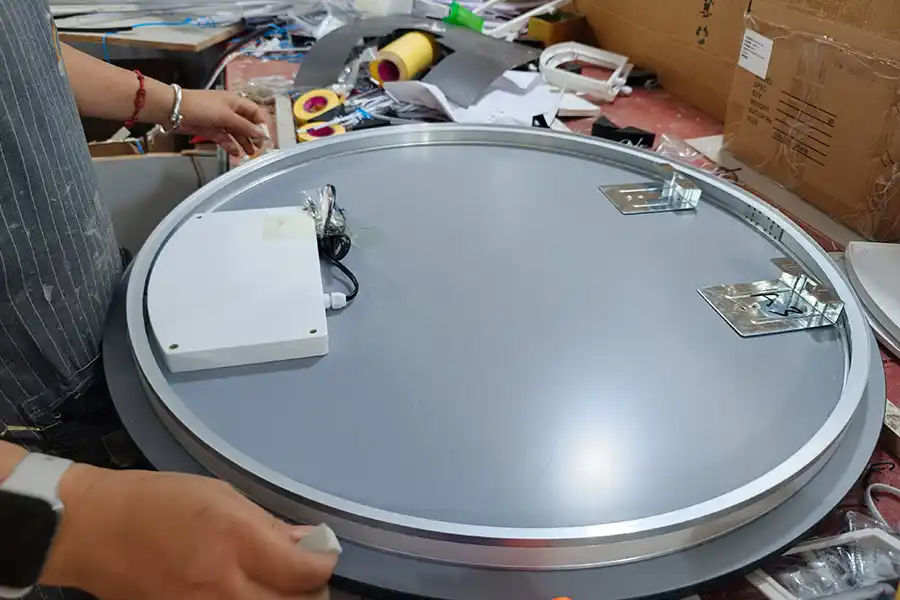
- Accessible rear service box: Check whether a technician can unhang the mirror from its mounting cleat, open an independent rear driver/control cover, and swap a module without delaminating the safety backing or breaking the glass.
- Warranty scope and spare-parts allocation: Standard OEM LED mirror warranties typically run 1 to 2 years depending on component specification and order agreement (with extended commercial coverage configurable through upgraded component tiers). For multi-floor commercial rollouts, lock in matched spare control modules and drivers on the initial purchase order so property engineers can execute same-day swaps without waiting for international air freight.
Project Qualification & Hard “Do Not Buy” Rules by Commercial Space
No single control option fits every commercial restroom. Matching the switch to physical room conditions and facility maintenance staffing prevents almost all post-installation complaints.
| Commercial Environment | Recommended Control Setup | Key Spec Adjustments to Include |
| Standard & Upscale Hotel Guestrooms | Capacitive Touch (primary) | Require power-off memory for master wall/key-card switches, separate anti-fog icon, and dimmable CRI 90+ lighting. Explore tailored hospitality LED mirror configurations. |
| Airports, Malls & Office Public Restrooms | Radar Motion or Circuit-Switched Only | Use concealed radar with tuned short-range boundaries for hands-free energy savings—or eliminate onboard switches entirely and tie mirrors to building occupancy sensors. |
| Clinics, Healthcare & Senior Living | IR Hand-Wave or High-Contrast Touch / Assisted Voice | Verify unobstructed vanity clearances for IR. For accessible spaces, confirm switch height and low-force operability align with U.S. Access Board ADA Operable Parts Standards (including reach ranges and single-hand operation without pinching or twisting). |
| Boutique Suites & Smart Showrooms | Offline Voice + Touch Backup | Favor local offline command sets over Wi-Fi cloud hubs to eliminate guest pairing friction and privacy liability, with touch control always active as fallback. |
4 Hard “Do Not Buy” Rules From the Factory Floor
- Do not specify side-mounted IR hand-wave sensors inside tight recessed wall alcoves. Narrow side clearances trap the infrared beam against adjacent tile walls, triggering nonstop flickering or sensor lockout.
- Do not install uncalibrated wide-beam radar mirrors opposite glass shower doors or open hallway entries. Microwave energy passes through non-metallic glass and thin partitions, causing late-night phantom activation and guest complaints.
- Do not roll out Wi-Fi or cloud-dependent voice mirrors across multi-room hotels without dedicated on-site IT support. Network credentials, router drops, and voice-assistant outages turn a lighting fixture into a recurring maintenance ticket.
- Do not specify custom wake-word or minor-language offline voice firmware on small-batch projects. Firmware NRE, acoustic tuning, and potential certification costs rarely pay back on low unit counts; stay with standard touch or IR hardware.
Pre-Order Engineering Checklist Before Locking Mirror Specs
Sending an incomplete inquiry forces suppliers to quote generic assumptions that fail during site handover. Before finalizing your mirror schedule—or alongside our complete LED mirror project RFQ checklist—assemble these five engineering inputs:
- Vanity elevation drawings & surrounding clearances: Mirror width/height, side wall alcove depth, faucet height, soap dispenser placement, and nearby glass doors or walkways.
- Electrical & wall-switch logic: Input voltage/frequency (e.g., 120V/60Hz or 220–240V/50Hz), hardwired vs. plug-in connection, master wall switch or key-card switching, and whether any external dimmer sits on the circuit.
- Target market compliance & bathroom IP zone: Destination country, required whole-unit safety marks (UL/ETL, CE, UKCA), RF rules if selecting radar/wireless, and moisture zone rating (IP44, IP54, or IP65).
- Required functions & backup override: Exact mix of dimming, CCT tuning, anti-fog auto-shutoff, and whether radar or voice units require a physical backup switch.
- Order volume, phasing & spare-parts plan: Total quantity per model code, phased delivery dates requiring locked IC/color bins, and target spare control/driver kit percentage.
Frequently Asked Questions
Q1: Can a commercial LED mirror with a touch or sensor switch still work with a wall switch?
Yes, if the mirror uses a hardwired driver with a built-in power-off memory function. When a hotel key card or master wall switch cuts power, the memory chip saves the last brightness and color temperature. When power returns, the mirror turns back on automatically in that same state. Without memory, the mirror stays dark until a guest presses the glass again.
Q2: Why does an IR hand-wave sensor keep turning on and off by itself?
Most self-triggering IR sensors are mounted too close to a reflective object. Active infrared beams bounce off tall faucets, shiny countertops, side walls, or soap dispensers placed within 15 to 20 cm of the sensor head. That constant reflection tricks the board into reading a hand wave. To fix this during design, keep at least 20 cm of clear space around the sensor or move it to the side frame.
Q3: Why does an IR hand-wave sensor keep turning on and off by itself?
Most self-triggering IR sensors are mounted too close to a reflective object. Active infrared beams bounce off tall faucets, shiny countertops, side walls, or soap dispensers placed within 15 to 20 cm of the sensor head. That constant reflection tricks the board into reading a hand wave. To fix this during design, keep at least 20 cm of clear space around the sensor or move it to the side frame.
Q4: How do hotels stop capacitive touch switch backlights from disturbing sleeping guests?
Standard white or bright blue standby icons can glow brightly in a dark guestroom, especially when the mirror faces the bed. Commercial projects solve this in two ways. First, specify a soft warm-amber standby light with reduced brightness. Second, choose a touch controller with a long-press backlight-off function, allowing guests to hold the icon for three seconds to turn the standby glow completely off at night.
Q5: If a touch switch or sensor breaks, must maintenance replace the whole LED mirror?
Not if you buy commercial-grade mirrors built with modular plug-and-play electronics. In a modular design, the LED driver, touch board, and sensor head sit inside a serviceable back housing with quick-disconnect wire plugs. A technician lifts the mirror off its wall bracket, unplugs the faulty module, and snaps in a spare part within ten minutes. Avoid low-cost glued assemblies that force full-mirror replacement after a single switch fails.
Q6: Can one commercial LED mirror combine a radar motion sensor with a separate defogger touch switch?
Yes, hybrid control setups are common in hotel and commercial OEM orders. In this layout, the 5.8GHz radar sensor controls the main LED light for hands-free entry and automatic shutoff. A separate capacitive touch icon controls the anti-fog heating pad on demand. Splitting these two loads saves energy because the defogger only runs during hot showers instead of turning on every time someone washes their hands.
Conclusion
Touch switches, IR hand-wave sensors, radar motion sensors, and voice modules each solve a different commercial problem. The best setup balances daily traffic, countertop clearance, power savings, and easy maintenance.
Shein Mirror factory manufactures ODM & OEM LED mirrors with custom switch layouts, power-off memory, modular drivers, and IP44-rated housings. Share your project drawings or vanity specs with our team, and we will configure the right control system for your order.