跳到内容

A mirror can fit the drawing and still block a door, hide a socket, or leave too little room to stand. Choosing between a wall-mounted and a freestanding full length LED mirror starts with those details. Wall-mounted full length models suit a fixed layout with a suitable wall. Freestanding full-length models offer more freedom to change a room. In both cases, check the support, power supply, and full cost before choosing.
Key Takeaways
- Wall-mounted full length mirrors: Best suited to layouts where floor clearance matters and the wall can support the specified fixings.
- Freestanding Full Length LED mirrors: Suitable when repositioning is useful and the complete stand footprint fits the room.
- Leaning and easel-style mirrors: These are different support arrangements; confirm the actual structure before ordering.
- Cost comparison: Compare equivalent sizes, lighting features, finishes, mounting parts, installation labor, and relevant delivery costs.
- Installation and power: Verify the mounting method, support requirements, electrical connection, and cable route for the exact model.
- Bulk purchasing: Confirm dimensions, intended use, quantities, support components, packaging, and sample approval requirements before production.
Wall-Mounted vs. Freestanding Full Length LED Mirrors: Key Differences at a Glance
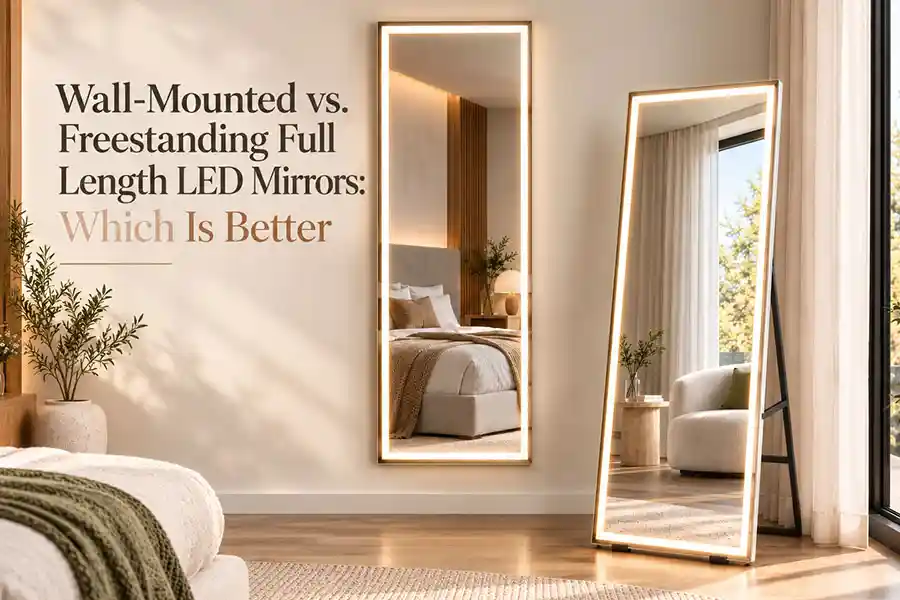
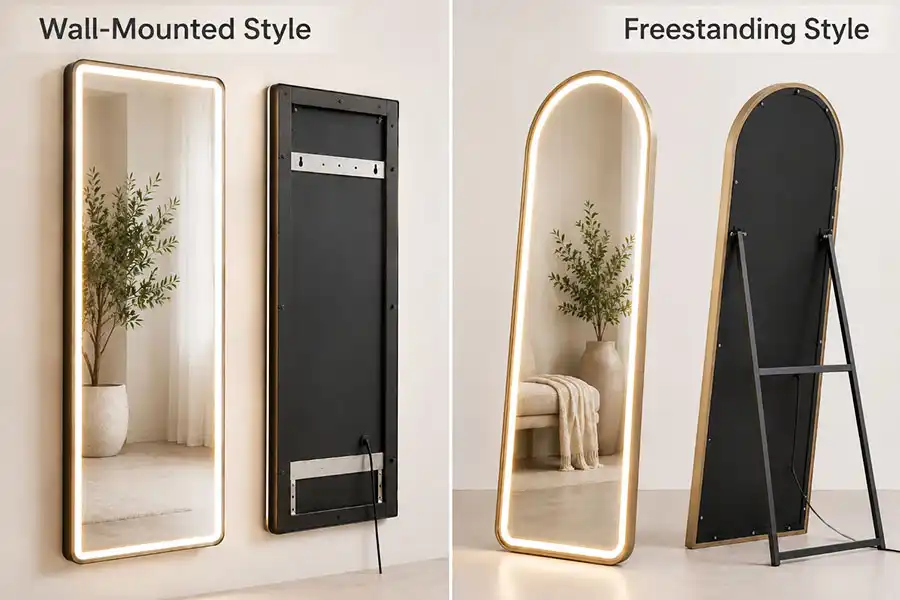
The main difference between wall-mounted and freestanding full-length LED mirrors is how each mirror is supported and how much floor space it requires. A full length wall-mounted mirror is secured to a suitable wall using an appropriate mounting system. A freestanding mirror rests on a base, legs, or another approved floor-support structure. The mounting style alone does not determine lighting performance, electrical requirements, weight, or ease of relocation; these depend on the specifications of the individual model.
Wall-Mounted, Freestanding, Leaning, and Easel-Style Mirrors: What’s the Difference?
Wall mount full body describes a mirror fixed to a wall. Freestanding means the mirror stands on the floor with a built-in frame, base or legs. The other terms need more care:
- Leaning: The mirror rests at an angle against a wall, but is not necessarily fixed.
- Easel-style: A hinged rear stand behind the mirror, similar to a picture easel. It is one type of standing structure, not a name for every floor mirror. An easel mirror is one kind of freestanding design.
- Floor-standing: This style may lean or stand upright. Check the drawing or picture to see the actual support.
Do not compare two products by their names alone. Request a front, back, and side view.
If a page uses “standing” and “leaning” for the same item, ask which setup the supplied parts support. A photo of a mirror against a wall is not an installation guide. The rear view should make the stand, mounting points, and cable exit clear.
Side-by-Side Comparison: Space, Installation and Ownership Costs
Compare the complete setup, not just the mirror face. Use the same size, finish, and LED features as your starting point.
| Decision | Wall-mounted Full Length LED mirror | Freestanding Full Length LED mirror |
|---|---|---|
| Space | Check wall width, projection, and viewing area | Check mirror width, open stand or base, and viewing area |
| Position changes | Removes from wall; heavier models need two people | Rolls or lifts, but weight and cable may limit movement |
| Installation | Confirm wall, brackets, fixings, and power | Confirm assembly, floor support, restraints, and power |
| Stability approach | Bracket and wall fixings carry the load | Base and frame carry the load; anti-tip restraint may still be needed |
| Lighting | Confirm the actual LED layout and controls | Confirm the actual LED layout and controls |
| Appearance | Compare the fixed wall position and frame | Compare the full mirror and visible support |
| Care | Plan cleaning and removal access | Plan cleaning, moving, and access around the stand |
| Cost | Product + fixings + installation labor + cable work | Product + assembly + possible restraint kit + cable routing |
A lower product price may not mean a lower installed cost. Request separate figures for the mirror, fitting parts, assembly, packing, and freight where relevant. Keep one-off work separate from costs charged per mirror.
For repeat room layouts, also compare how each choice affects fitting and later replacement. Use actual quotes; do not assume wall-mounted always costs more to install or standing always costs less.
Ask what is included in the carton. A stand in a photo may be an option. Wall hardware may need to suit the site. Put agreed inclusions in the quote so both offers cover the same work.
Compare the look in the same room, too. A wall-mounted mirror makes the frame and wall position the focus. A standing mirror also brings its support into the view. Review a side image, not just a front image. Decide which parts should be visible in the finished room.
Then compare available shapes and options in Shein Mirror LED full-length mirror collection.
Which Type Works Better in a Small Bedroom or Apartment?
A wall-mounted full-length mirror is worth checking first when floor space is tight. A freestanding mirror can still work if its full footprint fits. The room label alone does not decide the answer.
Measure the Mirror, Reflective Area and Open-Stand Footprint
Measure three things separately: the overall product, the usable reflection, and the space its support needs.
A frame or lit border may take up part of the front. Do not treat the full outside width as clear mirror glass. For a standing model, ask for the depth with the stand open in its approved position.
Next, mark the proposed location and viewing spot on a room plan. Check:
- Door and wardrobe movement.
- Drawers when fully open.
- The route people use through the room.
- The socket and cable path.
- Space to reach switches and clean nearby surfaces.
Do not close a stand partway just to make it fit unless the instructions allow that position. Confirm the approved setup before choosing the mirror.
Use one sketch for both options. Show the wall-mounted mirror in its proposed position, then add the open stand for the floor version. Keep the door, furniture, and viewing spot the same. This makes the trade-off clear without relying on two product photos shot from different angles.
For the measuring steps behind these checks, Read Shein Mirror guide to choosing the right full-length mirror size.
Small Rooms and Rentals: Which Constraints Matter Most?
Choose the format that fits both the room and the wall work you are allowed to do. A narrow floor gap does not help if the stand blocks a cupboard. An empty wall does not help if it cannot take the required fixings.
In a rental, wall alterations may be restricted. That makes freestanding options worth checking. “Freestanding” does not mean you can ignore any restraint required for that model. If a tall mirror is knocked, it may tip without a wall restraint.
Check the mirror with the furniture in normal use, not just in an empty room. Show open doors and the viewing spot on the plan. If neither setup fits, change the size or location rather than forcing a poor layout.
When Is a Freestanding or Easel-Style Mirror the Better Choice?
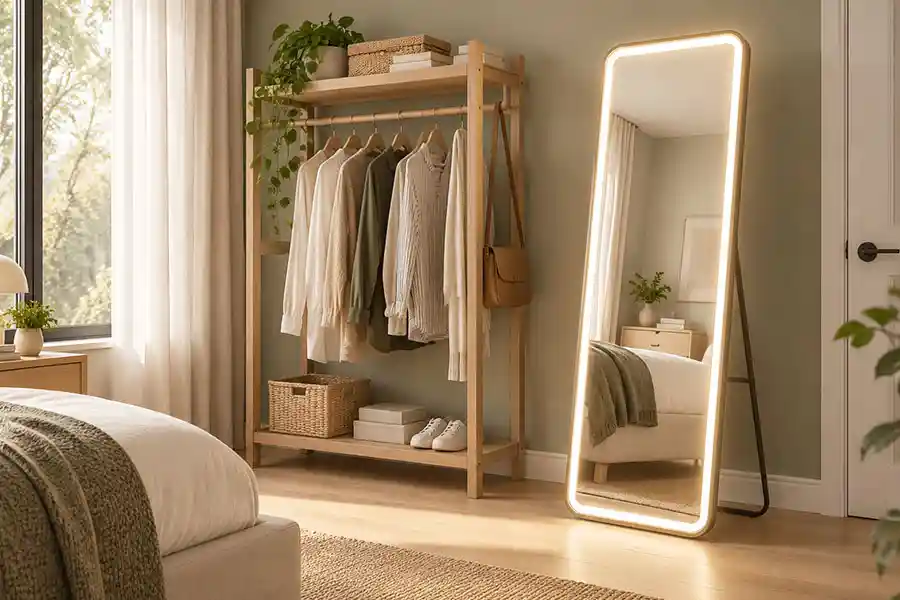
Freestanding makes sense when changing the layout has real value and the support fits the space. It is less suitable when the stand would crowd the room or moving it would be awkward.
When Does a Stand Add Useful Flexibility?
A stand helps when the full length led mirror needs a new position without a fresh wall installation each time. That fits a bedroom that gets rearranged, a dressing room area shared by different users, or a temporary setup.
An easel-style mirror may offer this benefit, but check the whole setup. “Can be moved” is not the same as “easy to move.”
Review the weight, frame handling points, stand, restraints, and cable. Follow the handling instructions; do not assume one person can lift it. A large full length glass mirror with a rigid frame may be heavy enough to require two people even with a stand. Recheck the support and required restraints after a move.
Look at the rear support as part of the design. Will it be visible from the door? Can it sit in the proposed position without touching furniture? A slim front view can hide a much deeper setup.
For a bedroom mirror with a stand, start with daily use. Can the wardrobe open? Is the viewing spot clear? Does the cable stay out of the route through the room? Those answers matter more than mobility shown in a product photo.
Can the Same Mirror Be Used on the Floor and the Wall?
Some models offer both setups, but you must confirm the exact version and supplied parts. A removable stand alone does not prove the mirror is ready for wall mounting.
Shein Mirror LED full-body mirror page lists wall-mounted and floor-standing options. Confirm which support, mounting parts, and instructions apply to the version you choose.
For a bulk order, put that choice on the drawing and sample approval record. If both methods are needed, confirm both in writing before approving the order.
What Should You Check for Installation and Stability?
Check the load path before choosing the type. A led full length wall mounted mirror transfers weight to the wall through a bracket and fixings. A led full length freestanding mirror transfers weight to the floor through its base or frame, and may still need a wall restraint to limit tipping. The required checks differ, but both options need a clear answer on weight, support and maintenance access.
Wall-Mounted Setups: Weight, Wall Conditions and Fixings
A full body wall-mounted mirror needs a fixing plan suited to its weight, mounting system, and wall. Confirm the mirror’s total weight, including the frame, glass and LED driver.
Request the net weight, bracket drawing, fixing points, and installation instructions. Confirm who selects the site fixings and who checks the wall. Do not choose anchors from the mirror’s height alone.
Also check space for lifting the mirror into place and removing it later. A tight recess may look neat on a drawing but still need a clear fitting route.
The U.S. Consumer Product Safety Commission’s Anchor It! guidance reinforces the importance of following manufacturer instructions when securing items against tipping. For a wall-mounted mirror, the actual bracket design, wall compatibility, and installation requirements must still be confirmed for the product being installed.
Glass protection and secure fixing are separate checks. Do not treat a film or glass label as proof that the mounting system is suitable.
Freestanding and Leaning Setups: Support and Anti-Tip Requirements
Use the stand, base, and restraint method specified for the mirror. Do not assume resting it against a wall completes the installation.
For a leaning floor mirror, ask for its approved resting position and restraint details. For a standing model, confirm how the support opens, connects, and is secured. Check the floor conditions against the instructions.
Keep the setup away from door swings and places where moving items could strike it. If the required support or restraint cannot be used, choose another position or product.
Ask for evidence of any claimed stability test, including the tested model and setup. Do not turn a general test claim into a promise about every size or stand.
Cleaning, Relocation and Replacement Access
Plan access before choosing a position. Check how staff will clean behind the mirror, reach its controls, and arrange removal if needed.
Use the care guide for the glass, finish, and electrical parts. Do not assume one cleaning product suits every surface.
Does Mounting Style Change LED Lighting and Power Requirements?
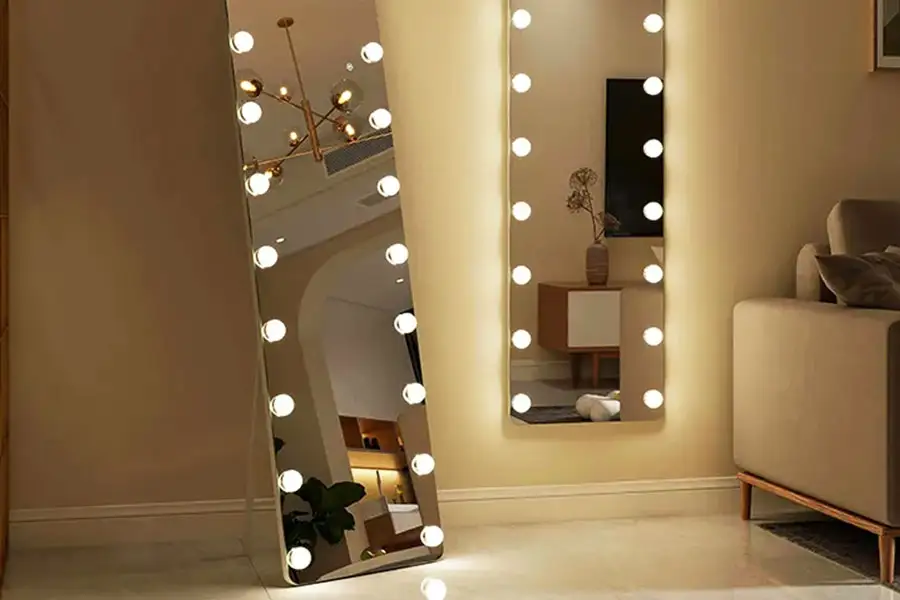
Mounting style affects mirror placement, cable routing, and access to electrical connections, but it does not determine whether the mirror is plug-in or hardwired or how well its LEDs illuminate the intended area. These features depend on the specifications of the individual model. Before choosing a mirror, verify its power connection, rated electrical requirements, light output, color settings, dimming options, and access to the switch or driver.
Plug-In or Hardwired: Check the Model, Not the Mounting Style
A full length wall-mounted LED mirror can be plug-in or hardwired. A freestanding LED full length mirror is often plug-in, but hardwired versions exist. Check the model’s electrical rating, cable length, switch location and driver placement. If the mirror will be hardwired, the installation needs a qualified electrician and a power source that meets local code. If it is plug-in, confirm the outlet is not hidden behind the mirror or blocked by the stand.
Confirm the power method for the exact model. Do not assume every wall mirror is hardwired or every standing mirror uses a plug.
For a plug-in version, mark the socket, plug clearance, and full cable route. Check whether the planned position leaves the connection accessible. For a hardwired version, agree the connection and service plan with a qualified electrician.
Moving a mirror also means reviewing its power route. Do not choose the display position first and leave a cable across a walking route as an afterthought.
For overseas bulk orders, confirm the market and power needs before sample approval. Ask whether any certification claim covers a part or the complete product. UL Solutions explains component recognition: a recognized component is not certification of a complete product sold on its own.
Lighting Quality Depends on the Specification, Not the Support
Compare light output, color settings, dimming, and LED placement before judging which mirror gives better light. The support type is not a substitute for that information.
The U.S. Department of Energy’s lighting guide explains that lumens describe light output, while Kelvin describes color temperature. A 3000K setting is not a brightness level.
Ask to review samples under the same room light and settings. Use the same task: checking an outfit, viewing detail, or adding background light. For a mirror used to judge clothing or skin tone, a CRI in the 90s is often preferred in hospitality and retail specifications.
The U.S. Department of Energy explains that CRI 90 or higher indicates excellent color fidelity. Read the DOE’s LED lighting guidance.
For outfit checks, evaluate the lighting with the room lights on and off where that reflects normal use. Note the chosen settings on the approval record.
Shein Mirror framed, front-lit full-length LED mirror provides one wall-mounted example. Confirm its chosen lighting and power version rather than using it to represent every wall mirror.
Which Setup Fits Bedrooms, Dressing Rooms and Hotel Projects?
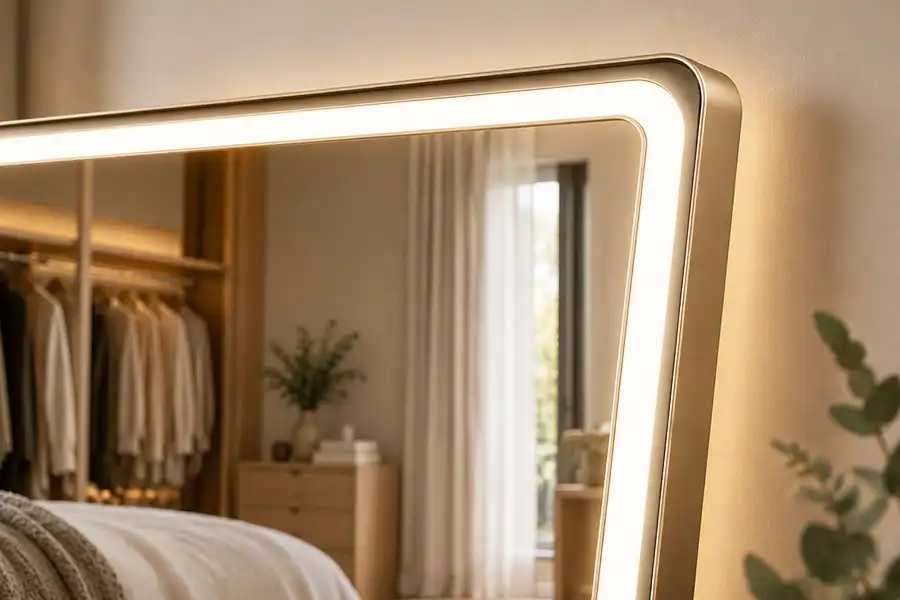
The best setup follows how the space is used. Dressing areas prioritize viewing position and layout. Retail fitting rooms prioritize consistent facial light and circulation. Hotels prioritize repeatable installation across room types and service access.
Full Length Mirror for Bedrooms and Apartments
A bedroom mirror works when it clears the wardrobe doors, the bed path and the outlet. If floor depth is tight, a wall-mounted mirror removes the stand footprint. If the wall cannot take fixings or the layout changes, a freestanding mirror with a confirmed restraint may fit better. Check the viewing position against the room’s natural standing spot, not only against the wall’s empty space.
Dressing Rooms and Retail Fitting Rooms
Start with the viewing position, customer route, and lighting needs. Then decide whether a fixed or changeable mirror position serves the room.
For a repeat fitting-room layout, list each mirror position and nearby fittings. For an open display area, check what changes when racks or furniture move.
Review a sample in the intended setting before repeating the order. Include the mirror’s light settings and support in that review. Our retail mirror solutions provide the wider application context; the final specification still needs to match the actual room.
Hotel Bedrooms and Multi-Room Projects
Choose by room type, not just the total number of mirrors. A clear wall in one room may become a wardrobe or door conflict in another.
Record the location, size, support, power connection, and access needs for each room type. Repeat the approved setup only where those conditions match.
Include removal and replacement in the review. A choice that fits the opening day must also fit the service plan.
How to Choose the Right Full-Length LED Mirror
First, determine the style of full length mirror with LED lighted you prefer. Second, determine the wall’s weight-bearing capacity, the clearance from the floor, and the available floor space. Based on these factors, choose between a floor-standing or wall-mounted mirror.
Start with the Room Constraints, Then Choose the Mounting Style
Choosing between a wall-mounted and a freestanding full-length LED mirror is easier when the decision follows a consistent order: room clearance, support conditions, electrical access, and day-to-day use.
Step 1: Check the available space. Measure the intended mirror position and the space needed to stand in front of it. For freestanding mirrors, include the full footprint of the stand in its approved position. Check doors, wardrobes, drawers, and walking routes.
Step 2: Confirm the support arrangement. For a wall-mounted mirror, verify that the wall and proposed fixing system are suitable. For a freestanding mirror, check the base or stand and any restraint required by the manufacturer’s instructions.
Step 3: Plan the electrical connection. Confirm the specified power connection, socket location, cable route, and access to switches or drivers before finalizing the position.
Step 4: Match the mirror to daily use. A fixed layout may favor wall mounting when floor clearance matters. A flexible room layout may favor a freestanding design if its support footprint fits and the product can be moved as intended.
Step 5: Resolve uncertainties before ordering. If the mounting method, support requirements, electrical connection, or installation conditions are unclear, request the relevant product information before approving the selection.
The best choice is not determined by mounting style alone. It depends on whether the complete mirror setup fits the room, can be installed as intended, and meets the user’s practical requirements.
Still choosing frames, controls, or light features? Check illuminated full-length mirror buying guide, which covers the wider selection process.
What to Send for a Full-Length LED Mirror Quote
To receive a useful and comparable quotation, give the supplier enough information to assess the mirror, its installation requirements, and the intended project. If some decisions are still open, mark them as “to be confirmed” rather than assuming that every option is available.
- Installation conditions: Available wall type, mounting restrictions, required support arrangements, and the intended installation location.
- Project consistency: Whether multiple rooms require the same dimensions, finish, lighting configuration, and mounting arrangement.
- Approval requirements: Drawings, product photos, samples, installation instructions, and packaging details that must be reviewed before production or shipment.
Frequently Asked Questions
Q1: What are the best types of full-length mirrors for small spaces?
A: A wall-mounted full-length LED mirror is often a good choice for small spaces because it keeps the floor area beneath the mirror clear. A freestanding or easel-style mirror may be more suitable when wall alterations are restricted or the mirror needs to be repositioned. Before choosing, measure the mirror’s overall dimensions, usable reflective area, and, for a freestanding model, the full footprint of the open stand. Also check door and wardrobe clearance, outlet access, cable routing, and any restraint required by the manufacturer’s instructions.
Q2: What are some tips for securing a leaning floor mirror to prevent accidents?
A: Secure the top of the mirror, not the bottom. Fix an anti-tip strap or bracket to a wall stud near the top edge, using the hardware supplied for that model. Add grip pads under the base to reduce sliding. Keep the lean shallow—about 16–24 cm out from the wall.
Q3: What are the advantages of using a floor easel mirror over wall-mounted ones?
A: A floor easel mirror’s main advantages are no wall drilling, easier repositioning. It’s simpler setup for renters or rooms where wall fixings are not allowed. It can move between a bedroom, dressing area and hallway without patching walls. Assembly may also be simpler than wall-mounted styles.
Q4: What should I check before installing a six-foot LED mirror on drywall?
A: Start with the mirror’s weight, fixing drawing, and the actual wall build. Its 6-foot height alone cannot tell you which anchors or supports are suitable. Give the model information to a qualified installer and follow the approved fixing plan. Also confirm lifting access, the power route, and later removal. Do not use a generic online anchor count as the installation specification.
Q5: What are the main differences between wall-mounted and free-standing full length mirrors?
A: Wall-mounted full length mirrors attach to a wall bracket and fixings, free the floor, and are harder to move. full length Freestanding mirrors stand on a base or frame, use floor depth, and are easier to reposition, but may need anti-tip restraint.
Conclusion
Wall-mounted and freestanding LED full-length mirrors solve different layout needs. The better choice is the one that fits the space, support plan, lighting needs, and full order scope.
Shein Mirror offers OEM full-length LED mirror options and custom options. Send your dimensions, quantities, mounting preference, and drawings to discuss the available choices.