LED Light Up Mirror RFQ Checklist: How to Get an Accurate Project Quote
Table of Contents
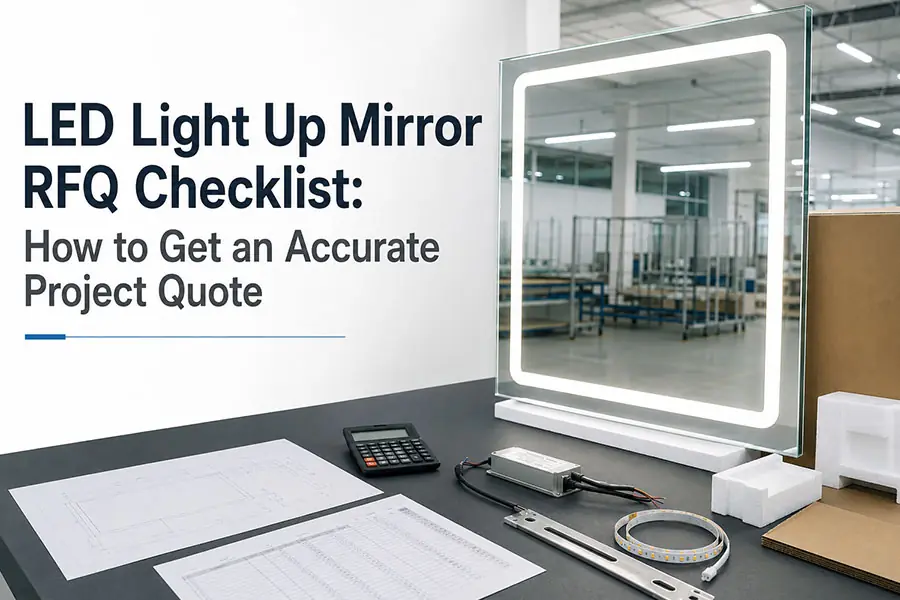
A quote-ready RFQ connects the drawing, BOM, quantity, packaging and commercial terms.
An accurate LED light up mirror quote requires more than a product photo and order quantity. You need six things: project scope and quantity, size and drawing, mirror and lighting BOM, electrical and compliance requirements, packing and shipping route, and delivery schedule with quote terms.
If some specs are not final, mark them TBD. But do not let the LED Lighted Mirror Suppliers guess. This guide gives you a 20-field checklist you can copy, two real quote examples that show why prices differ, and a response table that lets you compare quotes side by side.
Your RFQ should define the project, quantity, product configuration, electrical requirements, packing route, destination and delivery schedule in one controlled document.
Below is a master checklist. Copy this table and fill it out before you contact any supplier.
RFQ field
What you should provide
Status
Why it affects the quote
Project type
Hotel, residential, retail, or e-commerce project
Required
Different projects need different build quality, testing, and packaging
Installation area
Bathroom, vanity, or dry area
Required
Affects IP rating, moisture protection, and safety backing
Product family or reference model
Existing model name or new development code
Required
Helps supplier match previous tooling or start fresh
Shape, width and height
Round, oval, rectangle, or custom shape with exact mm
Required
Determines glass cutting, frame, and LED layout
Orientation and dimensional tolerance
Vertical, horizontal, or both; tolerance in mm
Required
Affects hanging system and production yield
Quantity by model and total quantity
Each model with separate quantity
Required
Mixed sizes change material use, packing, and CBM
Destination market
Country and region
Required
Drives voltage, plug type, certification, and label language
Drawing number and revision
File name, revision letter, and issue date
Required
Ties quote to exact dimensions and hole positions
Mirror material, thickness and safety backing
Copper-free silver, aluminum-coated, 4mm or 5mm, with or without safety film
Required
Changes material cost, weight, and durability
Frontlit, backlit or front-and-backlit design
Which sides emit light
Required
Changes LED count, light channel, and power draw
CCT, CRI, power and dimming needs
3000K, 4000K, 6000K; CRI 80+ or 90+; wattage; dimmable or not
Required
Affects LED quality, driver cost, and control board
Input voltage, wiring and plug type
110V, 220V; hardwired or plug-in; US, EU, UK, AU plug
Required
Changes power supply, wiring harness, and certification
Touch switch, sensor and control requirements
Touch, motion, or wall switch; memory function or not
Required
Changes control board and user experience
Defogger, clock, temperature display and other functions
Size of defogger pad; clock format; extra features
Optional
Adds components, wiring, and assembly time
Frame, finish, back structure and mounting system
Aluminum channel, stainless frame, painted finish; hanger type
Required
Changes structure cost and installation method
Logo, label, manual and private-label packaging
Logo artwork; label specs; manual language; retail-ready box
Optional
Affects artwork setup, printing, and packing materials
Required compliance documents
Full product cert, component cert, test report, or supplier declaration
Required
Determines testing cost and timeline
Export, LCL, pallet or e-commerce packaging route
FCL, LCL, or individual parcel
Required
Changes box strength, pallet count, and CBM
Destination and requested Incoterm
Port name or postcode; EXW, FOB, CIF, or DAP
Required
Changes who pays freight, insurance, and domestic transport
Sample schedule and required production delivery date
Sample approval date and mass-production ship date
Required
Affects production planning and material ordering
Copy This Checklist or Send Us Your Drawing for an RFQ Review
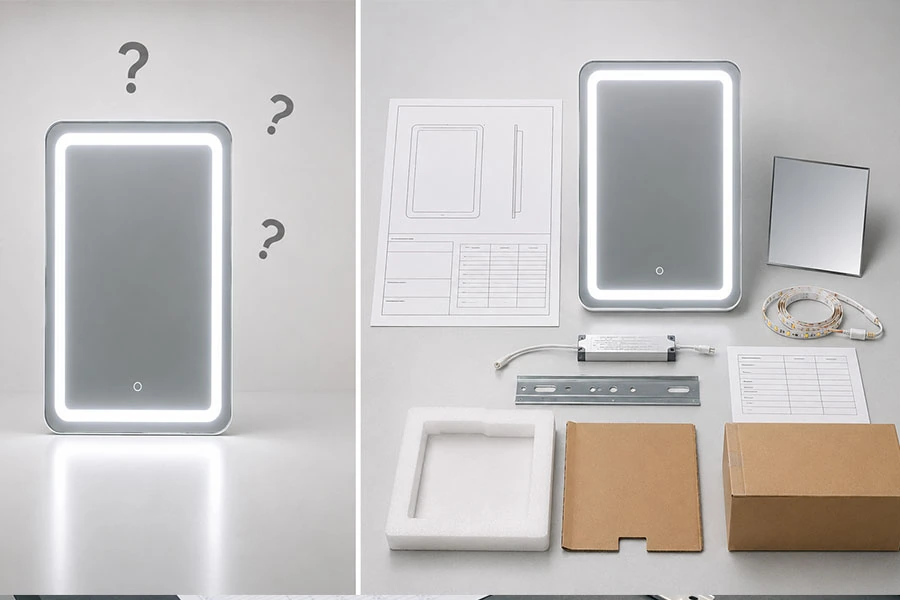
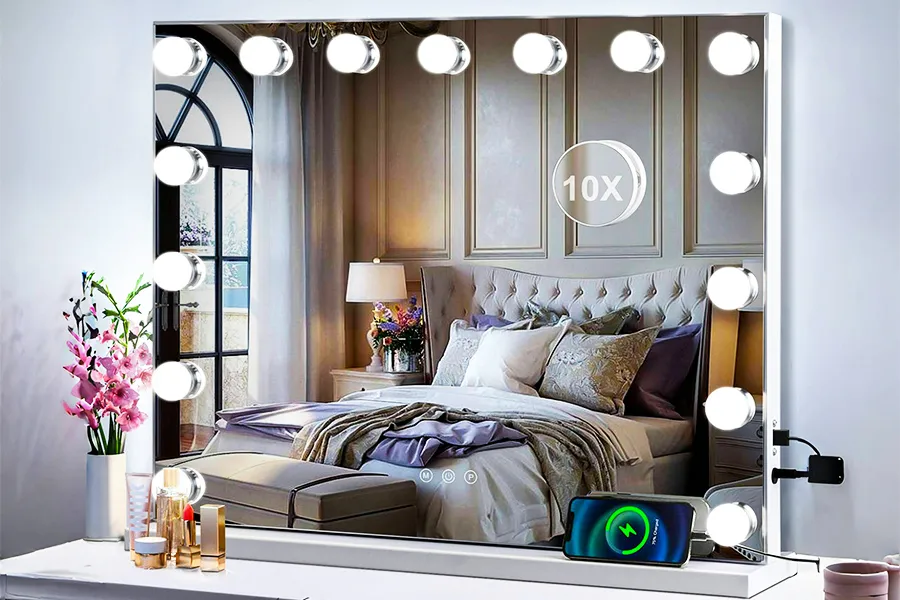
product photo vs led light up mirror specification
What Can You Mark as TBD in an LED Light Up Mirror RFQ?
You can mark an undecided feature as TBD, but you should ask the supplier to quote a stated base option and list the cost of each alternative.
TBD is not a blank check. If you are not sure about CRI, glass thickness, packaging, or control type, tell the supplier to:
Write down the base configuration used in the price
List each optional feature with its extra cost
State how each option changes lead time, MOQ, and certification
Example: “Mirror thickness: TBD. Please quote 4 mm as the base option and show the additional cost for 5 mm.”
This way you get a usable quote even when some specs are still open. Mark fields that do not apply as N/A instead of leaving them empty.
Can a Product Photo Alone Produce an Accurate LED Mirror Quote?
No. A product photo shows the appearance, but it does not confirm the BOM, electrical parts, mounting system, packaging or trade terms.
Here is what happens when you send only a photo and ask for 100 pieces:
The supplier has to guess. They might assume:
Thinner, cheaper glass
Basic LED strips and a low-cost driver
Standard export cartons with no inner protection
EXW price with no shipping included
That number is a budget estimate, not a final quote you can use to approve a purchase. A photo does not tell the supplier the voltage, defogger size, back structure, or packing route. Without those, the price you get is just a starting point. You need a product drawing or a filled-out spec sheet to turn that estimate into a firm quotation.
Which Project Details Should You Define Before Requesting a Quote?
Define the application, model quantities, destination and required dates before discussing optional mirror functions.
How Should You List Models, Sizes and Quantities?
List the quantity for each size and model instead of providing only one total order quantity.
Model
Size
Orientation
Quantity
A
600 × 800 mm
Vertical
120
B
800 × 1000 mm
Horizontal
80
Mixed sizes change material utilization, carton sizes, pallet layout, CBM, and production scheduling. Do not write “200 pieces” as one total without breaking it down by model. The supplier needs to know how many of each size to plan glass cutting, LED strip length, and packing materials.
Why Does Every Drawing Need a Revision Number?
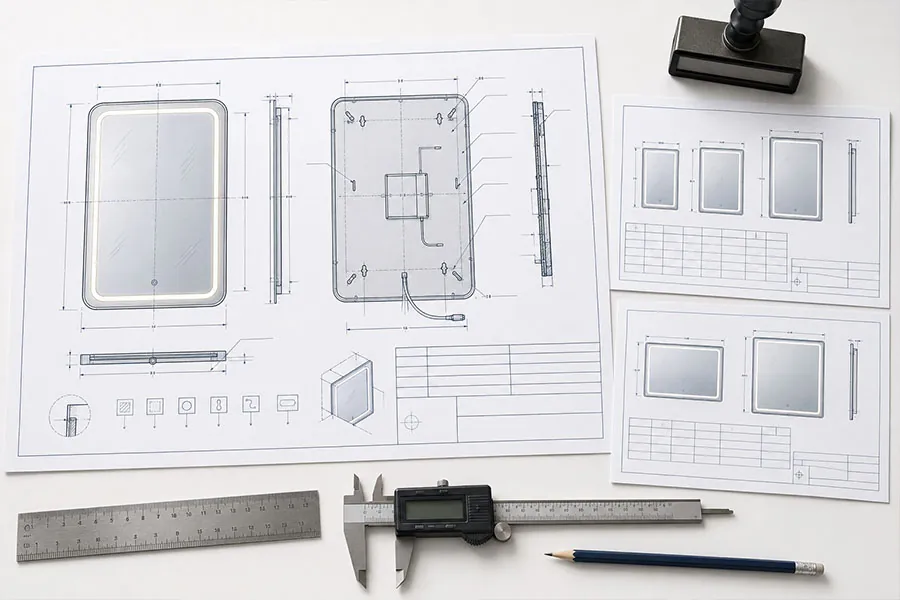
A revision number ties the quote to the exact size, hole position, lighting pattern and mounting design reviewed by both sides.
Your RFQ must state:
Drawing number
Revision letter (Rev A, Rev B, etc.)
Issue date
Unit of measurement (mm or inches)
Approved sample reference (if available)
If the quote is based on Rev A but production uses Rev C, the price, packaging, and delivery date may no longer apply. Changes in hole positions or mounting points can require new tooling, which adds cost and time.
Product photo compared with a complete LED mirror specification sheet
Which Light Up Led Mirror Specifications Change the Project Price?
The quote changes when the mirror system, lighting design, electrical parts, functions, structure or packing BOM changes.
Which Mirror Glass Details Should You Specify?
State the mirror system, glass thickness, safety backing and edge treatment instead of asking only for a “high-quality mirror.”
Cover these items in your RFQ:
Mirror type: copper-free silver mirror or aluminum-coated mirror
Thickness: 3 mm, 4 mm, or 5 mm
Safety backing: with or without safety film
Edge treatment: polished, beveled, or flat
Back coating and edge protection for moisture resistance
Optical distortion requirement, if any
A 5 mm copper-free silver mirror works well for hotels and premium residential projects. But it is not the right choice for every order. Glass thickness must match the size, weight, structure, and mounting method. Thicker glass costs more and weighs more, which changes shipping cost and hanging hardware.
Which Lighting and Electrical Details Belong in the RFQ?
Specify the lighting layout, input voltage, LED performance, driver and control method as separate fields.
Break down the lighting and electrical system:
Lighting layout: frontlit only, backlit only, or front and back combined
CCT and tolerance: 3000K, 4000K, 6000K, with acceptable range
CRI: 80+ is standard; 90+ for retail or hospitality
LED strip: model number or minimum performance specs (lumens per meter, power per meter)
Power and input voltage: 110V, 220V, or universal
Wiring: hardwired or plug-in
Plug type: US, EU, UK, AU, or no plug
Switch: touch sensor, motion sensor, or wall switch
Dimming: with memory function or without
Defogger: size and location on the mirror
Extra displays: clock, temperature, or both
Do not write “CRI 90+, DALI, 0–10V, IP65” as default requirements for every project. Use “if required by the project” and “subject to engineering review” to keep the quote realistic.
Which Structure and Branding Details Are Easy to Miss?
Back structure, hangers, frame finish, labels and packaging artwork can change both cost and production time.
These items often do not show up in product photos, but they affect cost and lead time:
Aluminum channel or support structure
Back panel material and finish
Hangers: type, quantity, and mounting direction
Frame material and color
Logo: position and printing method
Rating label: voltage, wattage, and certification marks
Instruction manual: language and page count
Printed carton: artwork setup and minimum order
Barcode and retailer labels
Ask the supplier to include these in the quote. If you skip them, you may face extra charges later for artwork setup, new molds, or documentation
What Do Two Historical 50-Piece LED Mirror Quotes Show?
Two quotes for the same visible size and quantity can still differ because their BOM, lighting structure, packaging and price basis are not the same.
The following anonymized historical quotations are used only to explain quote structure. They are not current market averages, and they do not include complete landed costs.
What Was Included in Historical Quote A?
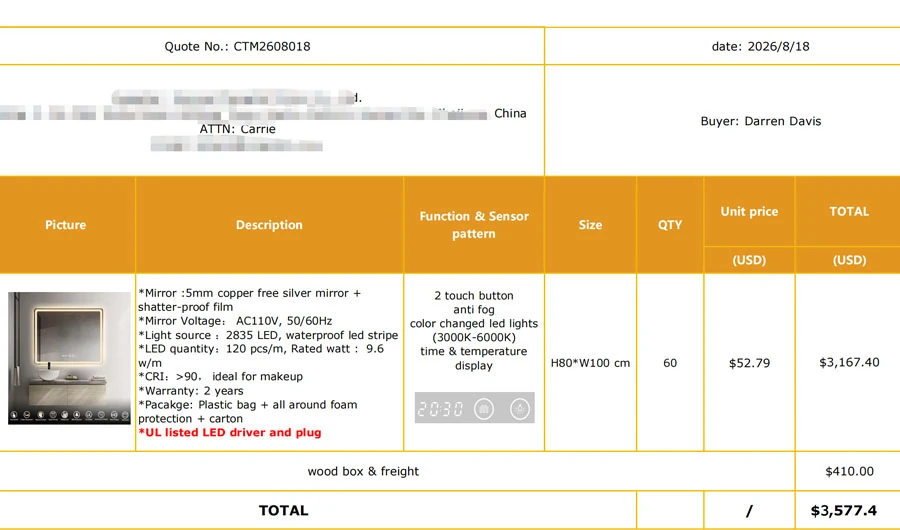
Quote A covered 60 mirrors at 80 × 100 cm with a product price of US$46.68 per unit.
Quantity: 60 pieces
Size: 80 × 100 cm
Mirror: 5 mm copper-free silver mirror with safety backing
Input: 110V
LED: 2835 waterproof LED, 120 LEDs/m, 9.6 W/m
CRI: stated as above 90
Functions: dual touch, defogger, three CCT settings, time and temperature
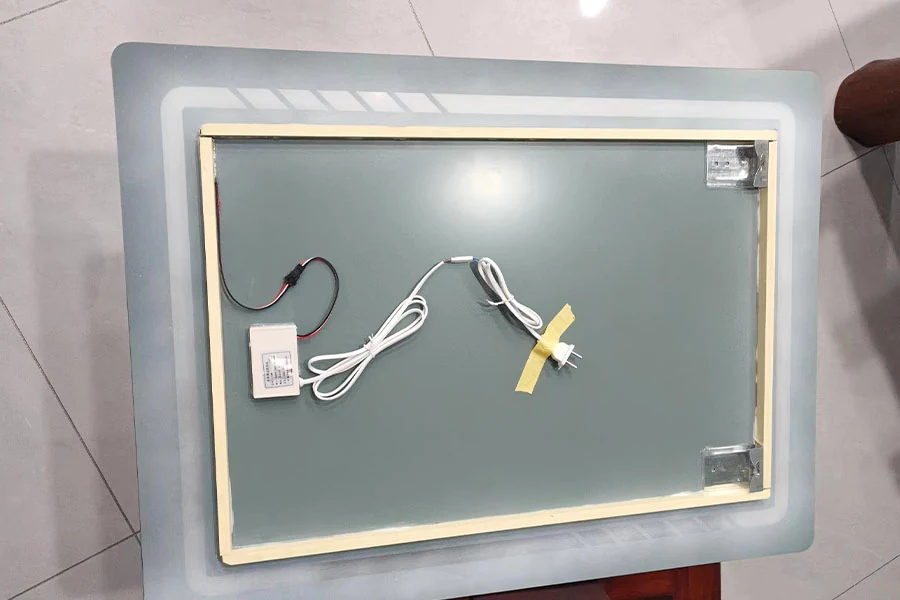
Electrical component: UL-listed driver and plug
Product bulk unit price: US$52.79
Wood crate and domestic transport: US$410
Visible total: US$3,577.4
Important: A UL-listed component does not mean the finished mirror has UL certification. The driver may have a UL mark, but the complete product needs its own evaluation
led mirror quotation demonstration
What Was Included in Historical Quote B?
Quote B covered the same visible size and quantity at a product price of US$63.27 per unit, but it used a different lighting and structural configuration.
Quantity: 60 pieces
Size: 80 × 100 cm
Mirror: 5 mm copper-free silver mirror
Lighting: front and back light
Functions: three CCT settings, defogger, time, temperature, and touch control
Aluminum light channel
UL power supply stated in the quote
Double hangers
Reinforced packing
Carton: 86 × 106 × 10 cm
Net weight: 12 kg
Gross weight: 15 kg
Product bulk unit price: US$63.27
Domestic transport: US$273.59
Visible total: US$4069.79
Why Can’t You Compare US$52.79 with US$63.27 as Like-for-Like Prices?
The US$10.48 unit-price gap cannot be assigned to one feature because the quotations do not share a frozen BOM or a fully stated commercial basis.
Quote B is about 19.8% higher on unit price. But Quote B includes front and back lighting, aluminum light channels, double hangers, and reinforced packing. Quote A lists LED density, power, voltage, and safety film, but Quote B does not show all the same fields.
Neither quote has a complete, unified Incoterm. The Additional costs have different names and different scopes. Neither number is the landed cost at the destination.
To compare two quotes properly, you need:
Same drawing
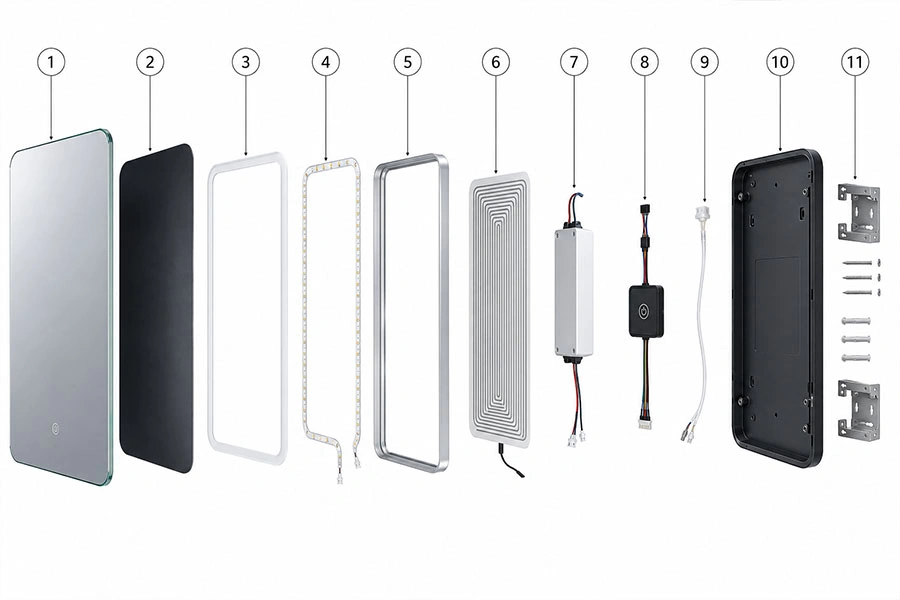
Same BOM
Same packaging
Same Incoterm
Same destination
Same quote validity period
Need help checking whether two LED mirror quotations use the same BOM? Send us the specifications for a line-by-line review.
light led mirror bom components exploded view
Which Compliance and Safety Details Should Be Included?
State the destination market, installation area and required documents, then ask the supplier to confirm them for the selected SKU.
How Should You State Electrical and Market Requirements?
Provide the destination country, input voltage, wiring method and project-specific approval requirements.
Include these in every RFQ:
Destination country
Voltage and frequency (e.g., 120V/60Hz or 230V/50Hz)
Plug-in or hardwired installation
Bathroom zone or dry-area installation
Required certification: full product certification, component file, test report, or supplier declaration
Label and manual language
Do not write “CE/UL required” as a blanket statement. Specify whether you need the full product certified, just components with test reports, or a supplier declaration of conformity.
OSHA NRTL Program – explains recognized testing labs for the US market
EU CE Marking – official EU requirements for product marking
What Do IP Ratings and Test Reports Actually Prove?
An IP rating describes protection against access, dust and water under stated test conditions; it does not prove every form of bathroom safety or corrosion resistance.
When a supplier gives you an IP rating or test report, ask for:
Product or component tested
Test method used
Rating or result
Report issuer
Model coverage
Report date
Numbers like salt spray hours, LED life, CRI, and IP ratings mean nothing without the test object and conditions. An IP44 rating on a driver is not the same as an IP44 rating on the assembled mirror.
IEC IP Ratings – international standard for enclosure protection
For e-commerce shipments, consider ISTA testing. The ISTA 6-Amazon.com SIOC test checks whether a product can survive Amazon’s distribution system without an outer box
led mirror fcl lcl ecommerce packaging
How Should a Supplier Return a Quote You Can Compare?
Require every supplier to use the same response table and disclose offered specifications, assumptions, exclusions and alternatives.
Which Columns Should the Supplier Response Table Include?
The response table should place your requirement beside the supplier’s offered specification and price impact.
Field
Your requirement
Supplier offer
Deviation
Price impact
Evidence
Mirror thickness
5 mm
5 mm copper-free silver
None
Included
Data sheet
CCT
4000K
4000K ± 300K
Within tolerance
None
Test report
Defogger
Yes, full mirror
Yes, 60% coverage
Deviation
-US$2.50
Drawing
The quote summary must also show:
Model and BOM version
MOQ
Unit price
Tooling or setup cost
Sample price
Packing cost
CBM
Incoterm
Quote currency
Quote validity
Payment terms
Assumptions
Exclusions
Alternatives
How Can You Send a Quote-Ready RFQ to Shein Mirror?
Send the product type, size, quantity, market, destination and available drawings first; mark undecided specifications as TBD.
Follow these six steps:
Select the light up LED mirror product family (bathroom, vanity, framed, or custom)
List each size and quantity separately by model
Upload a drawing, reference image, or specification sheet
State the destination market and electrical requirements
Select the packing route and requested Incoterm
Add the sample and delivery schedule
After you submit, Shein Mirror completes:
Requirement review
Missing-field list
BOM recommendation
Drawing or engineering clarification
Itemized quotation
The quotation time is confirmed after the required specifications and attachments are reviewed.
FAQ
Can I request a quote if I only have a reference image?
Yes, but you will get a budget estimate, not a final price. The supplier must list every assumption they make about size, materials, and functions. To turn that estimate into a firm quote, you need to provide dimensions, quantity, destination, and basic electrical requirements. A drawing or confirmed spec sheet is required for production.
Should mixed sizes be quoted as one total quantity?
No. Each size and model needs its own quantity. Different sizes use different glass cuts, carton sizes, and LED strip lengths. Mixing sizes changes material yield, packing efficiency, CBM, and production scheduling. Always break down the total quantity by model and size before asking for a price.
Why is a sample unit more expensive than the mass-production unit?
Sample costs include one-time setup, drawing review, custom parts, special packaging, and single-unit shipping. The supplier may also charge for engineering time and small-batch material ordering. Ask the supplier to separate sample fee, tooling cost, and any refundable conditions. Sample pricing is not the same as mass-production pricing.
Conclusion
An accurate LED Light Up Mirror quote comes from a complete set of specifications, not from the lowest surface price. Four things control the final number: the drawing, the BOM, the packaging, and the commercial basis. Get these four right before you compare any quotes.
Submit your dimensions, quantities, market, and available drawings. Shein Mirror reviews the requirements, and prepares an itemized quote based on your actual project needs.
From Shein Mirror. I am a LED Mirrors Expert in this field for more than 15 years. We offer competitive mirrors from China. Customize your illuminated mirrors solution now!
Have questions? Reach out to us, Customize your illuminated mirrors solution!
 跳到内容
跳到内容