跳到内容
跳到内容 
Custom LED bathroom mirrors for residential projects are not a size-and-quantity order. Residential developers and contractors must confirm mirror glass type, thickness, front appearance, rear structure, lighting design, control method, anti-fog coverage, and electrical requirements before a factory can quote accurately or produce consistently.
This guide uses a Mexico apartment project with 5,000 units to show how that process works in practice. This articels will also provide more detailed procurement plans for buyers with apartment and villa projects. Read Customization Residential LED Illuminated Mirror Solutions
A Real 5,000 Pieces Mexican Apartment LED Mirror Project
A Mexican fit-out contractor approached Shein Mirror. When they sourcing bathroom LED mirrors for a residential developer’s 5,000-apartment project. The contractor had its own installation team. They needed budget-friendly mirrors that still met basic residential requirements: anti-fog, three-color lighting, and touch control, back panel. The factory was asked Shein Mirror Manufacturer to recommend suitable models and provide comparable quotations.
What LED Light Mirror Specifications Did the Project Require?
The buyer needed a simple 600 × 800 mm backlit mirror that kept the main bathroom functions without pushing the price too high. Of course, there are some other requirements.
| Specification | Project Requirement |
|---|---|
| Mirror size | 60 × 80 cm |
| Position | Vertical rectangle |
| Lighting design | Backlit |
| Light setting | Three selectable diammable light colors |
| Anti-fog function | Need defogging function |
| Control | Touch switch |
| Front appearance | Frameless, with no visible aluminum frame |
| Rear structure | Protective PVC backing or support |
| Light output | Bright light requested |
| Packing | One mirror per inner box; five inner boxes per outer carton |
“Frameless” described the front view. The PVC support sat behind the glass.

How Did the Buyer Balance Function and Cost?
The contractor kept anti-fog, three-color lighting, touch switch, backlit structure, and PVC rear support. Bluetooth was considered and removed to control cost. For mirror glass, the project used 4 mm aluminum-coated mirror glass instead of the more expensive copper-free silver option. This was a project-specific budget decision, not a universal recommendation. One clarification matters here: three-color lighting changes color temperature. It is not the same as dimmable lighting, which changes brightness.
Aluminum-coated mirror glass typically reflects 80–88% of light at 15–30% lower cost than silver mirror. For a budget apartment project, aluminum-coated glass with proper edge sealing can work. For villas or high-end units, copper-free silver glass is the more.
Ultimately, we offered the lowest possible price: USD 7.20 per mirror (EXW cost). A total of 5000 pieces were ordered, for a total price of USD 36,000.

What Did the Buyer Ask to See Before Choosing?
The contractor asked for enough detail to match each price with a real product and packing method.
Each quoted option had to show a photo, model, size, specification, and price. The buyer also asked for front and rear photos plus a packing video.
After comparing the options, the contractor selected two designs. The same process applies to apartment buildings, villas, townhouses, and other residential developments.
This success cases proves:Shein Mirror can supply LED mirrors with anti-fog pads, dimmable lighting, and sensor switches for a residential development projects.
What Should a Residential LED Mirror Schedule Include?
A mirror schedule should link every mirror model to a room type, quantity, drawing, and required delivery date.
How Should You Group Mirrors by Apartment or Villa Type?
Give each mirror type its own model code, even when several models share the same front design.
One development may include apartments, villas, townhouses, and several unit plans. One home may also need more than one mirror. A useful schedule should list:
- Project country and property type
- Unit or villa type
- Bathroom location
- Mirror model code
- Width, height, and mounting direction
- Quantity for each model
- Main functions
- Planned delivery or installation date
This helps the supplier quote by model and the site team sort each delivery.
| Model | Use Area | Size | Quantity | Main Functions |
|---|---|---|---|---|
| M01 | Type A main bathroom | 600 × 800 mm | 500 | Anti-fog, three-color light, touch |
| M02 | Type B bathroom | 700 × 900 mm | 300 | Anti-fog, dimming, sensor |
| M03 | Villa guest bathroom | 800 × 1000 mm | 120 | Backlit, touch, memory |
What Drawings and Dates Should You Send?
Send the information you already have, but do not approve bulk production until the final drawing and written specification match.
The first quote can start with a bathroom elevation, floor plan, reference photo, or size list. Add the mounting direction, shape, quantity, country, voltage, and target date.
Before production, confirm:
- Final width and height
- Edge shape and corner radius
- Front lighting pattern
- Rear structure and hanging points
- Cable outlet position
- Control type
- Anti-fog area
- Drawing revision number
A model code stops a change from being applied to the wrong bathroom.
Which Custom Features Matter Most for Apartment and Villa Projects?
The main price and use decisions are the mirror glass, structure, lighting, controls, and anti-fog setup.
The current custom features includes size and shape changes, anti-fog, adjustable light, touch or sensor control, bluetooth, time and weather display, and built-in TV options. Each combination still needs model and project review. Click Here See More Custom LED Mirror Function Details.
Which Mirror Glass, Thickness, and Rear Structure Should You Choose?
Choose the glass and structure as one system, not as separate labels on a quote.
“Aluminum-coated mirror glass” and “copper-free silver mirror glass” describe the reflective glass, not the frame. Name the material in each quote. Aluminum mirrors are much cheaper than copper-free mirrors.
If no thickness is set, 4 mm can be an initial quote basis. Large sizes or special structures still need review. The factory’s quality-control page lists 3 mm, 4 mm, and 5 mm options.
Also confirm the front frame, rear support, hanging points, driver space, cable outlet, and wall clearance. Ask for front and rear photos, since the front view does not show how the mirror will hang or connect.
Read Related Article: Copper-Free Mirrors for Bathroom Guide, You will know more about copper-free led mirrors details.

Which Lighting Setup Should You Specify?
State the light layout, color setting, brightness control, and intended use as four separate items.
A backlit mirror sends light toward the wall. A front-lit mirror sends more light toward the user. A dual-lit mirror combines both. Choose by whether the project needs wall glow, face lighting, or both.
Light settings also need clear names:
- Single-color light: one fixed color setting
- Three-color light: the user changes between three color settings
- Dimmable light: the user changes brightness
- Three-color plus dimming: both functions are included, if the model supports them
Do not write only “bright light required.” State whether the mirror must light the face, the wall, or both. Ask for a sample, video, or measured data. Buyers may also ask how the data relates to methods from the illuminating Engineering Society.
An acrylic diffuser can reduce visible LED dots and smooth the light line. It does not by itself prove a higher water-protection rating.
Which Switch and Memory Setup Should You Choose?
Choose the control by how residents should use the mirror, not by the word “smart.”
A touch switch sensor gives manual control. A hand-wave sensor offers no-touch use. A radar or motion sensor may work when a person enters its range.
Confirm the position, sensing range, on/off action, dimming, color change, anti-fog control, auto-off time, and wall-switch behavior. “Memory function” must also say whether it saves the last color, brightness, or both after power is cut.
How Should You Specify the Anti-Fog Function?
Give the anti-fog pad a size, position, and control method instead of writing only “anti-fog required.”
The heated area should cover the part residents use most. Two mirrors with the same outer size may have different pad sizes. Show the pad size and location on the quote or drawing. Confirm its switch, link to the light, timer, sensor use, and power rating. These points can then be tested on the sample. If the heating area is not specified, it will be based on standard dimensions. The central heating area will be approximately 60% of the entire mirror surface.

Which Extra Options Need Only a Short Review?
Bluetooth, built-in TV, and special displays should be treated as priced add-ons, not default functions.
Bluetooth may suit a premium apartment or villa, but it adds cost and parts. A built-in TV mirror needs a screen size, position, input method, control plan, and service plan. Time, temperature, logos, and special etching can also be priced. Put each option on its own line so the buyer can remove what is not needed.
Which IP Rating and Electrical Details Should You Check?
Use the rating and wiring rules that match the exact model, bathroom location, and destination market.
An IP code has two digits: the first covers solid objects and the second covers water. The IEC IP rating guide explains the system. Ask for documents tied to the quoted model rather than asking for the highest number by default.
The project brief should also state:
- Country and input voltage
- Frequency
- Hardwired or plug-in connection
- Cable exit point
- Driver position
- Wall-switch use
- External dimmer use, if any
- Required product documents and labels
For a U.S. project, the installer should also check the current NFPA 70 National Electrical Code, local rules, and the approved product documents. Other markets should use their own national and local rules.
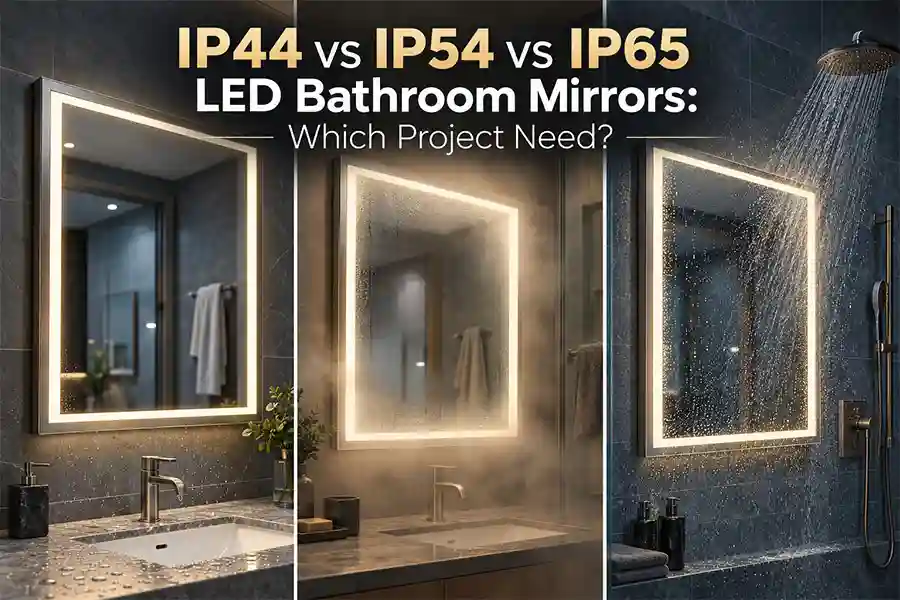
Read Related Article: IP44 vs IP54 vs IP65 LED Bathroom Mirrors, Learn More IP Rating Details.
How Should You Compare Quotes and Approve the Order?
Compare suppliers on the same written specification, then use one approved sample and drawing as the bulk-order reference.
What Should Every Project Quote Show?
Each price should sit next to the exact photo, material, function set, packing plan, and quantity it covers.
Ask each option to show:
- Product photo and model code
- Width, height, and orientation
- Mirror glass and thickness
- Front and rear structure
- Backlit, front-lit, or dual-lit layout
- Light color and dimming
- Touch or sensor control
- Memory setting
- Anti-fog pad
- Voltage and wiring
- Packing method
- Order quantity and unit price
- Price for each optional feature
A low price may use different glass, a smaller pad, simpler support, or basic packing. Compare prices only after the specifications match.
What Should You Check on the Sample?
Test the sample as a resident and inspect it as a contractor.
Check the size, shape, edge, reflection, light line, PVC support, hanging parts, driver, cable, labels, and outlet position. Then operate every confirmed function:
- Light on and off
- Color change
- Brightness change
- Touch or sensor response
- Memory after power loss
- Anti-fog coverage and control
Record all changes in the drawing. Add a model code and revision number. The sample, drawing, and specification must match.
How Should You Confirm Packing and Bulk-Order Identification?
Approve the packing plan before production and give each model a code that site staff can read.
The Mexico buyer asked for one mirror in each inner box and five inner boxes in one outer carton, plus a packing video. Other jobs may need a different count due to size, weight, route, or unloading.
Confirm foam, corner guards, accessories, inner boxes, and outer cartons. Buyers can also review International Safe Transit Association test procedures and agree on a test plan for the shipment route.
The carton label may include:
- Project name
- Model code
- Mirror size
- Unit type
- Building or phase
- Carton quantity
If the job needs phased delivery, list each phase, model, quantity, and required arrival date in the order file.

Who Can Supply Custom LED Mirrors for a Residential Development?
Shein Mirror can provide project-based LED bathroom mirror options for residential developers and contractors, subject to model, budget, electrical, and sample confirmation.
The available product range includes LED bathroom mirrors and backlit mirror options. Custom choices can cover size, shape, lighting, anti-fog, touch or sensor control, rear structure, Bluetooth, and built-in TV. Not every function should be added to every model. The project team should first set the must-have features and then price the add-ons.
To start a useful review, send:
- Project country and property type
- Drawings or reference photos
- Mirror sizes and quantities
- Required light and control setup
- Anti-fog needs
- Voltage and wiring
- Packing request
- Target delivery date
- Budget range, if available
What Do Developers and Contractors Ask About Custom LED Mirrors?
Q1: Is Three-Color Lighting the Same as Dimmable Lighting?
A: No. Three-color lighting changes the color setting, while dimming changes the light intensity level. Three-color lighting changes the color temperature between warm white, neutral white, and cool white. Dimmable lighting changes the brightness level at a fixed color temperature. When both are needed, write them as two items in the quote and sample checklist. This prevents a three-color switch from being mistaken for a brightness control.
Q2: Can a Frameless LED Mirror Still Have a PVC Back Panel?
A: Yes. A frameless front and a PVC rear support describe two different parts of the mirror. Frameless describes the front appearance of the mirror: no visible aluminum frame. PVC back panel describes the rear structure: a protective backing that supports the mirror body and wiring.
Q3: Should We Use Aluminum-Coated or Copper-Free Silver Mirror Glass?
A: Both can be quoted, but the choice should follow the project budget, product data, bathroom conditions, and approved sample. Aluminum-coated mirror glass helped meet the budget in the Mexico case. Another project may choose copper-free silver mirror glass. Ask the supplier to name the material and thickness on each quote instead of using a general term such as “silver mirror.”
Q4: Which Switch Is Better for an Apartment Project?
A: There is no single best switch for every apartment project. Touch control is simple and clear. A hand-wave sensor offers no-touch use. A radar or motion sensor may support automatic control, but its range and position need testing. Compare resident habits, bathroom layout, false-trigger risk, control logic, price, and the way the switch works with light and anti-fog.
Q5: Do Apartment and Villa Projects Need Bluetooth or Built-In TV Mirrors?
A: Not necessarily. Most projects should first settle the mirror size, lighting, controls, anti-fog, structure, and electrical plan. Bluetooth and built-in TV are optional. They may suit premium apartments, main bathrooms, or villas, but they add cost and more service points. Price them on separate lines. The Mexico contractor removed Bluetooth because it did not fit the final budget.
Conclusion
Custom LED mirrors for residential projects require early decisions on glass type, lighting design, controls, anti-fog coverage, and packaging. A clear mirror schedule and a comparable quotation make the process faster for both contractor and factory.
Share your project country, mirror sizes, quantities, and required functions. Shein Mirror Factory supply LED mirror solutions and a project quotation for your apartment, villa, or townhouse development. Contact Shein Mirror.
Read Related Article:
- How to Customize LED Mirrors for Residential Projects
- How to Choose a Private-Label LED Mirror Manufacturer?
- Hotel Bathroom Mirror with TV: 15 Specifications
- How Bathroom Furniture Manufacturers Choose LED Bath Mirror
- Glass Factory: How Build Own High-Quality LED Mirror Brand?
- Commercial LED Bathroom Mirrors: 2026 Sourcing Guide
- How to Choose Anti-Fog Bathroom Mirrors for Hotels?