跳到内容
跳到内容 
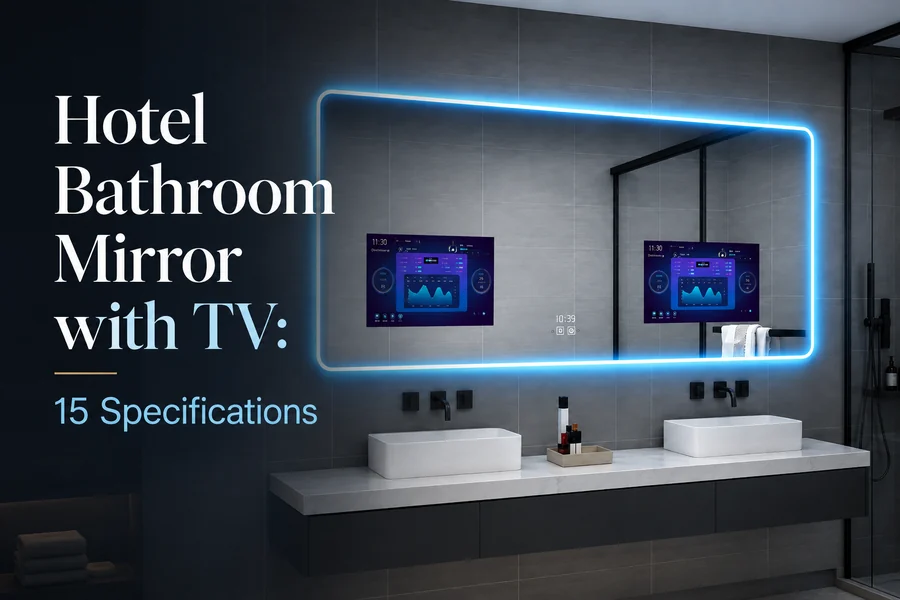
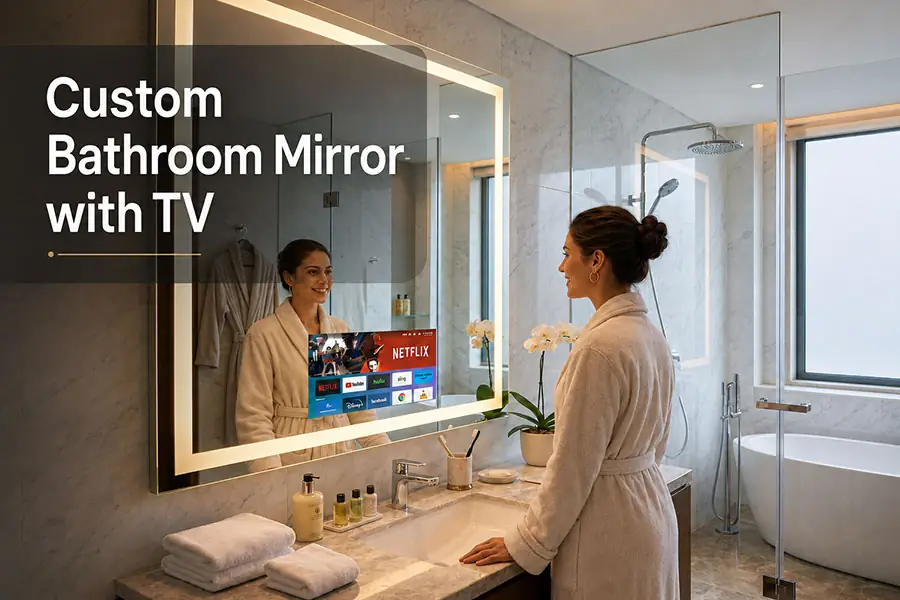
A hotel bathroom mirror with TV combines a bathroom mirror with a display installed behind part of the mirror glass. Guests can use it as a normal mirror when the screen is off. When the screen is on, they can watch TV or view hotel content.
A hotel project needs more than a mirror size and an order quantity. The hotel must also plan the screen, LED lighting, controls, TV signal, power, wall, service access, and packaging.
This guide covers 15 specifications that hotel owners, developers, designers, and purchasing teams should check before requesting a quote.
What Is a Hotel Bathroom Mirror with TV?
A hotel bathroom mirror with TV is a mirror, display, and LED system made as one product for a hotel guest room or suite.
The display sits behind a selected area of the mirror glass. Only that area shows video. The rest of the glass stays available for shaving, skincare, and other daily use.
When the screen is off, it becomes less visible. The final off-screen look depends on the glass, display, room light, and viewing angle. Buyers should ask for real photos instead of accepting a claim that the screen is fully invisible.
A hotel TV mirror may also include:
- Front LED lighting
- Backlighting
- Dimming
- Color temperature control
- Anti-fog
- Touch keys
- Remote control
- HDMI
- Wi-Fi
- Screen casting
- Built-in speakers
These functions must be planned as one system. The screen, LEDs, touch keys, anti-fog pad, and mounting parts cannot use the same space behind the glass.
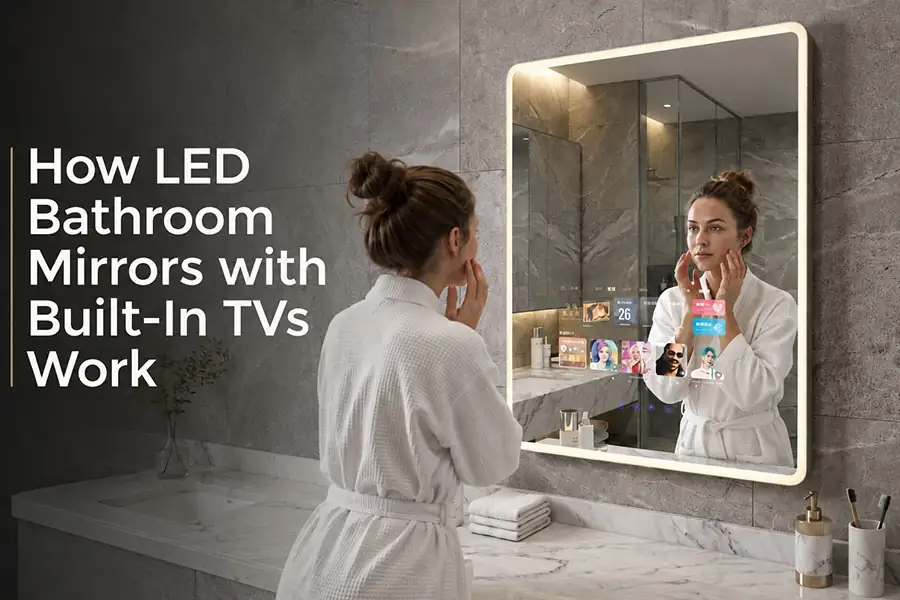
Read More About: how TV mirrors work in bathrooms.
How Is a Hotel TV Mirror Different from a Home TV Mirror?
A hotel TV mirror must be easy to repeat, install, use, and service across many rooms.
A home owner may buy one mirror for one bathroom. A hotel may need the same model for 50, 100, or 300 rooms. Each unit must match the approved drawing and sample.
Hotel guests also change every day. They should not need a long guide to turn on the light, change the TV channel, or adjust the volume.
| Project point | Home TV mirror | Hotel TV mirror |
|---|---|---|
| Order size | One or a few units | Many rooms or room types |
| Main user | One family | Many hotel guests |
| Controls | Can be personal | Should be simple |
| Drawing | Product drawing | Room and installation drawing |
| Approval | Owner approval | Sample-room approval |
| Packaging | Single-unit shipping | Model, room, or batch labels |
| Service | Home repair | Hotel maintenance plan |
The term “hotel grade” is not a single test or certificate. Buyers must check the real product specification, test records, installation plan, and service method.
Send Your Hotel Bathroom Mirror with Tv Built-in Project

Who Should Help Specify a Hotel TV Mirror?
The hotel owner, designer, FF&E team, MEP engineer, purchasing team, and installer should each confirm part of the specification.
FF&E means Furniture, Fixtures, and Equipment. MEP means Mechanical, Electrical, and Plumbing. Both teams affect how the mirror is selected and installed.
| Project member | Main responsibility |
| Hotel owner or developer | Budget, room level, guest needs |
| Interior designer | Mirror size, shape, lighting, screen position |
| FF&E consultant | Product specification, room schedule, sample |
| MEP engineer | Power, signal cables, wall space, ventilation |
| Purchasing team | Quantity, price, lead time, packaging |
| Installer | Brackets, wall opening, cable access |
| Hotel operations | Controls, maintenance, spare parts |
The purchasing team should collect these requirements before sending an RFQ. An RFQ is a Request for Quotation.
Hotel technology teams can also review [AHLA’s Hospitality Technology Next Generation resources] when planning connected guest-room systems.
What 15 Specifications Must Hotel Buyers Put in the RFQ?
A hotel TV mirror RFQ should define 15 specifications covering the room, mirror, display, lighting, controls, electrical system, installation, service, and delivery.
If buyers send only the mirror size and quantity, supplier quotes may not describe the same product. One quote may include a smart TV system and dual lighting. Another may include a basic display and one LED strip.
Use the following list as the base of the RFQ:
| No. | Specification | What the buyer should provide |
| 1 | Room type and quantity | Number of each room type |
| 2 | Mirror size and shape | Width, height, shape, clear area |
| 3 | Screen size and position | Screen size, eye line, viewing point |
| 4 | Mirror glass | Expected off-screen appearance |
| 5 | LED layout | Front-lit, backlit, or both |
| 6 | Light control | CCT, CRI, dimming, memory |
| 7 | Anti-fog | Pad size and position |
| 8 | Guest controls and audio | Touch, remote, speakers |
| 9 | TV system | Country, language, apps |
| 10 | Hotel content source | IPTV, coax, HDMI, set-top box |
| 11 | Media connections | HDMI, Wi-Fi, casting |
| 12 | Electrical system | Voltage, power, cable position |
| 13 | Installation | Wall-mounted or recessed |
| 14 | Service and test documents | Access, ratings, reports |
| 15 | Project delivery | Sample, inspection, labels, packing |
Which Room, Mirror, and Screen Specifications Come First?
Start with the room type and quantity, mirror dimensions, and TV screen size and position.
1. What room types and quantities are needed?
A hotel may have standard rooms, suites, villas, and accessible rooms. These rooms may use different vanities and wall sizes.
The room schedule should state:
- Room type
- Quantity per room type
- Mirror model
- Required delivery batch
- Spare quantity
Do not group all mirrors under one total quantity if the sizes or functions differ.

2. What are the mirror dimensions and shape?
Provide the finished width and height. Also state the shape, frame, edge finish, and maximum product depth.
The drawing should show:
- Vanity width
- Basin position
- Faucet height
- Countertop-to-mirror distance
- Nearby cabinets
- Wall lights
- Switches
- Doors
The clear mirror area also matters. A large display placed at face level may block the main grooming area.
3. What screen size and position are required?
The best screen size depends on the viewing distance and room use. A screen viewed from a bathtub may need a different position from one viewed at the basin.
Confirm:
- Screen diagonal size
- Visible picture area
- Full screen body
- Left, center, or right position
- Screen center height
- Viewing distance
- Viewing angle
Ask for a front-view drawing before approving the layout.
For More Options, See Custom Bahroom Mirror with TV sizes, lighting, and features.
Which Glass and LED Lighting Specifications Must Be Defined?
The RFQ must state the expected off-screen appearance, LED layout, and measurable light requirements.
4. How should the screen look when it is off?
A TV mirror uses coated glass that reflects the user while allowing screen light to pass through. The off-screen result changes with the room light and viewing angle.
Ask the supplier for three photos taken from the same position:
- TV off and LED off
- TV off and LED on
- TV on and LED on
The display outline may be easier to see under strong ceiling light or sunlight. A real sample gives better proof than a computer image.
5. Should the mirror be front-lit, backlit, or both?
Front light sends more light toward the user. It can help with shaving and skincare.
Backlight sends light toward the wall. It creates a soft border around the mirror. It may not replace the main bathroom light.
A combined design offers both types. It also needs more LEDs, wiring, drivers, and controls.
The RFQ should state whether the two light zones work together or on separate controls.
6. What CCT, CRI, and dimming controls are required?
CCT means Correlated Color Temperature. It describes whether the light looks warm, neutral, or cool.
CRI means Color Rendering Index. It helps describe how a light source shows colors. Buyers should request the real tested value instead of judging it from a photo.
Confirm:
- CCT range
- CRI
- Dimming range
- Touch or wall control
- Light memory
- Separate front and back controls
Do not write exact values in the project document until the supplier confirms them.
The [CIE method for measuring colour rendering] explains how the colour rendering of a light source is assessed.

Which Anti-Fog, Guest Control, and TV System Specifications Matter?
Buyers must define the anti-fog area, guest control method, and TV system for the destination country.
7. How large should the anti-fog area be?
An anti-fog pad warms one part of the mirror. It helps that area clear faster after a hot shower.
The pad does not always cover the full mirror. Its width, height, and position should appear on the drawing.
Keep the pad away from the screen, touch panel, and mounting parts. The control method should also be clear. It may work with the light or use a separate key.
8. How will guests control the mirror, TV, and sound?
Hotel controls should be simple and easy to replace.
Possible controls include:
- Mirror touch keys
- TV remote
- Wall switch
- Hotel room control system
- Volume control
- Separate anti-fog key
The hotel should decide which controls guests can use. It should also plan for lost or damaged remotes.
Speaker position affects sound and the rear housing. Test the audio in the sample room before approving it.
luetooth functions should be checked against the selected hardware and the [Bluetooth SIG technology overview]
9. Which TV system, language, and apps are needed?
The TV system must suit the project country and content source.
Confirm:
- Operating system
- Menu language
- Supported apps
- Local TV format
- Remote layout
- Software update method
- Target country
An app that works in the United States may not be offered in another country. Do not assume that every app works on every TV module.
Which IPTV, Connectivity, and Electrical Specifications Must Be Confirmed?
The hotel must confirm its content source, media connections, and electrical requirements before the wall is closed.
10. What is the hotel’s TV content source?
The hotel may use:
- Hotel IPTV
- Coaxial television signal
- HDMI media box
- Set-top box
- Local TV tuner
- Streaming device
- Hotel content server
IPTV means Internet Protocol Television. It sends television content through an IP network.
The mirror supplier needs to know how the content reaches the display. The hotel IT or AV team should provide the system name, output connection, and control needs.
A “smart TV” label does not prove that the screen will work with a hotel IPTV system.
11. Which HDMI, Wi-Fi, and casting options are required?
HDMI can connect a set-top box, media player, or other video source. The hotel must plan the cable route and the location of the external device.
Wi-Fi may support apps, software updates, or casting. The hotel should check signal strength in the bathroom.
Guest casting needs extra review. Confirm:
- Supported phones
- Pairing method
- Room-to-room isolation
- Guest logout
- Pairing reset after checkout
- Hotel network rules
A casting system should not send content to a screen in another guest room.
12. What voltage, power, and cable positions are required?
Provide the destination voltage and frequency. State whether the product uses a plug, fixed wiring, or another approved connection.
The technical drawing should show:
- Power input
- Cable exit
- HDMI route
- Network or coax connection
- Grounding point
- Media-box location
A qualified local electrician should check the final plan. Bathroom electrical rules vary by country and installation zone.
For projects in the United States, electrical work should also follow [NFPA 70, the National Electrical Code]. Other countries use their own electrical rules.

Which Installation, Service, and Delivery Specifications Complete the RFQ?
The final RFQ specifications should cover mounting, service access, sample approval, batch inspection, and delivery.
13. Will the mirror be wall-mounted or recessed?
A wall-mounted mirror sits on the finished wall. It may need less wall work, but its depth can be more visible from the side.
A recessed mirror places part of the rear housing inside a wall opening. It can look flatter, but the opening must match the approved drawing.
Confirm:
- Product depth
- Wall opening
- Bracket position
- Cable space
- Ventilation space
- Removal direction
Do not cut the wall from an estimated size.
14. How will the hotel reach service parts?
The hotel should be able to reach the display, LED driver, power parts, and media connections without breaking finished tile.
Service access may come from:
- A removable mirror
- A removable rear panel
- Reachable cable connections
- A planned wall opening
- Spare cable length
Any IP rating or electrical claim must match the ordered product. IEC 60529 explains the IP Code, but the standard itself is not a product certificate.
15. How will the sample, batch, and delivery be managed?
The project plan should include:
- Sample-room unit
- Approved drawing
- Approved specification
- Accepted change list
- Batch inspection
- Product labels
- Room-type labels
- Delivery batches
- Export packaging
- Spare remotes
- Replacement units
Hotel packaging should identify each model. This reduces mistakes when several mirror sizes arrive at the same site.
Send Your Hotel Bathroom Mirror with Tv Built-in Project

How Should Different Hotel Room Types Be Configured?
Each room type may need its own mirror size, screen position, and control plan.
A single hotel may use one design language but several product drawings. Use a room matrix to keep the models clear.
| Room type | Main viewing point | Mirror priority | TV priority |
| Standard room | Vanity | Clear face area | Simple screen and controls |
| Suite | Vanity and bathtub | Larger mirror | Longer viewing distance |
| Villa | Several positions | Custom design | More media options |
| Accessible room | Project-defined | Reach and eye line | Local access rules |
What Works for a Standard Hotel Room?
A standard room should use a simple TV mirror configuration that can be repeated across many rooms.
Keep a clear mirror area near face level. Place the display where it can be seen without blocking daily grooming.
Simple controls can reduce guest questions. A clear remote, common menu language, and easy light control may be more useful than many smart functions.
The same model should use the same drawing, label, accessories, and package.
What Works for a Suite or Luxury Hotel Bathroom?
A suite may use a larger mirror, a flexible screen position, and separate task and mood lighting.
A suite may include a double vanity, bathtub, or larger viewing distance. The screen can sit on one side while the center stays clear.
Possible options include:
- Larger mirror glass
- Medium or larger display
- Front and back LED lighting
- Separate light controls
- Custom frame
- Built-in audio
- Remote operation from the bathtub
Do not claim that a TV mirror will raise the room rate unless the hotel has real data.
How Should Accessible or Special Rooms Be Handled?
Accessible and special room types should be reviewed with the hotel designer and local access rules before approval.
Check the eye line, control height, vanity clearance, reach range, and viewing angle.
Do not copy the standard-room drawing without review. Local access laws and hotel design rules may require another mirror height or control position.
The final dimensions should come from the project architect or access consultant.
How Should Hotel IPTV, Casting, and Guest Controls Be Planned?
The TV mirror must match the hotel’s real content source, network, and guest-control plan.
The words “smart TV” do not explain how the screen will receive hotel channels or how guests will connect their devices.
How Will the Mirror Receive Hotel TV Content?
The mirror may receive content from hotel IPTV, a set-top box, HDMI, coaxial signal, or a supported streaming system.
Use this table during the system review:
| Content source | Possible connection | What to confirm |
| Hotel IPTV | Network or set-top box | System output and control |
| Set-top box | HDMI | Box location and cable route |
| Coax signal | TV tuner | Local format and channel control |
| Streaming device | HDMI and Wi-Fi | Power, network, and remote |
| Guest casting | Hotel network | Pairing and room isolation |
The hotel IT or AV team should join the review. A mirror factory can provide display inputs, but it cannot guess the hotel’s IPTV design.
How Should Guest Casting and Privacy Be Managed?
Guest casting should connect to the correct room, clear the connection after checkout, and keep other rooms separate.
The hotel should test the full process:
- Connect a guest phone.
- Select the correct room screen.
- Play video and sound.
- End the session.
- Clear the paired device.
- Confirm that the next guest cannot access the old session.
Casting support depends on the TV module, phone, software, and hotel network. State these limits in the approved specification.
Hotel IT teams should also check app login, account reset, software updates, and network access.
Which Controls and Audio Options Are Best for Guests?
Guest controls should be simple, clearly marked, and easy for hotel staff to replace.
A touch panel can control the mirror light and anti-fog pad. A remote can control the television and sound.
If the hotel uses a room control system, confirm the control method and protocol before production.
Built-in speakers save wall space, but their position can affect sound. Check volume, voice clarity, and vibration in the sample room.
Keep spare remotes in the hotel maintenance plan. Record the remote model in the product file.
What Must the FF&E and MEP Teams Plan Before Installation?
The FF&E and MEP teams must confirm the wall, product depth, power, signal cables, mounting, and service access before bathroom finishes are complete.
A late change can affect tile work, wall openings, wiring, and the bathroom vanity.
Should the Mirror Be Wall-Mounted or Recessed?
Wall mounting needs less wall preparation, while recessed mounting needs an accurate opening and depth.
A wall-mounted model attaches to brackets on the finished wall. The installer needs the product weight, bracket position, and cable area.
A recessed model needs a wall pocket. The drawing should state the width, height, and depth of the opening.
Both methods need a safe removal path. The installer should be able to lift or release the mirror without hitting the faucet, ceiling, or side cabinets.
Where Should Power, Signal Cables, and Ventilation Go?
Power and signal points should sit inside the approved connection area and remain reachable after installation.
The MEP drawing should show:
- Power point
- Voltage and frequency
- HDMI cable
- IPTV, coax, or network cable
- Media-box location
- Cable exit direction
- Ventilation area
Do not place a power point behind a bracket. Do not trap a media box inside a sealed space if it may need service.
Complete this review before tiling or closing the wall.
Why Must the Hotel Plan Service Access?
Service access lets a technician reach the display, LED driver, power parts, and media connections without breaking the bathroom wall.
A screen or power part may need inspection during the life of the hotel. The design should allow the mirror to be removed in a planned way.
The hotel should keep:
- Product drawings
- Wiring diagram
- Model numbers
- Remote model
- Spare-parts list
- Installation guide
- Supplier contact details
These files help the maintenance team after the original contractor leaves the project.
Send Your Hotel Bathroom Mirror with Tv Built-in Project
What Should Be Checked in the Hotel Sample Room?
The sample room should test the TV mirror under the same viewing, lighting, control, and installation conditions planned for guest rooms.
A sample on a factory table cannot answer every hotel question. The best review takes place in the real room or a full-size room mock-up.
What Should Be Checked with the TV On and Off?
The sample-room team should check the mirror appearance, screen visibility, and viewing comfort with the TV on and off.
Check the mirror from the basin, bathtub, shower entrance, and bathroom door.
Review:
- Screen outline when off
- Picture visibility when on
- Main viewing angle
- Screen center height
- Clear face area
- Ceiling-light reflections
- View from the guest room
- Mirror edge and frame
Take photos from the same position with the screen on and off.
What Lighting, Control, and Audio Tests Are Needed?
The sample should test every LED setting, touch key, remote function, audio source, and media connection.
Use four lighting states:
- TV off and LED off
- TV off and LED on
- TV on and LED off
- TV on and LED on
Test dimming, CCT, light memory, anti-fog control, remote range, volume, HDMI, Wi-Fi, and casting.
Run the test under normal hotel bathroom light. A dark showroom can hide glare and reflections.
How Should the Sample-Room Approval Be Recorded?
The approved sample should be recorded with a signed drawing, specification, photos, and accepted change list.
For hotel projects, Shein Mirror checks the display position, LED layout and control method against the approved sample-room drawing.
The approval file should include:
- Product model
- Mirror dimensions
- Display position
- Light specification
- Control method
- Connection ports
- Rear housing
- Mounting
- Labels
- Packaging
- Approved changes
The factory and buyer should use the same document during bulk production.
For hotel projects in the European Economic Area, the European Commission explains the rules and manufacturer duties behind [CE marking]
How Should Hotel TV Mirrors Be Tested Before Batch Shipment?
Batch inspection should compare finished TV mirrors with the approved sample, drawing, and project specification.
Testing one early sample does not prove that every finished unit matches it. The project needs a recorded pre-shipment check.

Which Product Functions Should Be Checked?
Inspection should cover the mirror, display, LED lighting, anti-fog pad, controls, media inputs, and audio.
The checklist may include:
- Mirror width and height
- Glass appearance
- Frame finish
- Screen position
- Screen picture
- LED lighting
- Dimming and CCT
- Anti-fog area
- Touch keys
- Remote control
- HDMI input
- Wi-Fi or casting
- Speakers
- Labels
- Accessories
Before shipment, Shein Mirror checks the mirror appearance, screen position, lighting, controls, labels and packaging against the approved specification.
Only publish test times, test values, or pass rates that have real records.
How Should Batch Consistency Be Checked?
Batch checks should compare units for size, screen position, light appearance, controls, and labels.
Compare several units under the same light. Use the approved sample as the reference.
Check that every room type has the correct:
- Product code
- Screen layout
- Light system
- Remote
- Voltage label
- Mounting parts
- Manual
- Accessories
Record any approved change before packing. Do not rely on a message that only one team member can see.
What Packaging and Room Labels Are Needed?
Hotel packaging should protect the glass and identify the model, room type, accessories, and delivery batch.
A project may use several mirror sizes that look similar inside a closed crate. Clear labels help the site team send each mirror to the correct floor and room.
The packaging plan should show:
- Product code
- Room type
- Quantity
- Floor or batch
- Crate dimensions
- Gross weight
- Handling marks
- Accessory list
Check the door, lift, and unloading limits before approving a large crate.
What Affects Hotel TV Mirror Cost and MOQ?
Hotel TV mirror cost depends on the mirror, display, lighting, TV system, structure, quantity, testing, packaging, and destination.
MOQ means Minimum Order Quantity. It can vary by product design, screen supply, custom parts, and packaging.
Which Product Choices Change the Price?
Mirror size, screen specification, glass, LED layout, anti-fog coverage, controls, audio, and rear structure all affect unit cost.
The main price factors are:
- Mirror width, height, and shape
- TV screen size and system
- Mirror glass
- Front or back LED lighting
- CCT, CRI, and dimming
- Anti-fog pad
- Controls and audio
- Mounting structure
- Custom labels and packaging
- Order quantity and destination
Two mirrors with the same front size may have different internal parts and prices.
Why Does a Sample Cost More per Unit?
A sample often costs more per unit because drawing, setup, testing, and custom packaging are spread across fewer pieces.
The sample price should not be multiplied by the full project quantity.
A sample can still reduce project risk. It can find problems with the screen height, lighting, controls, wall depth, or TV connection before bulk production.
For More Sourcing Points, Read Smart LED Bathroom Mirror with TV buying guide.

What Project Details Are Needed to Confirm MOQ and Price?
MOQ and project price require the room schedule, model quantities, target country, packaging, and delivery plan.
Separate the quantities into:
- Sample quantity
- Quantity per room type
- Total project quantity
- Spare quantity
- Quantity per delivery batch
Also state whether all models use the same screen, light system, controls, and frame. Shared parts may affect production planning.
What Should Buyers Send to Request a Hotel Project Quote?
Buyers should send the room schedule, mirror dimensions, TV requirements, drawings, quantity, destination, and project timeline.
A clear RFQ helps the factory review the product and installation before it gives a final quote.
What Should Be Included in the RFQ Package?
A useful RFQ package should contain enough information to review the product, installation, and delivery plan.
Include:
- Hotel type and location
- Room types
- Quantity per room type
- Mirror width and height
- Mirror shape and frame
- Screen size and position
- LED lighting
- Anti-fog area
- TV and IPTV system
- Controls and audio
- Voltage
- Mounting method
- Bathroom drawings
- Sample date
- Bulk delivery date
- Delivery destination
A Bill of Quantities, or BOQ, can list each mirror model and quantity.
What Should the Supplier Return Before the Order?
The supplier should return a clear quotation, drawing, specification, exclusions, and sample plan before the order is confirmed.
The return package should state:
- Product model
- Unit-price basis
- Included functions
- Excluded work
- Screen specification
- Technical drawing
- Sample cost
- Production plan
- Packaging method
- Warranty terms
- Quote validity
Buyers who are still building a supplier shortlist can also review these Smart TV mirror Manufacturers.
Send the room schedule, drawings, quantity, voltage, and destination when requesting a project-based quote.
What Do Hotel Buyers Ask About Bathroom Mirrors with TV?
Hotel buyers often ask about TV integration, IPTV, bathroom safety, custom sizes, sample rooms, and project cost.
Can a TV Be Built into a Hotel Bathroom Mirror?
Yes, a TV display can be installed behind a selected area of hotel bathroom mirror glass.
When the TV is off, the product works mainly as a mirror. When it is on, only the display area shows video. The off-screen look depends on the glass and room light.
Can a Hotel TV Mirror Connect to an IPTV System?
A hotel TV mirror may connect to IPTV when its display inputs match the hotel’s IPTV equipment.
The hotel IT or AV team should provide the IPTV system, set-top box, output port, control method, and network needs before the screen is selected.
Are TV Mirrors Safe for Hotel Bathrooms?
Bathroom safety depends on the ordered product, installation zone, electrical design, and local rules.
Ask for test records that match the ordered model. A local electrician should review the power and installation. Do not treat one IP rating as approval for every bathroom position.
Can Each Hotel Room Type Use a Different Mirror Size?
Yes, each hotel room type can use a different mirror and display size when every model has an approved drawing and quantity.
Each added model may affect sampling, labels, packing, spare units, and production planning. Record all models in the room schedule.
Why Is a Sample Room Needed?
A sample room lets the hotel test screen height, lighting, controls, sound, installation, and service access before bulk production.
It also gives the owner, designer, FF&E team, MEP engineer, and installer one product to review together.
How Much Does a Hotel Bathroom Mirror with TV Cost?
The price depends on the mirror, screen, glass, lighting, controls, structure, quantity, packaging, and destination.
There is no useful fixed price for every hotel project. Send the room schedule and specification to receive a quote based on the actual models.
How Should Hotels Specify a Bathroom Mirror with TV?
A hotel bathroom mirror with TV should be planned as part of the room’s FF&E, MEP, IPTV, and maintenance plan.
The buyer should confirm all 15 specifications before bulk production. The sample room should test the product under real viewing and lighting conditions. The approved drawing should then guide production, inspection, packing, and installation.
For a project review, send the room types, mirror sizes, TV system, quantity, voltage, drawings, and destination. The factory can then check the configuration and prepare a project quotation.
Shein Mirror is a professional LED Mirrors Factory and Supplier. Contact Us, Get Your Solutions and Quotations.
Related Articel:
- How Bathroom Furniture Manufacturers Choose LED Bath Mirror
- Glass Factory: How Build Own High-Quality LED Mirror Brand?
- Commercial LED Bathroom Mirrors: 2026 Sourcing Guide
- One-Way Vs. Two-Way Mirrors: You Need Know
- Top 17 FAQs About Sourcing OEM/ODM LED Mirrors from China
- Copper Free Mirror for Bathroom Guide: Why Choose It?
- Hotel LED Mirrors: Hardwired vs. Plug-in Security & Install
- TOP 20 LED Mirror Companies and Brands