跳到内容
跳到内容 
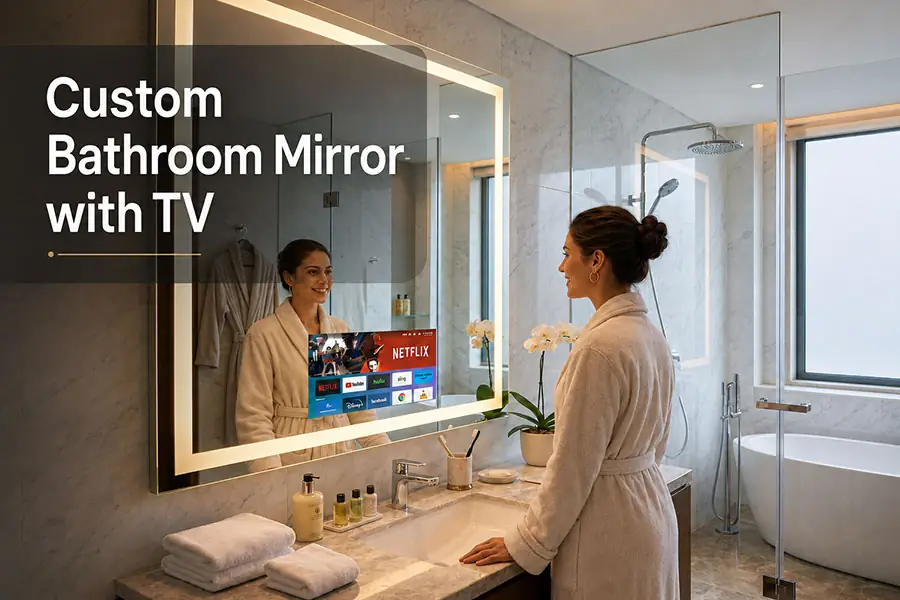
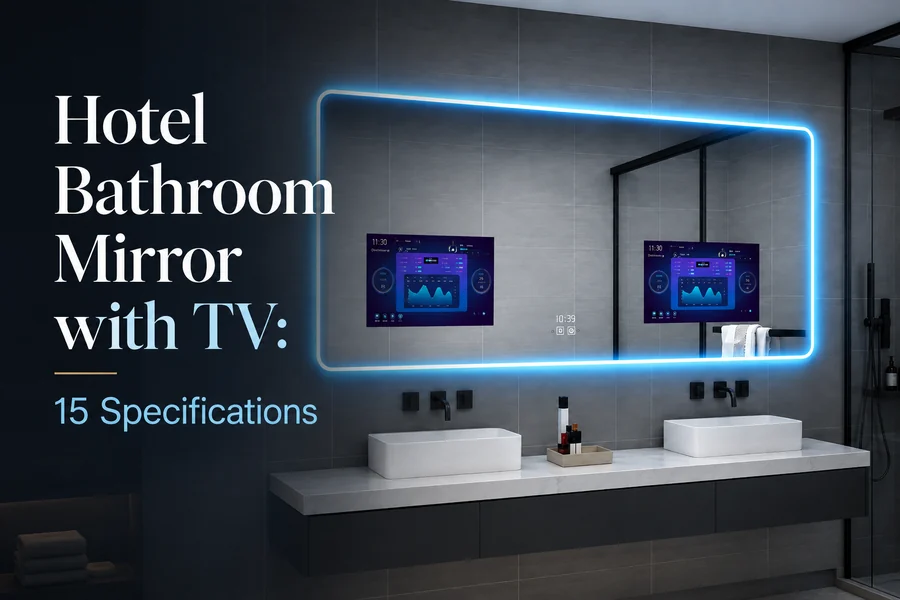
A bathroom mirror with TV combines an LED mirror with a display placed behind part of the mirror glass. Buyers can change the mirror size, screen position, LED lighting, and smart features. To suit a private bathroom or commercial project.
When the display is off, the product works as a normal bathroom mirror. When it is on, the screen can show live TV, streaming video, or content from a connected device.
This led TV mirror can be made for a private luxury bathroom. Hotel owns, villa owners, interior designers, bathroom brands order these high-end mirrors.
This guide helps you decide on mirror size, TV screen size and position, LED light setup, the 10 key features, budget factors, and the RFQ details you need to send.
What Is a Custom Bathroom Mirror with TV?
A custom bathroom mirror with TV is an LED mirror made with a display behind part of the mirror glass. Its size, screen position, lighting, and controls can be adjusted for the room and the buyer’s needs. A bathroom mirror with a TV is a type of smart mirror, as it combines reflective glass with a digital display and controls.
The mirror glass, LED light, hidden display, and control parts are built into one unit. The screen does not cover the whole mirror. It sits in a defined display area. The rest of the surface stays clear for normal mirror use. Buyers choose where that display area sits.
When the TV is off, the screen becomes less visible. The mirror keeps a clean front view. The exact effect depends on the mirror glass, room light, and display structure.
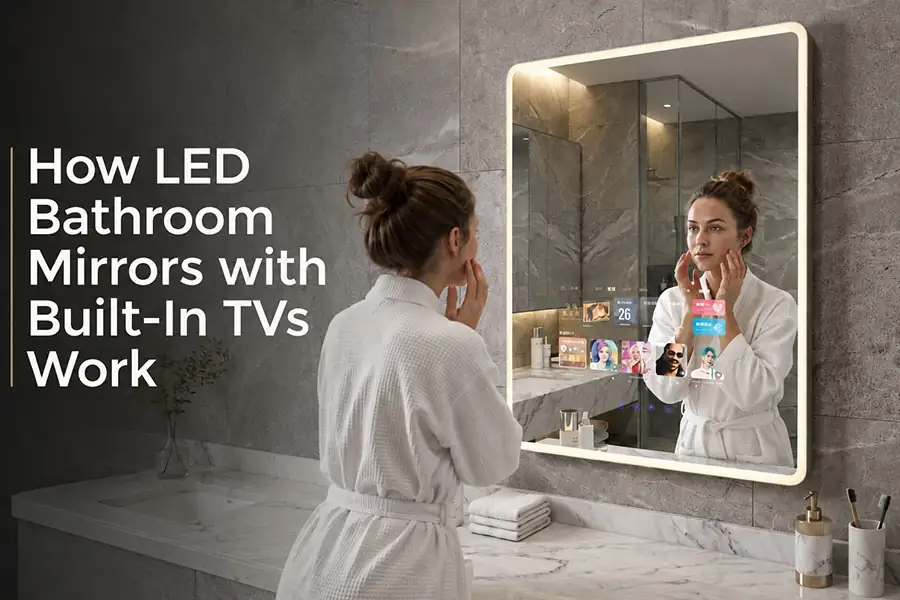
When the TV is on, light from the screen passes through the coated glass. Only the display area shows a picture. The rest of the product remains a mirror.
Read Related Article: How LED Mirrors with Built-in TVs Work.
How Is a TV Mirror Different from a Regular LED Bathroom Mirror?
A regular LED bathroom mirror provides light and mirror functions. While a bathroom mirror with TV also contains a display and media connections.
A standard LED mirror often includes front light, backlight, dimming, color temperature control, and an anti-fog pad. Those features support daily grooming and room lighting. A TV mirror adds a screen, a media input, control buttons or remote, audio options, and extra wiring.
The table below shows the main differences.
| Feature | Regular LED Bathroom Mirror | Bathroom Mirror with TV |
|---|---|---|
| Mirror function | Yes | Yes |
| LED lighting | Yes | Yes |
| Anti-fog | Optional | Optional |
| TV display | No | Yes |
| Media input | No | HDMI, Wi-Fi, or casting |
| Control | Light only | Light + screen + audio |
| Installation planning | Basic | Needs power and signal points |
A current LED mirror design may not accept a TV screen later. The internal space, power supply, and glass structure must be confirmed at the design stage.
What Is the Difference Between an Added TV and a Built-In TV?
An added TV is mounted near or on a mirror. While a built-in TV is integrated behind the mirror glass as part of one product.
An added TV is easier to replace. However, the screen body and cables may remain visible. It can also use more wall space. A built-in TV sits inside the mirror panel. The screen area is part of the mirror surface. You do not see cables or a separate frame.
The TV does not need to cover the full mirror. In most products, the screen uses one set area. The other areas remain free for shaving, skincare, and makeup.

Who Buys a Custom Bathroom Mirror with TV?
Custom TV mirrors are often bought for luxury homes, hotels, villas, apartments, and branded bathroom projects.
A private buyer may care about screen position, lighting, and personal viewing habits. A hotel may need simple controls and the same specification for many rooms.
Bathroom brands and property developers may need custom labels, packaging, drawings, samples, and batch control.
When asking for a quote, state the project type, order quantity, sales country, and planned use. These facts help the factory suggest the right product.
Custom Your Bathroom Mirror with Tv Built-in Project
What Mirror Sizes and Shapes Can Be Customized?
A bathroom mirror with TV can use standard or custom dimensions. But the final size must leave enough space for the display, LED system, wiring, and mounting structure.
Mirror size is not only about wall width. You also need to check the vanity, faucet, wall lights, power outlet, and door clearance. A mirror must fit the wall, but it must also remain easy to use.
Should You Choose a Standard Size or a Custom Size?
Choose a standard size for a simple order and a custom size when the mirror must match a set wall, vanity, or drawing.
Start with the vanity width. A mirror over one basin may follow the cabinet width. It may also leave a small gap on each side.
A double vanity often needs a wider mirror. Yet the final width depends on the basins, wall lights, cabinets, and screen position.
For example, a 1,200 mm wide mirror may fit a 1,400 mm vanity, but only if the wall and lights allow it. Actual production limits depend on the display and mirror structure.
For a custom mirror, provide:
- Finished mirror width
- Finished mirror height
- Vanity or countertop width
- Distance above the countertop
- Maximum product depth
- Position of nearby doors and cabinets
- Position of wall lights and switches
- Required size tolerance
There is no single best mirror size for every bathroom. The possible size also depends on the glass shape, screen body, rear housing, and shipping limits.
Can a Large Bathroom Mirror Include a Built-In TV?
Yes. A large bathroom mirror can include a built-in TV if the glass, backing, mounting points, and screen position are planned for its size and weight.
A large mirror covers a double vanity and makes a small bathroom feel bigger. It also lets you place the screen away from the main face area. That keeps the center clear for grooming.
But large mirrors bring three limits:
- Building access: door width, elevator size, and stair turns.
- Packaging and shipping risk: bigger glass breaks more easily in transit.
- Wall support: drywall, concrete, and wood studs need different anchors. Two installers may be required.
A factory should not promise that every size works. Ask your installer to check the wall and access route before you finalize a large panel.
Which Mirror Shapes Work with a Built-In TV?
Rectangular mirrors give the most room for a TV, while round, oval, arched, and custom shapes need a more careful internal layout.
A rectangular mirror has straight edges and a large usable area. It is often easier to place the screen, LED strips, controls, and mounting parts.
Common shapes include rectangle, circle, oval, arch, and custom cut. A rectangular mirror gives clean straight edges for the screen, light strip, touch key, and anti-fog pad. Round or oval mirrors leave less straight space. The screen, LED channel, and control pad cannot share the same area.
For a custom shape, send a drawing with the full width, height, curves, and screen position. The factory can then check the layout.
How Do You Choose the TV Screen Size and Position?
Choose the TV screen size and position from the normal viewing distance, eye level, mirror dimensions, and main use of the room. A larger screen is not always better if it reduces the clear mirror area.
A private bathroom and a hotel room have different viewing habits. One person may watch from the tub. Another may only check news at the vanity. The screen should match the real use.
Which TV Screen Size Works Best in a Bathroom Mirror?
The best screen size is large enough to view from the bath, vanity, or shower area but small enough to keep the mirror useful.
Screen size is measured diagonally. Viewing distance, content type, and mirror ratio all matter. A small display near the face works well for short videos. A larger display helps when you sit in the tub or stand far away.
Use the room and viewing distance as a guide:
| Project use | Viewing need | Screen choice logic |
|---|---|---|
| Vanity use | Close viewing | Smaller display, less mirror loss |
| Bathtub viewing | Longer distance | Medium or larger display |
| Hotel guest room | Mixed use | Balanced screen-to-mirror ratio |
Do not choose a huge screen just because the mirror is wide. Leave enough clear mirror area for daily grooming.
Where Should the Screen Be Placed?
The screen can be centered or placed on the left or right side, depending on the user’s eye line and the clear mirror area needed.
- Center: visual balance, but it takes the main grooming area.
- Left or right: keeps the center mirror clear for daily use.
- Higher position: easier to see from the tub, but less comfortable at the vanity.
Here is a simple front layout:

The drawing shows the mirror border, screen area, light strip, and control key. Each zone must stay separate. Send a photo of the standing position or a bathroom elevation. The factory uses that to suggest the screen location.
What Measurements Should Buyers Provide?
Buyers should provide the wall size, vanity width, viewing distance, preferred eye level, and the location of nearby fixtures.
Use this checklist:
- Mirror width and height
- Vanity width
- Countertop-to-mirror distance
- Viewing position
- Power outlet location
- Wall opening, if recessed
- Door and cabinet clearance
These numbers help the factory make a size drawing. They are not the full quote. Screen type and features also change the price.
Which LED Lighting Options Work Best?
Front lighting gives better face light, while backlighting gives softer wall light around the mirror.
A bathroom mirror with TV can use front light, backlight, or both. The right choice depends on how the mirror will be used.
The light layout must also work with the screen. Poor placement can create glare, dark areas, or an uneven front view.
Should You Choose Front-Lit, Backlit, or Both?
Front-lit mirrors are better for grooming, backlit mirrors create ambient light, and a combined design can provide both effects.
Front light sits on the mirror edge or behind a sandblasted strip. It lights your face directly. This helps shaving, makeup, and skin checks. Backlight glows around the mirror. It adds depth and a soft halo. It does not replace the main ceiling light.
A combined design gives task light and mood light. But it costs more and needs more wiring. If you choose both, confirm the light zones do not overlap the screen area.
What Do Dimming and Color Temperature Do?
Dimming changes light output, while adjustable color temperature lets users switch between warm, neutral, and cool light.
Warm light feels calm. It suits a bath or night use. Neutral light works for daily grooming. Cool light looks bright and clean. No single color temperature is right for every skin tone or makeup task. Do not claim a mirror guarantees accurate makeup.
Common controls include a touch key, remote, or wall switch. Some models remember the last light setting. Check the real CRI and color temperature range with the factory. Do not invent numbers.
For technical context, the CIE method for measuring colour rendering explains how the colour rendering of a light source is assessed.
How Should Lighting Be Tested Around the Screen?
The LED layout should be tested with the screen position because bright light near the display can affect contrast and visual balance.
The factory should check the light strip spacing, screen edges, dark areas, and glare. A bright LED too close to the screen can wash out the image. A dark gap can look odd when the screen is off.
At Shein Mirror, the LED layout is checked with the real display position before the final drawing is approved. Ask for a test photo with the screen on and off under normal bathroom light.
What Do Dimming and Color Temperature Do?
Dimming changes light output, while adjustable color temperature lets users switch between warm, neutral, and cool light.
Warm light feels calm. It suits a bath or night use. Neutral light works for daily grooming. Cool light looks bright and clean. No single color temperature is right for every skin tone or makeup task. Do not claim a mirror guarantees accurate makeup.
Common controls include a touch seosor, voice control, or human body sensing. Some models remember the last light setting. Check the real CRI and color temperature range with the factory. Do not invent numbers.
How Should Lighting Be Tested Around the Screen?
The LED lighting should be tested with the real screen position to check glare, dark areas, reflections, and screen contrast.
The test should include four modes:
- TV off and LED off
- TV off and LED on
- TV on and LED off
- TV on and LED on
The screen edges should not create dark blocks in the lighted area. Bright LEDs should not make the picture hard to see.
At Shein Mirror, the LED layout is checked with the real display position before the final drawing is approved.
Real sample photos and test videos give buyers more useful proof than a computer image.
What Are the 10 Key Features of a Bathroom Mirror with TV?
The 10 key features are a hidden display, custom screen placement, LED lighting, dimming and color control, anti-fog, flexible controls, smart TV functions, media connections, audio, and custom exterior design.
Not every project needs all 10. More features mean more cost, and more service points. Choose what fits the room and the user.
| Feature | Buyer benefit | What must be confirmed |
|---|---|---|
| Hidden display | Clean look when off | Glass type, room light |
| Custom screen size and position | Fits viewing angle | Eye line, mirror layout |
| Front or back LED lighting | Task or ambient light | Light zone, driver space |
| Dimming and color temperature | Comfort and mood | Control type, CRI |
| Anti-fog pad | Clear spot after shower | Pad size, coverage area |
| Touch or remote controls | Easy operation | Button layout, protocol |
| Smart TV and streaming | Apps and video | OS, region, network |
| HDMI, Wi-Fi, screen casting | External content | Ports, casting method |
| Bluetooth or built-in speakers | Audio | Speaker location, version |
| Custom shape, frame, branding | Project fit | OEM scope, packaging |

How Do a Hidden Display and Custom Screen Position Help?
A hidden display keeps the mirror cleaner when the TV is off, while a custom screen position puts the picture near the main viewing point.
The screen can become less visible when it is off. The result depends on the mirror coating, screen body, room light, and viewing angle.
No supplier should call a screen “fully invisible” without showing real photos. Ask for images in both bright and dark rooms.
The screen position should appear on the production drawing. The drawing should show the visible picture and the full screen body behind the mirror.
This helps prevent the screen from touching the LED area, anti-fog pad, touch keys, or mounting brackets.
How Do LED Lighting and Light Controls Improve Mirror Use?
LED lighting makes the mirror easier to use, while dimming and color controls let the user change the light during the day.
Front lighting supports face care. Backlighting adds softer light around the mirror. Some products use both.
Dimming allows the user to lower the brightness at night. Color control can change the light from warm to neutral or cool.
The touch panel may control each light on its own. It may also use one key to move through several settings.
Dimming and color temperature change the feel of the room. A bright cool light works in the morning. A warm low light helps at night.
How Do Anti-Fog and Touch or Remote Controls Work?
An anti-fog pad warms one part of the mirror, while touch keys or a remote control the mirror and TV functions.
An anti-fog pad only covers part of the mirror, not the whole surface. Do not write “the mirror never fogs.” It warms a small area so condensation clears faster.
Touch keys give direct control at the mirror. A remote lets the user operate the TV from a bathtub or another part of the room.
Hotels should keep the controls simple. Guests should not need a long guide to turn on the light or screen.
What Smart TV and Media Connection Options Are Available?
Smart TV functions can provide apps and streaming, while HDMI, Wi-Fi or screen casting connect the display to external content sources.
Buyers can check the official HDMI specifications when reviewing ports, cables and supported video connections.
Smart features depend on the TV module, operating system, target country, and network. A mirror sold in Germany may not support the same apps as one sold in the US.
Do not promise that every app, phone, or region works. Use a simple compatibility table:
- Operating system
- Input ports
- Wi-Fi connection
- Supported casting method
- Target market
Tell the factory your sales country and required content source when you ask for a quote.
The Wi-Fi Alliance provides official information about Wi-Fi technology and device interoperability.

What Audio and Custom Branding Options Can You Get?
Bluetooth or built-in speakers add audio, while custom shapes, frames, and branding help the mirror fit a project or product line.
Speaker location changes the sound and the rear structure. Bluetooth version and connection range need real testing. Some mirrors support an external speaker instead.
Custom options may include mirror shape, frame color, touch icon, packaging, and brand logo. OEM service scope must be confirmed in writing. Do not assume every branding option is available.
For projects in the United States, electrical work should follow NFPA 70, the National Electrical Code. Other countries have their own electrical rules.
Which TV Mirror Configuration Fits Your Project?
The right configuration depends on the room, viewing habit, number of users, order size, and repair needs.
A private bathroom and a hotel project may use the same base product. Yet they often need different controls, packaging, and order plans.
What Should a Private Luxury Bathroom Choose?
A private luxury bathroom should focus on viewing position, clear mirror space, comfortable lighting, and simple daily control.
For bathtub viewing, check the distance and screen height. A remote control may be more useful than a touch key.
For vanity use, keep the center of the mirror clear. Front lighting and an anti-fog pad may be more useful than a large screen.
Choose smart functions that work with the home’s phones, network, and media services.
What Should a Hotel or Serviced Apartment Choose?
A hotel should choose simple controls, repeatable specifications, clear labels, and easy service access.
Hotels need the same mirror across many rooms. Controls must be easy for a tired guest. Housekeeping and maintenance need access to the screen and power supply. Prepare a room type list and a sample room plan before bulk order.
Do not assume one mirror fits every hotel standard. Different brands have different voltage, AV, and IP requirements.
What Should Brands, Designers, and Developers Prepare?
Brands, designers, and developers should prepare a clear product specification that can be sampled and repeated.
The file should state the dimensions, TV location, glass shape, frame finish, light system, controls, connections, packaging, voltage, and target country.
A room schedule is useful when a project has several mirror sizes. Each model should have its own code and drawing.
Clear files reduce changes after the sample and make the quote more accurate.
What Must Be Planned Before Installation?
Before installation, plan the mounting method, wall structure, power, signal connections, ventilation, and future service access.
See the full explanation of how a TV mirror works in a bathroom. That page covers the technical background. Here we focus on site planning.
Should You Choose Wall-Mounted or Recessed Installation?
A wall-mounted mirror is fixed to the wall surface, while a recessed design places part of the product inside a prepared wall opening.
Wall-mounted is easier to install and service. Recessed looks flatter and cleaner. But it needs a built wall pocket, thicker mirror body, and careful waterproofing around the opening. Do not cut the wall until your engineer confirms the needed depth.
What Should You Plan for Power, HDMI, and Network?
Power and signal points should be confirmed before the wall is closed or tiled.
Check the power outlet, HDMI cable route, Wi-Fi signal, and where the external box will sit. If you plan to use a set-top box or streaming stick, leave space for it. Cables must be reachable later. Ask a local licensed electrician to follow local wiring rules.
What About Bathroom Safety and Service Access?
Bathroom safety depends on the product specification, installation zone, and local electrical rules, while service access allows the screen or control parts to be checked later.
Some projects ask for an IP rating. The actual rating must come from a real test. Do not write “completely waterproof,” “safe in every bathroom zone,” or “maintenance-free.” Those claims are false and unsafe. Service access means the screen, driver, and connections can be reached without breaking tiles.
An IP rating should be read under IEC 60529, the IP Code, which classifies enclosure protection against access, dust and water.
How Much Does a Bathroom Mirror with Built-In TV Cost?
The price depends on the mirror size, screen, glass, lighting, smart functions, structure, quantity, packaging, and destination.
A custom TV mirror does not have one fixed price. The factory needs a clear specification before it can give an accurate quote.
Which Eight Factors Affect the Price?
Eight main factors set the price: mirror size, TV screen, glass, lighting, controls, smart functions, structure, and order terms.
- Mirror size and shape: Large or curved glass needs more work and stronger packing.
- TV screen: Screen size, system, and supply market affect cost.
- Mirror glass: The coating and display area affect the front view.
- LED lighting: Front, back, or dual lighting uses different parts.
- Controls and anti-fog: More control channels add parts and wiring.
- Smart and audio functions: Wi-Fi, casting, ports, and speakers affect the TV system.
- Mounting structure: Recessed and wall-mounted products need different rear designs.
- Order terms: Quantity, labels, packing, destination, and delivery plan affect the quote.
Why Does a Prototype Cost More per Unit?
A prototype costs more per unit because drawing, setup, testing, and special packaging are spread across one or a few pieces.
A sample price should not be multiplied by the full order quantity. Bulk pricing is based on the approved model, final quantity, shared parts, packing method, and delivery plan.
A working sample can still save money. It can find problems with screen height, lighting, controls, or installation before full production starts.

How Do You Start a Custom TV Mirror Order?
Start with the product requirements, then approve the drawing, test a sample if needed, and check the goods before shipment.
A clear order process protects both the buyer and the factory. It also reduces late changes.
What Project Information Should You Send First?
Send the project type, dimensions, screen needs, lighting, functions, quantity, sales country, and delivery plan.
For a hotel or apartment project, include the room schedule. State whether every room uses the same design.
For a branded product, include:
- Logo file
- Product label
- User manual
- Carton marks
- Barcode
- Package design
- Sales country
The factory should review missing details before it confirms the final price or lead time.
What Should You Check on the Drawing and Sample?
Check the mirror size, visible display area, LED zone, controls, connections, rear housing, and mounting points.
Do not approve a drawing from its front view alone. Check the side depth and rear layout.
For a large order, use a working sample or sample-room mirror. Test it from the real viewing position.
Check the display with the room lights on and off. Test the LED light, anti-fog pad, remote, sound, ports, and smart functions.
Any change after sample approval may affect the structure, price, and production time.
Bathroom Mirror with TV FAQs
Is There a Smart Mirror with a Built-In TV?
Yes. A smart mirror with a built-in TV combines a mirror, hidden display, and supported smart media functions in one product.
Options may include Wi-Fi, streaming, screen casting, or remote control. Actual functions depend on the TV system, target country, and device compatibility. Ask for a demo or a spec sheet before you order.
Is There a Bathroom Mirror That Can Turn into a TV?
Yes. A bathroom mirror can appear as a normal mirror when the display is off and show video through the display area when it is on.
Only the screen area shows video. The whole mirror does not turn into a TV. The rest of the surface stays as a mirror. This matters when you plan the layout.
Can the TV Screen Stay Hidden When It Is Off?
The screen can be made less visible when it is off, but the result depends on the mirror glass, room lighting, and display structure.
Do not claim it is completely invisible. Some light may reveal the screen outline. Ask for real photos with the screen on and off, in bright and dim bathroom light. That shows the true effect.
Can a Large Bathroom Mirror Have a Built-In TV?
Check the product weight, wall strength, door width, lift size, crate, and number of installers.
Yes. A large bathroom mirror can have a built-in TV when its glass, backing, mounting, and transport plan are designed for the final size.
Check the wall, door access, elevator, packaging, and installer count before you order a large panel. A big mirror needs more support and careful shipping.
Can the Smart Functions Be Customized?
Some smart functions can be changed, but the options depend on the TV system, software, order size, and target market.
Buyers can ask about apps, HDMI, Wi-Fi, casting, Bluetooth, speakers, remote controls, and menu languages.
List each required function in the quotation and approved specification. Do not rely on the words “smart mirror” alone.
Conclusion
A successful bathroom mirror with TV starts with the right mirror size, screen position, lighting, and control plan.
A private home can focus on personal comfort and clean style. Hotels, brands, and developers must also plan for repeatable specs, installation limits, service access, and batch quality. Do not treat the mirror, screen, and light as three separate products. They share one structure, one power supply, and one glass surface.
To request a product review, send the mirror dimensions, screen position, lighting choice, required functions, quantity, voltage, and destination.
Shein Mirror is a Professional LED Mirror Manufacturing Factory, Conatc Us to Get Your Quote!
Read Related Product:
- TOP 10 Smart TV Mirrors Manufacturers in 2025~2030
- TV Mirror for Bathrooms: How LED Mirrors with Built-In TVs
- How Bathroom Furniture Manufacturers Choose LED Bath Mirror
- Glass Factory: How Build Own High-Quality LED Mirror Brand?
- Commercial LED Bathroom Mirrors: 2026 Sourcing Guide
- One-Way Vs. Two-Way Mirrors: You Need Know
- Smart LED Bathroom Mirror with TV Built In: Buyer’s Guide
- What is a Smart Mirror?
- 8 Common Led Illuminated Bathroom Mirror Problems