跳到内容
跳到内容 
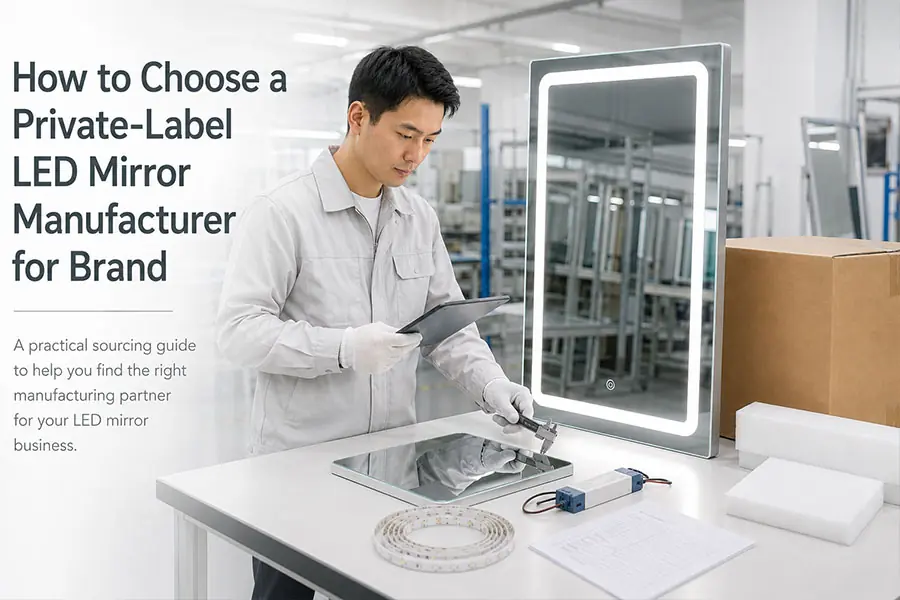
A mirror project can move from one approved sample to hundreds or thousands of units. Small gaps in glass, drivers, controls, packing, or test files can then become costly claims. Choose a private-label LED mirror manufacturer that can turn your market plan into a fixed BOM and an approved sample.
The right LED mirror production factory should turn your market plan into a clear product record and keep that record stable through production. This guide shows you how to check that process before you compare the final quote.
What Should You Check First in a Private-Label LED Mirror Manufacturer?
You should first check whether the manufacturer can control the product from your first brief to the final shipment.
A logo service is not enough. You need clear product specifications, an approved sample, a fixed bill of materials, valid compliance files, production records, suitable packaging, and written after-sales terms.
Use this scorecard before you compare unit prices.
| Check | What You Should See | Warning Sign |
|---|---|---|
| Product fit | Experience with your mirror type and sales channel | A general catalog with no related proof |
| Custom options | Clear limits for standard and custom work | Every request gets an instant “yes” |
| BOM details | Named glass, LED, driver, control, structure, and packing | Only a photo and total price |
| Sample plan | Clear sample stages and approval points | One sample is treated as full approval |
| Change control | Written approval before any part is replaced | Parts can change without notice |
| Compliance | Files tied to the market, model, and configuration | Certification logos with no documents |
| Quality control | Test items, methods, limits, and records | A simple “100% inspected” claim |
| Capacity | A production plan based on your order | One large monthly capacity number |
| Packaging | A design made for the product and shipping route | One carton design for every order |
| Quotation | The same BOM, quantity, packing, and Incoterm | The lowest unit price with missing details |
| Delivery control | Dates for approval, materials, production, and inspection | One delivery date with no milestones |
| After-sales | Clear warranty scope, spare parts, and claim steps | 1years-3years |
A high score does not remove all risk. Any gap linked to safety, compliance, or part changes must be solved before production starts.
How Should You Define Your Brand Brief Before Contacting a Factory?
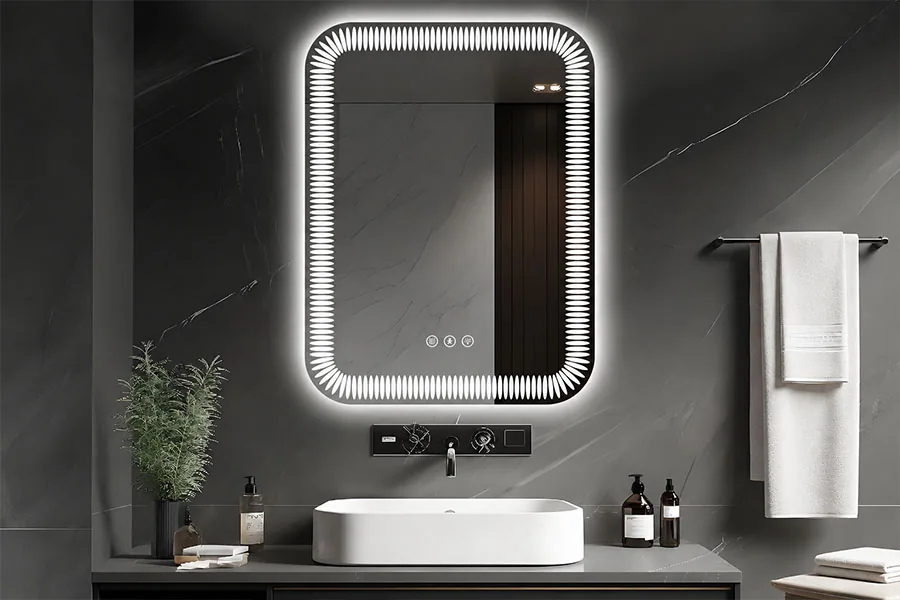
You should define the market, product use, price level, sales route, and launch plan before asking for a quote.
The same LED mirror may need a different electrical setup, carton, label, manual, and spare-parts plan when sold through another channel. A factory cannot prepare a useful proposal when it only receives a product photo and a target price.
How Does the Sales Route Change the Product Plan?
Your sales route changes how the mirror should be designed, packed, tested, and supported.
For example:
- An online order may pass through parcel hubs and several drops. It needs strong single-unit packaging and clear installation parts.
- A hotel order may require fixed specifications, batch records, installation drawings, and spare drivers.
- A distributor may need repeatable SKUs, mixed-model loading, stable colors, and regular restocking.
- A bathroom furniture maker may need fixed mirror sizes that match its cabinet range.
Shein Mirror has separate solutions for e-commerce mirror programs and hospitality mirror projects. These pages can help you match the product plan to the sales route.
What Information Should Your First Product Brief Include?
Your first brief should give the factory enough facts to identify design, cost, compliance, and delivery risks.
Include these fields:
- Destination market
- Sales channel
- Product category
- Size and shape
- Estimated quantity
- Target product level
- Lighting layout
- Required functions
- Input voltage and plug
- Logo and label needs
- Packing route
- Required documents
- Target launch date
- Reference drawing or product image
A good private label led mirror manufacturer will ask follow-up questions before giving a final price. A fast quote based on missing information may use a different glass type, driver, back structure, or carton than the product you expect.
You can review the available custom LED mirror services before preparing your brief.
How Can You Check Product Fit and Real Customization Ability?
You should check whether the factory understands your mirror category and can define each custom change in writing.
A long catalog does not prove deep product knowledge. You need evidence linked to the products in your launch plan.
Which Mirror Category Matches Your Brand Plan?
Each mirror category has its own design, test, installation, and packing risks.
| Product Category | What You Should Check | Shein Mirror Page |
| LED Bathroom mirrors | Moisture protection, defogging, electrical parts, and mounting | LED Bathroom Mirrors Manufacturer |
| Floor and full-length mirrors | Glass flatness, frame support, stability, and large-item packing | LED Floor Mirrors Factory |
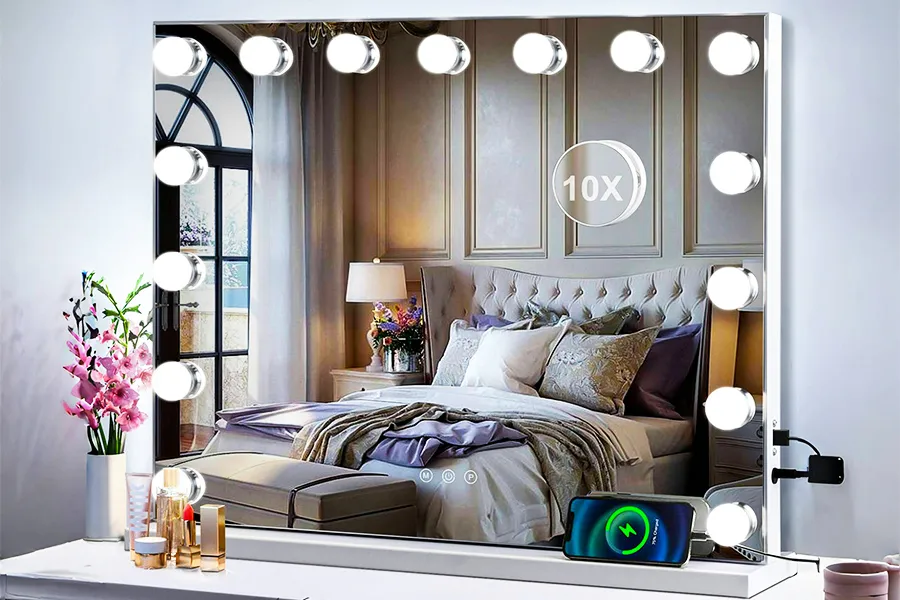
| Hollywood mirrors | Bulb system, dressing-table size, retail packing, and replacement parts | China Hollywood Mirrors |
| Vanity and makeup mirrors | Magnification, power source, stand, and control system | LED Vanity Mirrors |
| Framed mirrors | Frame material, finish, color control, and corner joints | LED Framed Mirrors |
| TV mirrors | Screen, signal, power, heat, access, and project installation | TV Mirrors China |
If your first launch only includes bathroom mirrors, check depth in that category. If you plan to add other mirror types, ask how the factory changes its engineering, inspection, and packing rules for each type.
How Can You Tell Whether Customization Goes Beyond a Logo?
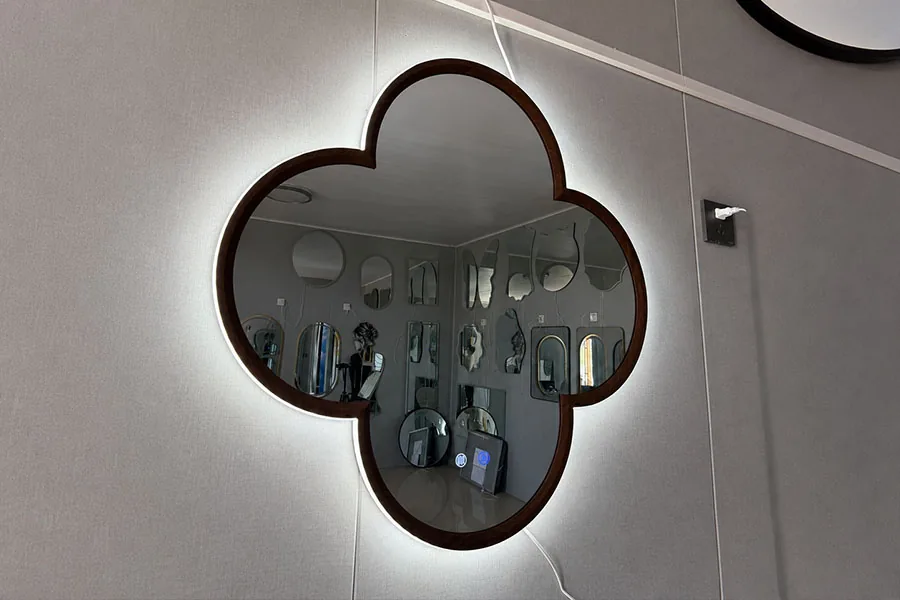
Real customization has clear technical limits, approval steps, costs, and lead-time effects.
Ask the factory to place each request in one of these groups:
- Standard option: A known size, color temperature, switch, logo, or packing choice.
- Optional configuration: A part or function that needs another BOM item or test.
- Engineering review: A new structure, special shape, TV system, mounting method, or market requirement.
Each custom item should have a drawing version, option code, sample need, price effect, lead-time effect, and approval owner.
A supplier that says “everything is possible” may not have checked how the change affects safety, compliance, production, or packaging. This guide on building a private-label LED mirror range gives more examples of moving from a design idea to production.
Why Should You Compare the Full BOM Instead of the Product Photo?
Two mirrors can look the same from the front while using very different glass, lighting, electrical parts, structures, and packaging.
The bill of materials, or BOM, tells you what you are buying. Without it, two supplier quotes may describe two different products.
How Should You Compare Mirror Glass and Thickness?
You should compare the mirror coating system, glass thickness, edge work, backing, safety film, and planned use together.
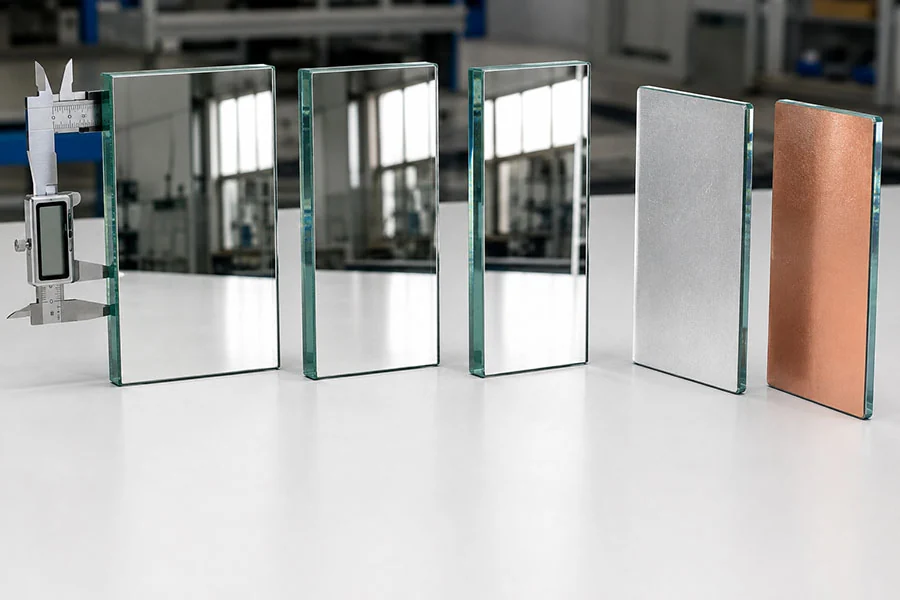
Aluminum-coated mirror can support a price-sensitive product. Yet it may be more open to oxidation, edge corrosion, black-edge marks, or lower reflection quality when its backing and edge protection are weak.
Copper-free silver mirror is often used for higher-grade bathroom and hotel products. It can offer better corrosion resistance when the full mirror system is well made. It should not be sold as “corrosion-proof.”
Glass may be supplied in 3 mm, 4 mm, 5 mm, or nearby commercial thicknesses. Thicker glass adds weight and material cost. It may also support better stiffness in some large mirror designs. Yet thickness alone does not prove quality. Glass flatness, coating, edge work, support, and mounting still matter.
Read more about copper-free mirror glass for bathrooms.
Which Lighting and Electrical Parts Should Be Listed?
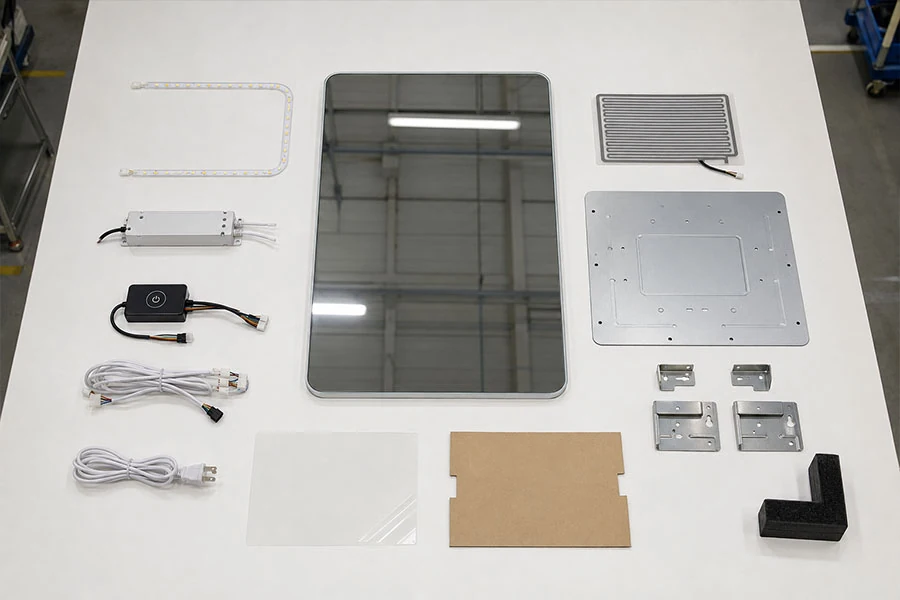
Your BOM should name the LED strip, driver, controller, defogger, wiring, plug, and each related setting.
Do not accept “high-quality LED” as a specification. LED count does not prove final light output. A driver file does not prove that the complete mirror has passed the same safety review.
The supplier should confirm these values for the exact SKU. If a value has not been tested, it should remain open until the sample and product record are complete.
Which Back Parts and Mounting Details Can Change Product Quality?
The back structure controls protection, mounting, wiring space, glass support, and service access.
Compare these items:
- Full back panel, partial cover, or no back panel
- Aluminum, steel, PVC, wood, or mixed structure
- Junction box and wire protection
- Hanger type and mounting direction
- Adhesive connection points
- Safety film
- Frame joints
- Access to the driver and controller
- Installation hardware
A mirror without a back panel should not be treated as the same product as a mirror with a supported and protected back, even when both front views look alike.
Ask the supplier to connect each part to a drawing and an inspection point. Shein Mirror explains its inspection work on the LED mirror quality control page.
What Should a Useful BOM Comparison Table Contain?
A useful BOM table names each part, its requirement, and the evidence used for approval.
| BOM Field | What You Should Record | Approval Evidence |
| Mirror | Coating system, thickness, edge finish, backing | Sample, supplier file, inspection record |
| LED | Model, density, CCT, CRI, power | Part label and test result |
| Driver | Model, input, output, dimming, file status | Label, datasheet, safety file |
| Controller | Model, functions, settings | Functional test |
| Defogger | Size, power, position | Drawing and test |
| Back structure | Material, thickness, cover type | Drawing and sample |
| Mounting | Hangers, screws, direction, load plan | Installation check |
| Safety parts | Film, wire protection, grounding where needed | BOM and inspection |
| Branding | Logo, label, manual, carton marks | Approved artwork |
| Packaging | Foam, carton, protection, pallet, test plan | Packing specification |
Terms such as Economy, Standard, and Premium are only useful when each level has a written BOM. The label alone does not tell you what changed.
How Can You Verify Compliance for the Destination Market?
You should match every compliance file to the destination, product model, electrical setup, and sales route.
There is no single certificate package for every LED mirror and every country. Requirements can change with voltage, radio functions, installation area, and product structure.
Which Facts Should You Confirm Before Requesting Documents?
You should first define the market, model, configuration, installation area, and electrical features.
Build a simple compliance record with these fields:
- Destination country or region
- Product model
- Size and configuration
- Input voltage and frequency
- Plug or connection type
- Wireless module, if used
- Installation area
- Applicable rule or certification scheme
- Required report or certificate
- File status
For the European Union, the official CE marking guidance explains that CE marking applies only when covered by relevant EU rules. The European Commission also explains the current scope of the RoHS Directive.
These links help you check the method. They do not replace a product review for your exact model.
How Can You Check Whether a Certificate Covers the Complete Mirror?
You should check the model, standard, issuer, dates, applicant, product photos, and stated scope.
For each file, record:
| Document Field | What You Should Verify |
| Product name and model | Matches the quoted mirror |
| Standard or scheme | Applies to the product and market |
| Report or certificate number | Can be checked with the issuer |
| Laboratory or issuer | Has the right role for the claim |
| Applicant and factory | Match the approved supply chain |
| Issue and expiry dates | Still valid where a validity period applies |
| Product photos or drawings | Match the planned structure |
| Covered options | Include the selected size and electrical setup |
| Listed parts | Match the proposed BOM |
“In the United States, OSHA explains how its Nationally Recognized Testing Laboratory Program works. UL has also published a warning about an unauthorized UL mark on LED illuminated bathroom mirrors.”
This is why you should verify the complete product record. A UL file for one driver does not mean the full mirror is UL Listed.
Does an IP Rating Prove That a Mirror Is Safe for Every Bathroom?
No. An IP rating only states the tested level of protection against solid objects and water entering an enclosure.
The IEC explanation of IP ratings shows what the code covers. It does not prove that the mirror coating will resist corrosion. It also does not prove that the defogger works well or that the mirror can be installed in every bathroom zone.
Match the IP requirement to the installation area, local rules, enclosure design, and exact model.
How Should You Approve the Sample and Freeze the BOM?
You should approve the physical sample and the written product record before mass production starts.
A good sample is useful only when the factory can repeat it. The approved sample and the fixed BOM must point to the same product version.
How Many Sample Stages Do You Need?
The number of sample stages should match the risk and amount of custom work.
A project may use:
- Appearance sample: Checks size, shape, edge, frame, logo, and finish.
- Functional sample: Checks lighting, controls, defogger, TV, sensors, and electrical parts.
- Pre-production sample: Checks the final BOM, artwork, labels, manual, and packaging.
Not every order needs three separate samples. A mature model with a logo change may need fewer steps. A new frame, unusual shape, TV system, or new packing design may need more checks.
The sample plan should state what you will test, who will approve it, and what happens after approval.
What Should Your Sample Approval Checklist Include?
Your checklist should cover appearance, function, structure, documents, branding, and packaging.
Check:
- Overall size and tolerance
- Glass appearance and reflection
- Edge finish
- Lighting layout
- Color temperature and CRI
- Dimming and controls
- Defogger coverage
- Input voltage and wiring
- Back structure
- Mounting parts
- Logo and artwork
- Labels and manual
- Packaging parts
- Open document items
Photos can record the appearance. They are not enough for light color, electrical function, mounting strength, or packing performance.
Keep one approved reference sample when practical. Mark it with the product code, approval date, and revision. This gives the factory and your team a common reference.
What Does It Mean to Freeze the BOM?
A frozen BOM means that the approved parts and product records cannot change without written review.
If a part becomes unavailable, the factory should tell you why. It should explain the effect on fit, function, appearance, compliance, cost, and lead time. You should approve the new part before it enters production.
A sample can look good while later orders use other parts. A frozen BOM closes that gap.
Get a Private-Label BOM Review: Send your target market, mirror category, size, quantity, functions, and current specification. Shein Mirror can help identify missing BOM, sample, and document fields before you move to a production quote.
How Can You Check QC, Capacity, and Production Consistency?
You should ask for product-specific inspection points, an order-based production plan, and records tied to your batch.
A factory tour can prove that a site exists. It does not prove that your product will use the approved parts or ship on time.
What Should a Product-Specific QC Plan Show?
A useful QC plan states what is checked, how it is checked, when it is checked, and what result can pass.
The checks should change by product family. Bathroom mirrors need strong checks on electrical parts, moisture-related construction, controls, and mounting. Floor mirrors need checks on glass flatness, frame support, stability, and packing. Makeup mirrors need checks on magnification, stands, charging, and controls. TV mirrors need checks on display, signal, heat, and service access.
How Should You Verify Factory Capacity?
You should test capacity against your SKU mix, order size, material status, packing work, and required shipping date.
Ask for a production plan that shows:
- Drawing and sample approval date
- Material order date
- Material arrival date
- Production start
- In-process inspection
- Packing start
- Final inspection
- Planned shipping date
- Main production bottleneck
- Peak-season buffer
A large monthly output claim has little value without the product mix and time period behind it.
Review the Shein Mirror factory and production process when checking physical production support.

Which Production Records Should You Request?
You should request records that can be tied to your order, product revision, and shipment batch.
Useful records include:
- Approved BOM version
- Incoming material checks
- First-piece approval
- In-process inspection
- Functional test results
- Final inspection report
- Packing record
- Failed-product record
- Corrective action
- Shipment lot code
A blank report template shows the factory has a form. A completed record tied to your order shows how the form was used.
These records also make later claims easier to study. You can check whether the problem came from a part, production step, packing method, or transport event.
How Should Packaging Match the Product and Sales Channel?
You should design packaging for the mirror size, structure, shipping route, handling steps, and final delivery method.
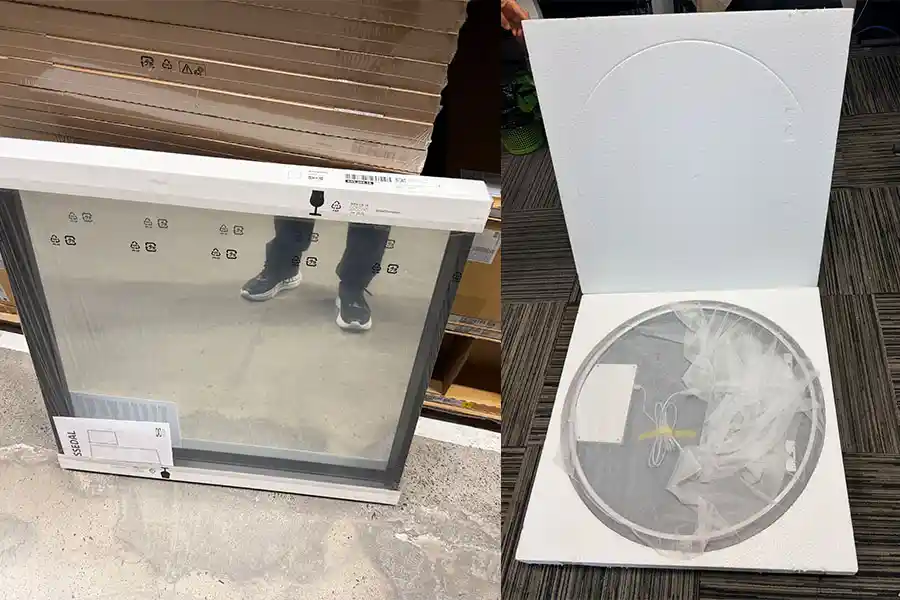
One packing method cannot serve every order. A full container, mixed LCL shipment, hotel delivery, and parcel network create different risks.
How Do FCL, LCL, Project, and E-Commerce Packaging Differ?
Each shipping route puts the carton and mirror through a different handling process.
| Shipping Route | Main Packing Focus |
| FCL wholesale | Loading use, stacking, carton strength, and pallet plan |
| LCL shipment | Extra handling, mixed cargo, edge protection, and reinforcement |
| Project delivery | Site labels, installation sequence, and replacement units |
| E-commerce parcel | Single-unit drops, accessory control, return handling, and customer opening |
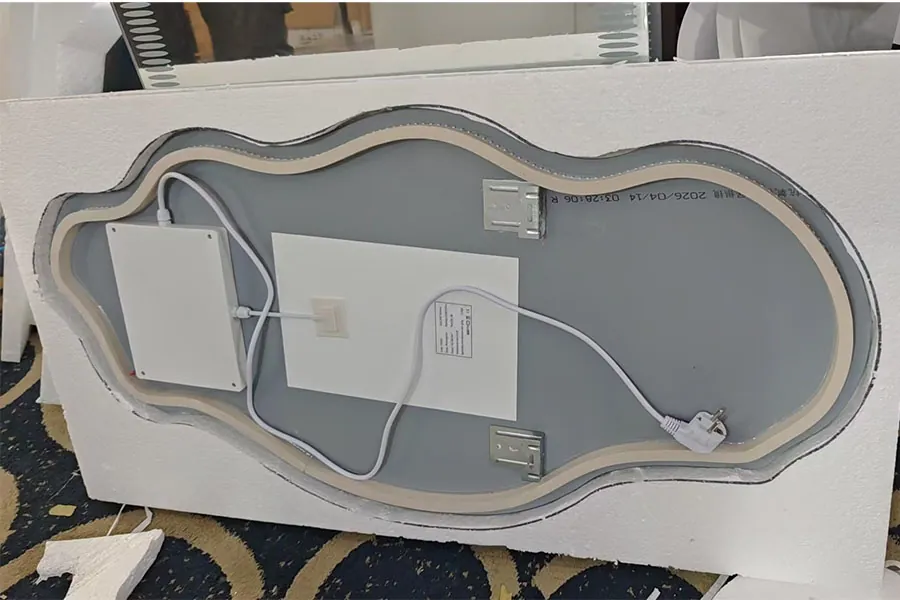
Large LED floor mirrors need support for their size, weight, and long glass edges. Hollywood mirrors need protection for bulbs or raised parts. Framed mirrors need corner protection. TV mirrors need protection for the screen and internal parts.
What Should a Packing Specification Include?
Your packing specification should name the materials, dimensions, protection points, labels, and test method.
Record:
- Inner bag or film
- Foam type and position
- Edge and corner protection
- Space between product and carton
- Accessory position
- Carton size and material grade
- Net and gross weight
- Label and handling marks
- Pallet or wooden case (This requirement is not required for all orders; it depends on the quantity of goods.)
- Packing revision
- Test method and setup
- Pass or fail result
A five-layer carton may be strong or weak based on its material, size, load, and design. The layer count alone does not prove protection.
For Amazon programs, ISTA 6-Amazon.com SIOC is one test framework that may apply to some package types. Confirm the current channel rule and package category before using it.
Good proof should show the packed product, test setup, opening check, damage points, and any design change made after a failed test.
How Should You Compare Quotes, Terms, and After-Sales Support?
You should compare suppliers only after the product scope, packing, trade terms, and service duties use the same basis.
The lowest unit price may exclude parts or services that appear in another quote. It may also use another glass type, driver, back panel, carton, or Incoterm.
Which MOQ, Sample, Lead-Time, and Trade Questions Should You Ask?
You should ask how each commercial term is calculated and when each time period starts.
Ask:
- Is MOQ set by model, size, color, carton, or total order?
- Can several models share one order quantity?
- Does the sample fee include custom parts and packing?
- When does the production lead time start?
- Does the lead time include sample approval?
- Which costs are included under EXW, FOB, or CIF?
- Who pays for tests, pallets, wooden cases, and local transport?
- Which payment step comes before final inspection?
- What happens when buyer approval is late?
Avoid treating a quoted lead time as a fixed promise when drawings, parts, samples, or files are still open.
The OEM and ODM LED mirror sourcing FAQ covers more basic ordering questions.
What Should an After-Sales Plan Cover?
Your after-sales plan should define the covered parts, claim evidence, response steps, replacement method, and cost limits.
An LED mirror claim may relate to:
- Driver
- LED strip
- Controller
- Defogger
- Glass
- Frame
- Mounting parts
- TV system
- Transport damage
For each issue, confirm the warranty start date, covered part, required photo or video, response time, spare-parts plan, replacement unit rule, freight duty, and action for repeated batch defects.
A long warranty statement has little value when it does not say who pays for parts, freight, removal, or installation. Agree on these points before the first order.
FAQs
What Is the Difference Between Private-Label and OEM LED Mirrors?
Private-label work often starts with an existing product platform, while OEM work may involve deeper product changes. A private-label order may add a logo, manual, carton, size, or selected functions. An OEM order may need new drawings, structures, parts, or tooling. The terms can overlap, so you should define the BOM, ownership, tests, and approval steps in writing.
Can Launch Several Mirror Categories with One Manufacturer?
Yes, but you should review each product category as a separate engineering and quality task. Bathroom, floor, Hollywood, vanity, framed, and TV mirrors do not share the same structure, tests, or packaging. Ask the manufacturer to show how its BOM, inspection plan, production line, and packing rules change for every category in your first launch.
Conclusion
You should leave the selection process with an approved brief, sample, BOM, document list, QC plan, packing specification, and comparable quote. These records help you control quality when one sample becomes a full order.
If you are planning a private-label range, Send Shein Mirror your product plan. We can review the mirror type, specifications, packaging route, and sample-to-production steps with you.
Related Atricle:
- TOP 20 LED Mirror Companies and Brands
- What Are the Best LED Mirrors for Bathroom Use in 2026?
- 8 Common Led Illuminated Bathroom Mirror Problems
- Copper Free Mirror for Bathroom Guide: Why Choose It?
- How Bathroom Furniture Manufacturers Choose LED Bath Mirror
- TV Mirror for Bathrooms: How LED Mirrors with Built-In TVs
- Custom Bathroom Mirror with TV: Sizes, Lighting & Features
- Glass Factory: How Build Own High-Quality LED Mirror Brand?