跳到内容
跳到内容 
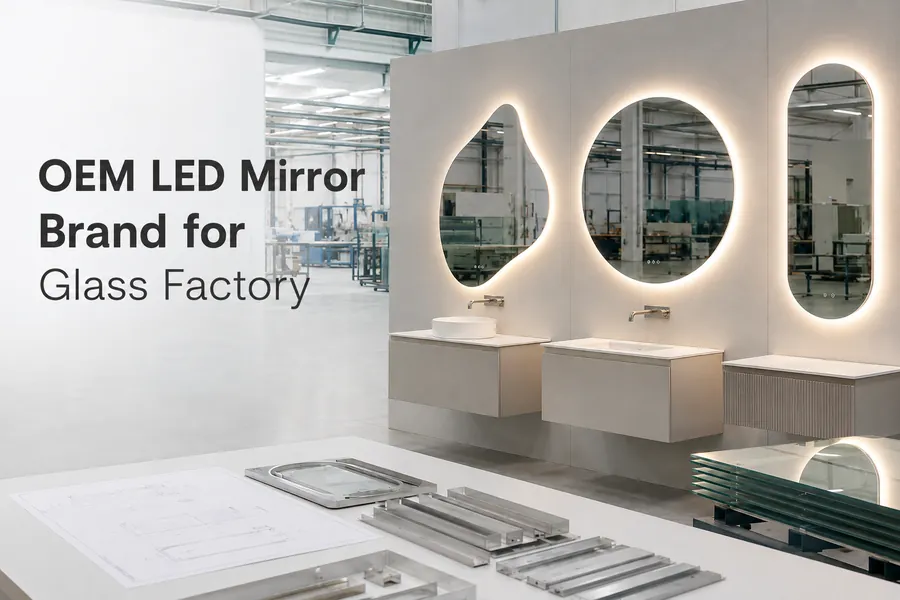
A glass factory doesn’t need to build electronics from scratch to launch own LED mirror brand. You can focus on glass cutting, polishing, and local sales.
An OEM LED mirror manufacturer can handle the rest. From lighting and waterproof parts to quality control and custom packaging. This strategy works for glass factories, importers, and new brands worldwide.
| Project Item | Details |
|---|---|
| Customer type | Glass manufacturer |
| Case market | Hamburg, Germany |
| Applicable markets | Global |
| Business goal | Build a private-label premium LED mirror brand |
| Starting point | Customer drawings and two test samples |
| Main products | Standard and special-shaped LED mirrors |
| Main concerns | Quality, waterproofing, shape accuracy, shipping, and packaging |
| Technical support | Rear-structure planning, component selection, and CAD files |
| Quality process | One pre-production sample for every model |
| Packaging scope | Individually printed cartons for 32 SKUs |
| Final stage | Customer approval followed by bulk production |
Why Glass Factory Decide to Build a Premium LED Mirror Brand?
The glass factory wanted to move from processed glass to higher-value LED mirrors sold under its own brand. Every company wants to expand its market share.
A glass processor already has useful production skills. It understands glass thickness, cutting, polishing, drilling, shaping, and edge finishing.
However, an high-quality LED mirror brand needs more than processed glass. It also requires:
- LED lighting
- Electrical components
- Touch controls
- Waterproof protection
- Rear support structures
- Mounting hardware
- Product testing
- Branded packaging
Building all these capabilities in-house takes time and money. It also requires new staff, equipment, testing procedures, and suppliers.
There is a simpler route. The factory can partner with An experienced OEM LED mirror manufacturer.
Read Realted Product: Are LED Lighted Mirrors Worth It? – Shein Mirror

What Challenges Did the Glass Factory Face?
The customer faced five main challenges: costly sample shipping, breakage risks, special-shaped structures, strict finishing requirements, and complex packaging for many SKUs.
The customer didn’t want one basic LED mirror. It wanted a full premium collection with different shapes, structures, and packaging designs.
That made the project more complex.
| Challenge | Why It Mattered | Solution |
|---|---|---|
| Large sample sizes | Large mirrors increase airfreight costs and breakage risks | Use smaller samples with the same materials and functions |
| Special-shaped mirrors | Standard rear structures don’t fit every mirror shape | Design a separate rear-support structure for each model |
| Bathroom moisture | Electrical parts need protection in humid environments | Use waterproof COB LED strips and enclosed electrical boxes |
| Premium appearance | Standard foam strips looked rough and discolored | Replace them with finer white sponge strips |
| Shape accuracy | Photos can’t define irregular curves and dimensions | Confirm every special shape through CAD files |
| Multiple models | Each model has different buttons, hangers, lights, and rear structures | Make one pre-production sample for every model |
| Packaging for Different SKUs | Generic labels weaken the private-label brand image | Create separate printed-carton artwork for every SKU |
Each issue was manageable on its own.
Together, they created real production risk.
A weak process could lead to broken samples, wrong dimensions, poor lighting, unsuitable rear structures, mixed packaging, and costly rework.
The customer needed more than a product quotation. It needed a clear product development and approval process.
Read Related Product: 8 Common Led Illuminated Bathroom Mirror Problems – Shein Mirror
How to Avoid Shipping Costs and Breakage Risks?
A glass factory can reduce sample freight and breakage risks by testing smaller mirrors that use the same materials, lighting, structure, and finish as the final products.

Large LED mirrors are expensive to ship by air. They also pass through many handling points.
More handling means more risk.
Buyers often ask for a full-size sample because they want to inspect the exact product. That makes sense. But the first sample doesn’t always need to match the final selling size.
For this project, the customer first selected two large models. We recommended smaller versions instead.
The samples still allowed the customer to inspect:
- Mirror quality
- Edge finishing
- LED brightness
- Light distribution
- Touch-button response
- Rear structure
- Waterproof parts
- Sponge-strip quality
- General assembly
We also refund the sample charge when customer order mass production. This reduced the customer’s initial cost.
The samples arrived by air in about seven days. The customer approved the quality and added more models to the project.
How Produce Special-Shaped LED Mirrors?
Special-shaped LED mirrors need custom rear supports, lighting routes, mounting points, and waterproof electrical protection.
A standard rectangular mirror is easier to produce. The rear structure and LED strip can follow a repeatable layout. Custom Led Mirrors Read Here
Irregular mirrors need more work.
A special shape can change:
- The rear-support layout
- The LED-strip route
- The power-supply position
- The hanging-point position
- The illuminated edge
- The balance of the installed mirror
This project included several unusual mirror shapes. One standard rear structure could not fit them all.
We used aluminum profiles for the rear support. We then adjusted the layout for each mirror shape.
The customer also wanted a cleaner finish.
Standard foam strips looked rough. Their color also appeared dirty against the mirror. That didn’t match the planned premium image.
We replaced them with finer white sponge strips. We also used COB waterproof LED strips and waterproof electrical boxes.
| Product Area | Common Option | Project Solution |
|---|---|---|
| Rear support | Standard fixed structure | Shape-specific aluminum profile |
| LED strip | Conventional LED strip | COB waterproof LED strip |
| Electrical protection | Basic component placement | Enclosed waterproof box |
| Edge finishing | Ordinary foam strip | Fine white sponge strip |
| Structure planning | One layout for many models | Separate layout for each shape |
Premium quality often depends on small details.
Standards and Compliance Reference
Customers may not know the name of every material. They still notice when a product looks rough or unfinished.

How to Confirm Mirror Shapes and Dimensions?
CAD files gave both sides a clear and measurable standard for every special-shaped mirror.
Reference photos help with style. They don’t define exact curves.
A sketch may show the height and width. It may still leave the corner radius, edge curve, button position, or hanging point unclear.
That can cause mistakes.
We used a simple confirmation process:
- The customer sent the original mirror drawings.
- We reviewed the shapes and production requirements.
- We prepared CAD files for the special-shaped models.
- The customer checked the dimensions and curves.
- The customer made physical templates in its own glass factory.
- Both sides reviewed the results.
- We revised the CAD files where needed.
- The approved files became the production standard.
This removed guesswork.
The customer could measure each shape before placing the full order. It could also compare the digital drawings with its own glass-processing equipment.

Why Pre-Production Sample Made for Every LED Mirror Model?
Each LED mirror model needs its own pre-production sample because the shape, lighting, buttons, hanging points, and rear structure may change from one SKU to another.
Approving one model does not mean every other model is correct.
A touch button may sit too close to the edge. A hanging plate may block installation. The light may look uneven around a tight curve.
These issues often appear after assembly.
That is why we made one complete pre-production sample for every model.
The customer checked:
- Mirror shape
- Finished dimensions
- Touch-button position
- Hanging position
- Lighting effect
- Rear structure
- Electrical-box position
- Visible materials
- Product functions
| Checkpoint | Approval Question |
|---|---|
| Mirror shape | Does it match the approved CAD file? |
| Dimensions | Do the width and height match the specification? |
| Button position | Is the button in the correct place? |
| Hanging plate | Does it suit the installation plan? |
| Lighting | Is the light even around the mirror? |
| Rear structure | Does the support fit the shape? |
| Electrical box | Is it secure and easy to install? |
| Visible materials | Do all strips and fittings match the approved finish? |
| Functions | Does every electrical feature work? |
The customer requested several changes during this stage.
We completed the revisions and sent updated photos or videos. Bulk production started only after final approval.
This step took extra time.
It also prevented much larger problems later.
How Private-Label Packaging Created for Different SKUs?
Each LED mirror SKU received its own approved carton design with the correct model, size, lighting details, and product artwork.
Packaging became one of the hardest parts of the project.
The reason was simple: 32 SKUs.
The customer didn’t want generic cartons with adhesive labels. It wanted the product information printed directly on each box.
Every carton needed to show:
- SKU
- Mirror size
- Lighting specification
- Model information
- Product artwork
This required 32 separate printing layouts.
Many carton suppliers didn’t want to handle a low-volume order with so many designs. We contacted several suppliers before finding one that could support the project.

We then prepared and checked each layout.
| Packaging Item | Purpose |
|---|---|
| SKU | Prevent warehouse and delivery errors |
| Product size | Identify the model without opening the carton |
| Lighting details | Separate similar models with different functions |
| Product artwork | Match the carton to the correct mirror |
| Carton layout | Keep the brand style consistent |
| Final proof | Allow the customer to approve the design before printing |
The customer approved every carton layout before production began.
It was slow work. But it mattered.
A premium product should not arrive in careless packaging. The carton is often the buyer’s first physical contact with the brand.
Clear SKU information also helps distributors and warehouse teams identify products without opening the boxes. This reduces handling errors and protects the mirrors during storage and delivery.
For a new LED mirror brand, packaging is not just a shipping container. It is part of the product and part of the brand experience.
How Project From Initial Samples to Bulk Production?
The project moved through nine controlled stages, from the first drawings to final product and packaging approval.
Step 1: The Customer Shared Its Brand Plan
The glass manufacturer contacted us through the website. It explained the quality level it wanted and sent mirror drawings.
Step 2: We Revised the Sample Plan
The first sample choices were large and costly to ship. We suggested smaller models that could still show the required materials and functions.
Step 3: The Customer Tested the Samples
The samples arrived in about one week. The customer checked the quality and added more models.
Step 4: We Planned the Product Structures
We reviewed the new designs. We then selected suitable supports, LED strips, waterproof boxes, and finishing materials.
Step 5: We Prepared CAD Files
We created technical files for the special-shaped models. The customer checked the shapes and made physical templates in its own factory.
Step 6: The Customer Approved the Order
The customer confirmed the dimensions, structures, materials, models, and commercial terms.
Step 7: We Made Pre-Production Samples
We produced one complete sample for every model.
Step 8: We Corrected the Details
The customer reviewed each sample. We made the requested changes before production.
Step 9: We Approved the Packaging
We prepared 32 carton layouts. The customer checked each one before printing.
Bulk production started only after the customer approved the products and packaging.
We didn’t jump from quotation to production.
Every major risk had its own approval stage.

Conclusion
A glass factory doesn’t need to build a complete LED mirror line before launching its own brand.
Start with a focused product range. Test smaller samples. Confirm special shapes through CAD files. Approve one finished sample for each model. Then build packaging around a clear SKU system.
Shein Mirror can help your OEM LED lighted mirror brand. Planning your own LED mirror brand collection? Send Shein Mirror your drawings, target market, and brand requirements. We’ll help turn them into a production-ready range.
Source: Relevant compliance references include the European Commission’s CE Marking guidance, the EU Low Voltage Directive 2014/35/EU, the EMC Directive 2014/30/EU, the RoHS Directive 2011/65/EU, IEC 60529 IP-rating guidance.
Realted Blogs:
- Custom Bathroom Mirror with TV: Sizes, Lighting & Features
- Smart LED Bathroom Mirror with TV Built In: Buyer’s Guide
- Copper Free Mirror for Bathroom Guide: Why Choose It?
- How to Choose Anti-Fog Bathroom Mirrors for Hotels?
- Commercial LED Bathroom Mirrors: 2026 Sourcing Guide
- Custom Bathroom Mirror with TV: Sizes, Lighting & Features
- TOP 10 Smart TV Mirrors Manufacturers
- Frontlit vs. Backlit Bathroom Mirror: Which Is Better?