跳到内容
跳到内容 
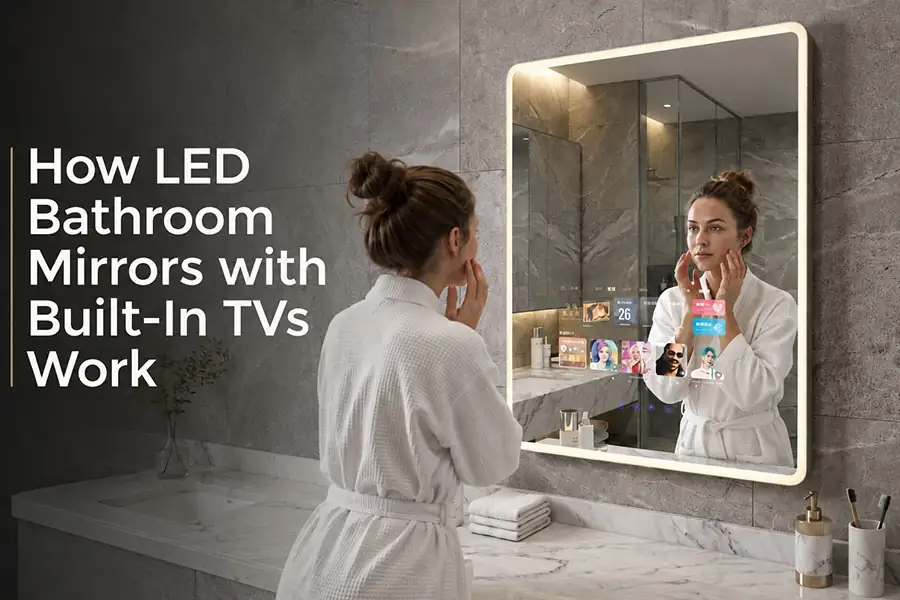
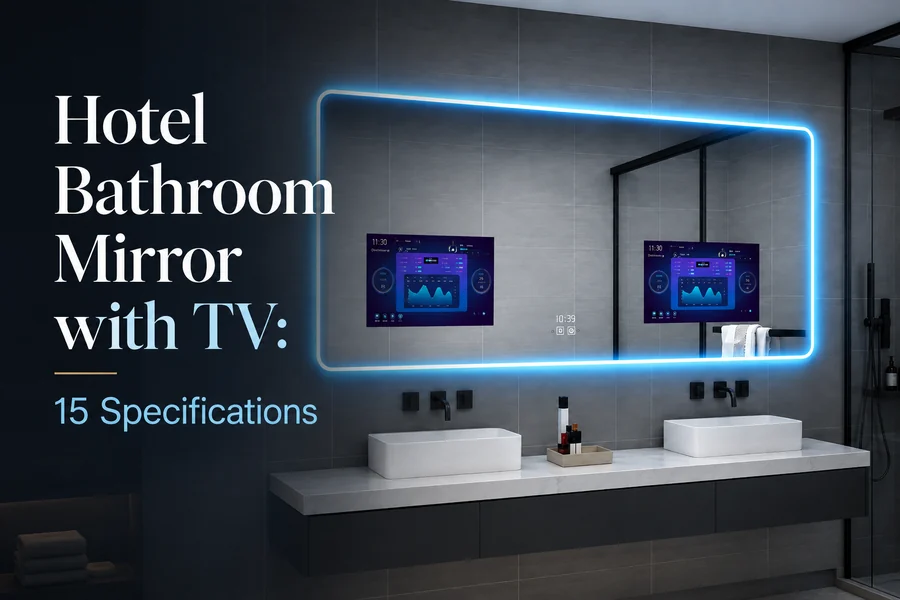
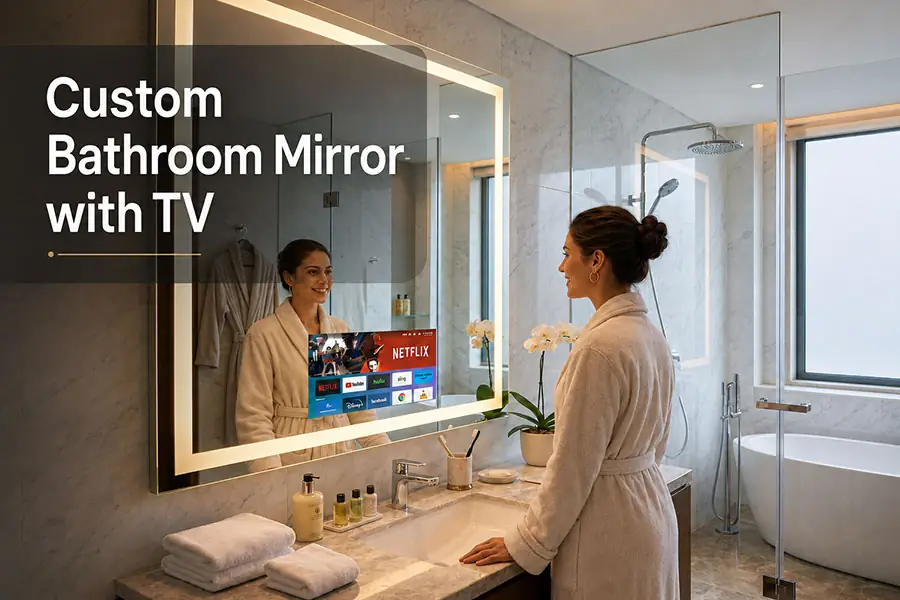
A TV mirror for bathroom combines an LED bathroom mirror with a display installed behind specially coated mirror glass. When the screen is off, you see a normal mirror. When you turn it on, light from the screen passes through the glass. You can watch television or stream content right from the mirror.
A TV mirror can be made for a private luxury bathroom. The mirror size, screen position, light color, and smart features can all be changed. It also works well in hotels, villas, apartments, and high-end building projects.
This article explains how the hidden display works, what the mirror looks like when the TV is off, and whether it is safe for bathroom use.
What Is a TV Mirror for a Bathroom?
A TV mirror is an LED bathroom mirror with a hidden screen. It works as a mirror each day. When the screen turns on, it can show television, video, or streamed content. Standard and custom sizes are available for many bathroom plans.
TV mirror uses semi-transparent mirror glass, which reflects part of the room light while allowing some display light to pass through.
How Is a TV Mirror Different from a Regular LED Bathroom Mirror?
A regular LED bathroom mirror gives you light for shaving, makeup, and daily care. It may also offer dimming, touch controls, and an anti-fog pad.
A TV mirror adds a display behind the glass. It also needs a display controller, a power system, and a way to receive content. The glass must reflect the room and let screen light pass through.
| Feature | Regular LED Mirror | LED Mirror with Built-In TV |
|---|---|---|
| LED lighting | Yes | Yes |
| Anti-fog option | Often | Often |
| Hidden display | No | Yes |
| Media playback | No | Based on the system |
| Custom screen position | No | Available |
What Happens When the TV Is Turned On or Off?
When the TV is off, room light reflects from the mirror coating. The dark screen stays behind the glass. A good match makes the screen area hard to notice during normal mirror use.
Strong light or a side view can reveal the screen edge. No supplier should promise a fully hidden screen from every angle.
When the TV is on, screen light passes through the mirror. Picture quality depends on the glass, screen brightness, and room light. Ask to see the same mirror with the display both on and off.
Can a TV Mirror Be Custom-Made for a Private Luxury Bathroom?
Yes. A TV mirror can be made for one private luxury bathroom. The design can match the wall, vanity, and style of the room.
A client can choose the mirror size, shape, frame, and light color. The client can also choose the screen size and position. Other options may include an anti-fog pad, speakers, dimming, and smart controls.
Start with clear wall photos and measurements. Mark the vanity, faucet, power point, and preferred screen position. An interior drawing is also useful.
For an overseas order, confirm the voltage, plug, and local installer before approving the drawing.
Request a Private TV Mirror Design Consultation

How Does an LED Bathroom Mirror with a Built-In TV Work?
The display sits behind mirror glass that can pass some light. The mirror reflects the room when the display is off. It shows the screen image when the display is on. The LED lights and TV system can work on their own.
How Does the Picture Pass Through the Mirror Glass?
The picture reaches the viewer in four steps:
- The display creates an image behind the mirror.
- The mirror coating reflects light from the bathroom.
- Some light from the display passes through the glass.
- The viewer sees the image on the mirror surface.
The glass does two jobs at once. It reflects enough room light for normal mirror use. It also lets enough screen light through for a clear picture.
The final view depends on the mirror glass, display brightness, room light, viewing angle, and screen position. A bright bathroom may need a stronger display. A darker room may allow a more reflective glass.
A useful product diagram should show the viewer, mirror glass, screen light, embedded display, and rear enclosure.
How Do the LED Lighting and TV Systems Work Together?
The LED lights and the TV are separate systems inside one mirror. LED strips provide front light, backlight, or both. An LED driver supplies their power.
The display has its own power supply and controls. Users can often turn on the mirror light without the TV. They can also use the TV with the main mirror light off.
Controls may include touch buttons, a wall switch, a sensor, or a remote. A hotel may want simple controls. A private client may want more options.
How Is the TV Content Controlled?
The content source depends on the display system. A basic model may use an HDMI input and an outside TV box. A connected model may use Wi-Fi, Bluetooth, or screen casting.
A smart display may support apps. App access can change by country and system. Live television may also need a tuner that matches the local signal standard.
Control options can include a remote, touch buttons, or an outside device. Audio may come from built-in speakers or another sound system.
Do not assume that every mirror supports each app or media source. Confirm the destination country and preferred content before choosing the display.
How Does the Mirror Glass Hide the TV Screen?
The glass hides the TV by reflecting room light while passing screen light. The effect depends on the mirror coating, light transmission, screen brightness, and bathroom light. These parts must be tested together.
What Type of Glass Is Used in a TV Mirror?
A normal silver mirror is made to reflect light. It often blocks too much light for a hidden screen.
A TV mirror uses glass with controlled reflection and light transmission. It may be called semi-transparent mirror glass or display mirror glass.
Good glass should give a clear reflection and a usable picture. It should also have neutral color, a smooth surface, and stable quality across the screen area.
Private clients should check the off-state color and screen hiding effect. A real sample is more useful than glass data alone.
Why Must Reflectivity and Screen Brightness Be Balanced?
Higher reflection can make the mirror look better when the screen is off. Yet it can also block more light from the display.
Higher light transmission can make the picture brighter. Yet it can make the dark screen easier to see when the TV is off.
No glass gives the highest reflection and highest light transmission at the same time. The choice depends on the room and how often the screen will be used.
A bright bathroom may need a brighter screen. A darker room may favor a stronger mirror effect. Clients should decide which view matters most before approving the glass.
How Does Shein Mirror Balance Mirror Reflectivity and Screen Visibility?
At Shein Mirror, the glass is checked with the real display panel. Glass figures alone do not show the full result.
The test should show the TV on and off. It should also use bright and low room light. The team checks the picture from the front and side.
The client can approve the result through a sample, clear photos, or a video. For a large order, the approved sample can become the production standard.
Request a Mirror Glass and Display Sample Evaluation

What Components and Features Are Built into a TV Mirror?
A TV mirror contains glass, a screen, LED lights, controls, power parts, and a rear structure. Each part affects the final mirror. They must be selected as one system.
What Are the Essential Components?
| Component | Function |
| Mirror glass | Reflects the room and passes screen light |
| Display | Shows the picture |
| LED lighting | Lights the face or wall |
| Controller | Manages screen functions |
| Power system | Supplies the lights and display |
| Enclosure | Holds and protects the parts |
The rear structure must hold the glass and screen while matching the mounting method.
Which LED Mirror Features Can Be Added?
Common options include dimming and adjustable color temperature for warm, neutral, or cool light.
An anti-fog pad can keep part of the mirror clear after a shower. Its size and position should avoid the hidden screen area.
Touch controls or sensors can manage mirror functions. Mark each feature as standard or optional before ordering.
Which Media and Smart Features Are Available?
A basic TV mirror may use an HDMI display. This works with an outside box or media player.
A connected model may add Wi-Fi, Bluetooth, or screen casting. A smart model may include an operating system and supported apps.
Other options may include remote control, speakers, and different display resolutions. The right set depends on the room and user.
A hotel may prefer simple controls. A private home may need streaming and phone casting. Confirm all functions in writing before production.
Send Us Your Required Screen, Audio, and Control Functions
Are TV Mirrors Waterproof and Safe for Bathroom Use?
TV mirrors can be made for bathroom use. This does not mean every model can go in every part of a bathroom. Safety depends on the tested product, its location, and local rules.
What Does an IP Rating Mean for a Bathroom TV Mirror?
An IP rating describes how an enclosure protects against solids and water. The code uses two numbers. Each number covers a different type of protection.
Water-resistant does not mean that a mirror can sit under running water. A rating for one power part does not always apply to the whole mirror.
An IP claim should match the exact product that was tested. Changes in size, controls, joints, or housing may affect the result.
Ask for documents tied to the model you plan to buy. Also check the planned location with a trained local installer. Bathroom rules vary by country. The final power connection must follow local requirements.
An IP rating under IEC 60529 describes how an enclosure protects against solid objects and water.
or U.S. installations, the CPSC guide to ground-fault circuit interrupters explains how GFCIs help reduce electric shock risks in wet areas.

How Do You Choose the Right Mirror and TV Screen Size?
Choose the screen after you know the mirror size and viewing point. The screen should be easy to watch without taking over the main mirror area. Its width and height matter more than its diagonal size alone.
Which TV Screen Sizes Can Be Built into a Mirror?
Common screen choices may include 15.6, 21.5, 27, and 32 inches. Actual options depend on the factory and display supply.
| Screen Size | Common Use |
| 15.6 inches | Small mirror or corner display |
| 21.5 inches | Single vanity or hotel bathroom |
| 27 inches | Wide single vanity |
| 32 inches | Large mirror or double vanity |
Ask for the real screen width and height. A 32-inch TV mirror needs enough glass and a suitable mounting system.
Where Should the Screen Be Positioned?
A center screen creates a strong visual focus. It may also reduce the main mirror area.
A lower corner keeps more space clear for daily use. A left or right screen can suit a wide vanity or double sink.
The screen should avoid the faucet and main face-viewing area. It should also match the user’s normal standing point.
Mark the screen on a wall photo. Hotel layouts should be easy for first-time guests.
What Measurements Are Needed Before Customization?
Provide these measurements before a design review:
- Wall width and height
- Vanity width
- Planned mirror size
- Faucet and backsplash height
- Power point position
- Preferred viewing position
- Wall or recess depth
Take photos from the front and side. Include nearby cabinets, lights, and doors. A simple sketch can support the first review. Production should use an approved technical drawing.
What Should Be Planned Before Installing a Bathroom TV Mirror?
Plan the wall, mounting method, power, media source, and service access before production. These points should be set before the wall is closed or tiled. Early planning can prevent costly changes.
Wall-Mounted or Recessed Installation?
A wall-mounted TV mirror sits on the wall surface. It is often easier to install, but the mirror body may be seen from the side.
A recessed mirror sits partly inside the wall. It gives a flatter look, but it needs enough wall depth and a correct opening.
| Method | Main Benefit | Planning Need |
| Wall-mounted | Simpler wall work | Check depth and side view |
| Recessed | Flatter appearance | Check opening and wall depth |
Check pipes, studs, cables, and product weight before ordering a recessed mirror.
What Power, Signal, and Network Connections Are Required?
A basic mirror may need main power, display power, and an HDMI cable. It may also need a place for an outside media box.
A connected model may need Wi-Fi or a network cable. Signal strength should be checked before the mirror is installed.
Plan all cable points before closing the wall. Hidden lines are hard to change after tile work is complete.
The final wiring must follow the product drawing and local rules. A trained installer should make the power connection.
How Should Maintenance Access Be Planned?
A TV mirror contains parts that may need service. The design should allow access without breaking the wall.
Access may use a removable mirror body, a rear cover, or a service opening. The best method depends on the wall and mounting type.
Ask how the screen, controller, and power parts can be reached or replaced.
Submit Your Wall Dimensions for an Installation Review

What Can Be Customized on an LED Bathroom Mirror with TV?
The mirror size, shape, lighting, screen, controls, frame, and packaging can all be changed. A good custom design mirror with LED starts with the room and user, not a long feature list.
Mirror Shape, Size, and Lighting Options
Common shapes include rectangles, circles, arches, and rounded rectangles. A custom outline may also be possible. The mirror can be framed or frameless.
Lighting may use front light, backlight, or both. Dimming and adjustable color temperature can help the light match the room.
An anti-fog pad can be added when needed. Its position should not affect the screen area.
Use real samples when frame or light color must match other finishes.
Display, Control, and Audio Options
Choose the display by use. HDMI can suit basic playback. Wi-Fi can support streaming. A smart system can support compatible apps.
Control may use a remote, touch button, or outside device. Some users want one simple control. Others want both touch and remote use.
Audio may come from built-in speakers or another sound system. Speaker size and position affect sound quality.
Confirm the screen size, resolution, brightness, media input, controls, and speaker type. Put the final choices in the approved function sheet.
Branding, Packaging, and Market Requirements
Brand buyers may need a private-label TV mirror. Options can include a logo, custom touch icons, branded cartons, and manuals in the right language.
The power system must match the destination voltage and plug. Product labels and documents must also fit the target market.
Packaging must protect both the glass and display. A TV mirror has more sensitive parts than a basic mirror.
Certification claims should match the exact model and market. Buyers should check valid files before using any mark in sales material.
For products sold in the EU, buyers should check whether the EU Low Voltage Directive applies to the final electrical product.
Buyers selling in the EU should also follow the European Commission’s CE marking guidance before placing a CE mark on the product.
Request a Custom Configuration Sheet

How Are Custom TV Mirrors Manufactured and Tested?
A custom TV mirror moves from requirements to a drawing, sample, test, and final approval. Each step fixes part of the design. Production should not start until both sides confirm the main details.
From Project Requirements to Technical Drawings
The process can follow five steps:
- Collect the mirror size, functions, and project needs.
- Select the glass, display, lights, and control system.
- Prepare a drawing with screen and mounting details.
- Make a sample to check use and appearance.
- Approve the sample before production.
The drawing should show the mirror size, screen position, light area, controls, rear structure, and power entry. Changes are easier before the sample is made.
Clients can send a PDF, image, CAD drawing, or clear hand sketch for the first review.
What Should Be Tested Before Shipment?
The test plan should match the product functions. The main checks include mirror appearance, screen alignment, TV on/off effect, LED controls, and packaging.
The mirror check finds scratches, coating marks, and color problems. The display check confirms its position.
The LED and control test checks light output, dimming, touch buttons, and remote use. If the product has anti-fog, speakers, or Wi-Fi, those functions should also be tested.
Packing should protect the glass, screen, and corners. Buyers can ask for inspection photos or records. Large orders may also use third-party inspection.
How Does a Concept Become a Production-Ready TV Mirror?
A hotel buyer may request a wide mirror with a screen near the lower corner. The first drawing may place the display too close to the faucet. The factory can move it higher and adjust the controls.
A private client may ask for a large center screen. This may take too much daily mirror space. A smaller screen or side position may work better.
The sample then checks the mirror view, picture, light, controls, and mounting. The client approves these points before production.
This process creates a repeatable product and reduces late changes.
Conclusion
A bathroom TV mirror places a display behind special mirror glass. The surface works as a mirror when the display is off. It shows television or streamed content when the display is on.
The final product depends on many decisions: glass selection, screen brightness, moisture protection, heat management, installation method, and custom functions. Each choice affects how the mirror looks and performs.
Private clients can order a TV mirror for a luxury bathroom. Hotels, developers, and mirror brands can also order custom models. Let Shein Mirror Custom Your Smart Bathroom Mirror with Tv Built-in.
Read Related Article:
- TOP 10 Smart TV Mirrors Manufacturers
- TV Mirror for Bathrooms: How LED Mirrors with Built-In TVs
- Smart LED Bathroom Mirror with TV Built In
- How Bathroom Furniture Manufacturers Choose LED Bath Mirror
- Glass Factory: How Build Own High-Quality LED Mirror Brand?
- Commercial LED Bathroom Mirrors: 2026 Sourcing Guide